
Elon Musk's rocket and space Internet business, SpaceX, is merging with his generative AI business xAI.
The merger, which values the combined business at around $1.25 trillion, comes days after SpaceX filed with the FCC for plans to launch up to a million orbital data centers.
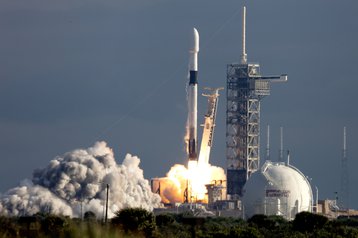
In a blog post confirming the merger, Musk again said that the move was due to the new company's data center ambitions.
"The basic math is that launching a million tons per year of satellites generating 100kW of compute power per ton would add 100 gigawatts of AI compute capacity annually, with no ongoing operational or maintenance needs," he claimed, although this requires SpaceX's Starship to first reliably reach orbit, and then achieve reusability.
"Ultimately, there is a path to launching 1TW/year from Earth."
Musk claimed: "My estimate is that within two to three years, the lowest cost way to generate AI compute will be in space. This cost-efficiency alone will enable innovative companies to forge ahead in training their AI models and processing data at unprecedented speeds and scales, accelerating breakthroughs in our understanding of physics and invention of technologies to benefit humanity."
Looking further into the future, Musk – who is known for grandiose visions, but poor timeline management – envisioned building a lunar base.
"Factories on the Moon can take advantage of lunar resources to manufacture satellites and deploy them further into space. By using an electromagnetic mass driver and lunar manufacturing, it is possible to put 500 to 1000 TW/year of AI satellites into deep space, meaningfully ascend the Kardashev scale and harness a non-trivial percentage of the Sun’s power."
Last week's FCC filing pitched the idea of up to a million orbital data centers operating between 500km and 2,000km altitude. The 'SpaceX Orbital Data Center System' would then connect to space Internet Starlink satellites via high-bandwidth optical links, with Starlink then connecting by laser mesh down to ground stations.
Late last year, Google announced 'Project Suncatcher,' a plan to partner with Planet for TPUs in space. The company is still in the early test stages, but said that it could theoretically scale to terawatts of compute in space.
Grok-maker xAI's ambitions currently remain terrestrial, with the company last month confirming plans to build a third data center in Mississippi, with a pledge to invest more than $20 billion in the state.
Its previous facilities have been caught up in legal fights over air pollution.
The company is itself the result of a previous merger of Musk companies, with xAI taking over X, the social media platform previously known as Twitter.
Last month, Musk's automotive business, Tesla, announced it would invest $2bn into xAI. The car firm has also been rumored to be in merger talks with SpaceX and xAI, but as a public business, more hurdles apply.
Tesla has also seen sales shrink, and has cut its product line-up.
SpaceX is expected to go public this summer.

Comments