
Elon Musk has said that Tesla is aiming for a nine-month design cycle for its forthcoming AI chips, three months shorter than the yearly cadence both Nvidia and AMD are currently working to.
In comments posted on his social media platform X, Musk also said that, given the progress the autonomous vehicle company had made with its forthcoming AI5 chip, Tesla has “some headroom” to resurrect its Dojo chip that the company paused development of last year.
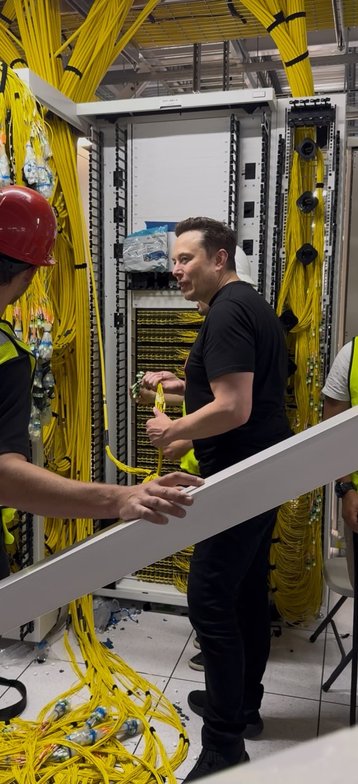
The Dojo D1 chips were custom-built to process videos from Tesla cars and train its autonomous fleet, and had been slated for use in the company's Optimus humanoid robot. The team was dissolved in August 2025, with 20 employees leaving for DensityAI, a startup headed by Ganesh Venkataramanan, who previously oversaw the Dojo supercomputer and D1 chip before leaving in 2023.
Musk provided no additional information about the company’s plans to restart work on Dojo, beyond labelling the chips ‘Dojo3’ and claiming that, alongside a planned AI7 chip, it would be used for “space-based compute.”
In multiple posts published on the social media platform over the weekend, Musk said that Tesla’s AI5 chip design is almost done and AI6 is in “early stages,” adding that the company also plans to develop AI7, AI8, and AI9 chips.
He said that while Tesla’s current AI4 chip will achieve “self-driving safety levels very far above human,” AI5 will make the cars “almost perfect” while greatly enhancing the company’s humanoid Optimus robot.
“AI6 for Optimus and data centers. AI7/Dojo3 will be space-based AI compute,” Musk wrote. In November 2025, the world’s richest man took to X to claim there was a “clear path to a doubling of performance on all metrics for AI6 within 10 to 12 months of AI5 shipping,” a timeline that he is now aiming to further shorten.
While Musk himself did not appear to confirm the production timeline for the AI5 chip, in response to questions from other X users, Grok – the AI chatbot developed by Musk’s other company xAI, and which has recently come under fire from users and politicians for posting non-consensual nude images of women and children – said that limited production of the AI5 is expected in 2026, with high-volume manufacturing targeted for 2027.
Late last year, Musk told Tesla shareholders that the company would likely need to build a “gigantic chip fab” to make its AI chips, claiming that even if Tesla were to extrapolate the best-case scenario for chip production from its suppliers, it still wouldn’t be enough.
Tesla is already working with TSMC and Samsung for the production of its AI5 and AI6 chips at the companies’ respective fabs in Arizona and Taiwan, and South Korea and Texas. During that same shareholder meeting, Musk said it was “probably worth having discussions with Intel,” although no such agreement has emerged in the wake of those comments.
“Solving AI5 was existential to Tesla, which is why I had to focus both the teams on that chip, and I’ve personally spent every Saturday for several months working on it,” Musk wrote. “This will be a very capable chip. Roughly Hopper class as single SoC and Blackwell as dual, but it costs peanuts and uses much less power.”
For individuals who want to be involved in the Tesla chip design process, Musk posted an email address via which he said interested parties should contact the company with three bullet points outlining the toughest technical problems they’ve solved.
“Join us to work on what I predict will be the highest volume AI chips in the world by far!" he wrote.



Comments