
DARPA is looking to fund research into modular, interconnected cryocoolers with sub-kelvin stages requiring no helium-3.
Cryocoolers have a number of applications, including applied superconductivity, superconducting photon detectors, MRI machines, and quantum computers.
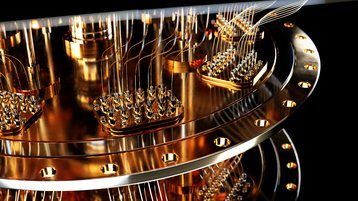
Different approaches to quantum computers require vastly differing cooling systems, with superconducting quantum computers needing huge dilution refrigerators that cool the chip to sub-kelvin (<1K) temperatures.
IBM's quantum computer was cooled to ~25 mK, with 'Project Goldeneye' requiring both helium-3 (He-3) and helium-4 (He-4) as well as a large amount of physical space. Google, Amazon, Microsoft, Intel, and others also use similar systems.
He-4 is the more common form of helium, as found in party balloons, and faces some supply chain challenges. Helium has seen multiple shortages in the past two decades as demand grows for medical systems, semiconductor manufacturing, and more. Supply has been impacted by the Ukraine war, US government shutdowns, and now the Iran war.
However, He-4 is still significantly more available than He-3. Helium-3 has primarily been produced as a byproduct of the nuclear weapons programs of the US and Russia, as Tritium decays into He-3. It is also produced by a limited number of civilian sites, including Laurentis Energy Partners in Canada.
With He-3 used for nuclear smuggling detection, nuclear fusion research, medical machines, and quantum computers, it has perpetually been in short supply. Should quantum computers that use He-3 based cooling systems grow in popularity, this shortage could significantly limit the market.
"Of note is the lack of temperature-stable, sub-kelvin (i.e., <1K) cryocoolers not requiring helium-3," DARPA states in its request for information.
"Dilution refrigerators require large volumes of helium-3, which must be circulated throughout the entire vessel, from mixing chamber to ambient."
The agency notes that there are ways to get below 1K with HE-4, "but this requires either incorporating helium liquefaction or an open loop of externally sourced liquid helium, neither of which is practical for cryogenic microsystem applications."
Similarly, adiabatic demagnetization refrigerators can achieve sub-kelvin temperatures without helium-3 or helium liquefaction, but are subject to temperature fluctuations from their magnetizing and demagnetizing cycles.
Due to the size, weight, and power (SWaP) limitations of current approaches, "today’s bespoke cryostats are employed to cool merely a single device within its lowest temperature stage, rather than multiple devices operating at disparate, optimized temperatures."
DARPA hopes to fund research into modular cryocoolers with thermally conductive interconnections so that multiple systems could all be cooled at the same time - without the use of helium-3.
This month, quantum computing dilution refrigerator market leader Bluefors announced the 'Modular Cryogenic Platform.' The system, which still relies on helium-3 and -4, supports payloads up to 800kg with up to 36 side-loading wiring ports.
The company has also signed a deal with Interlune to purchase up to 10,000 liters of helium-3 annually between 2028 and 2037.
Interlune plans to harvest the He-3 from the Moon, where the substance is far more prevalent. However, significant hurdles exist - first, actually getting to the Moon, then crushing lunar regolith to filter the helium-3 with autonomous robots, and then getting it back to Earth.



Comments