
Australian subsea cable firm SubCo is to develop a new subsea cable linking Australia to the US.
The company this week announced plans for APX East, a 16-fiber-pair system set to connect the two countries “without any landing or interconnection” in between to offer lower latency.
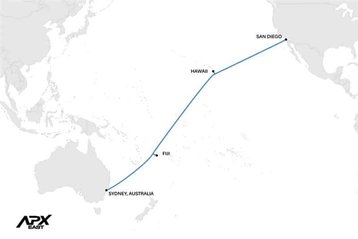
The cable is set to run from the north of Sydney in New South Wales to San Diego, California.
The cable is planned to be Ready for Service (RFS) in Q4 2028. A Hawaii branch is to follow in Q4 2029, and a Fiji branch is also planned.
The company says the system will be the first between Australia and the United States not requiring optical regeneration, instead capable of being single-end powered, fed across the entire system. It will be the longest such system in the world. Subsea cables traditionally require repeaters every 100km or so to boost the signal.
“By utilizing the latest developments in submarine cable technologies, we have designed the longest, continuous optical subsea cable path in the world, and one that can be powered from a single end in fault condition. Unlike all existing transpacific systems between Australia and the United States, fiber pair owners on APX-East simply need to install SLTE on either end, and they’re away. No regeneration, no intermediate PoPs, just a single all-deepwater route,” said Bevan Slattery, founder and co-CEO of SubCo.
On LinkedIn, Slattery confirmed the cable’s landing station will be at NextDC’s S1/S2 site in Sydney.
SubCo, part of Slattery’s Soda Group, also owns the Oman Australia Cable and has capacity on the Indigo subsea cables. The company is developing the SMAP cable linking Sydney, Melbourne, Adelaide, and Perth.
“With all the talk of AI factories, people are forgetting that the longest lead item for Australia isn’t going to be power, land, data centers or chips, it’s going to be international connectivity at AI scale. APX East will be a critical enabler for Australia’s aspirations to become a leader in the AI world,” said Slattery.
“Hyperscalers and neoclouds are looking to deploy 3GW of AI factories in Australia between now and 2028. This is going to need between 75-150TB of international capacity to deliver those tokens to the world. Any future system with a 2029 or 2030 RFS simply won’t work. APX-East is an all-deepwater system between Sydney and California, that reduces permitting risk, allowing an accelerated installation and completion.”
Sydney is the landing point for more than a dozen subsea cables, several of them travelling across the Pacific to the US.
NextDC’s S1 and S2 sites are located close to each other in the Macquarie Park technology park. Combined, the two facilities offer 36MW across 14,500 sqm.
San Diego currently has no international cables landing there. Google’s Honomoana system, however, is set to link the city to Sydney and Melbourne in Australia, with landings in French Polynesia and Auckland, New Zealand. Google, via Elkhorn Services LLC, will be developing its own cable landing station in San Diego County.
EdgeConneX was previously set to host a domestic subsea cable from fiber firm Electric Lightwave in its San Diego facility linking to an Equinix facility in the El Segundo area of Los Angeles. Zayo acquired Electric Lightwave in 2017.





Comments