
US carrier AT&T grew its revenue by 2.9 percent Year-on-Year (YoY) for the first quarter of 2026, as the telco continued to highlight its focus on growing out its fiber footprint.
The telco pointed to further fiber growth, as fiber passings surpassed 37 million for the year, including the addition of four million after AT&T's recently completed $5.75 billion acquisition of Lumen's mass market fiber business.
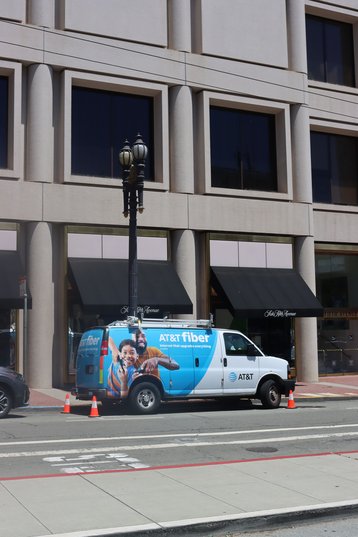
CEO John Stankey previously upped AT&T's initial goal of reaching 50 million premises with fiber by 2029 to 60 million by 2030.
According to Stankey, AT&T is on course to achieve this target.
"Today, we reach over 37 million customer locations with fiber, and we’re on track to reach 60 million-plus locations by the end of the decade," said Stankey on the company's earnings call this morning.
"As I discussed last quarter, when we complete our work at a fiber location, we believe we’re able to offer that customer access to the Internet on a lower marginal cost structure than any competitor."
By the end of this year, he expects AT&T's total fiber passings across the US to reach 40 million, a target set out by Stankey earlier this year.
For the quarter itself, AT&T added a total of 584,000 consumer and business advanced connectivity Internet net adds, consisting of 292,000 fiber and 292,000 fixed wireless.
Combined, AT&T claims to have reached more than 90 million customer locations across the US with its advanced Internet services, over either fiber or 5G services.
Stankey anticipates the growth of AT&T's fiber footprint to center around the handling of its Lumen assets, noting that the aim is to "scale" this footprint. That acquisition was worth 1.1 million customers and four million passings. The carrier now has more than 11 million fiber customers in total.
"We’re scaling Lumen. We said coming into the year that Lumen, early on, we’re going to have to invest significantly in order to stand up that organization, in order to drive incremental fiber penetration into their footprint, and to really set ourselves up," said Stankey.
"That process began in earnest in Q1, will continue, but I expect every month that passes, the performance of the Lumen asset will continue to get better. We’re going to continue to see improvement in fiber net adds and converged relationships."
While the future is fiber, AT&T does still offer legacy copper services. However, as the carrier is pushing to phase its legacy offering out, this has led to a drop in revenue for AT&T's legacy segment revenues.
For Q1, legacy segment revenues were down 25.3 percent YoY, mainly due to lower demand for services as AT&T continues to decommission its copper-based network.
Q1 revenue growth
Despite the drop in legacy services revenue, AT&T's overall revenue grew by 2.9 percent for the quarter to $31.5 billion.
AT&T said this increase was mainly because of its advanced connectivity, wireless, and fiber revenues, including two months of impact from the customers acquired from the Lumen transaction.
The telco added 294,000 postpaid phone net adds during the first quarter.
A strong showing in its Latin American segment was up 20.8 percent Year-on-Year, driven by favorable foreign exchange impacts, plus subscriber growth, and increased equipment sales. AT&T posted revenue of $1.17bn in Latin America for the quarter, amid reports that the carrier is seeking to exit the Mexican market.
Overall operating revenues increased by 4.3 percent during Q1 to $28.4bn.
AT&T also noted that the company returned $4.3bn to shareholders in the first quarter through dividends and share repurchases, and plans to return more than $45bn to shareholders during 2026-2028 through dividends and share repurchases.

The US fiber frenzy
Can M&A help US carriers meet their build-out targets?
Wholesale satellite offering?
While AT&T has focused on building out its 5G mobile network and fiber footprint across the US, the carrier is also pushing to bolster satellite-to-device connectivity as well.
During the company's earnings call, Stankey ruled out the idea of offering MVNO services via satellite partners when asked.
He did, however, note that AT&T would be open to working with more than one satellite operator.
The carrier is notably a strategic investor in AST SpaceMobile, along with other mobile operators, including Verizon and Vodafone.
"I think it's natural that we work with LEO (low Earth orbit) providers that have the capabilities to solve that problem to integrate those offerings into our services. We have a great position with those customers," he said.
"And as you've heard me say, my ideal outcome for the satellite space is that there's more than one satellite constellation up there. And I've offered that at some point, I'd expect that there's probably at least three serving the United States with capable products and services. We're working with one closely right now to make sure that they get off the ground and they're viable. That's AST SpaceMobile."
Stankey named SpaceX and Amazon as other satellite operators that will compete in this market, while noting that a fourth contender is possible. "My goal would be that I have a good, strong wholesale relationship, and it may not just be one of them, it may be with more than one of them," he added.





Comments