
Turkish tech giant Aselsan has confirmed it is investing in a government program to develop a 198-satellite low-Earth orbit (LEO) dual-use broadband constellation called the Gökbağı (Astralink), expected to be in service by the early 2030s, with the first Astralink satellite to be tested in 2028.
“From 2029 onwards, we plan to accelerate deployment through successive phases, initially with technology demonstration and test satellites, followed by the ramp-up of serial production satellites,” Aselsan CEO Ahmet Akyol told Space Intel Report at the International Astronautical Congress (IAC) in early October. “This phased approach will allow us to validate key technologies, mature the system architecture and progressively expand the constellation,” he said.
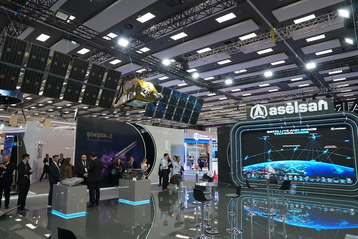
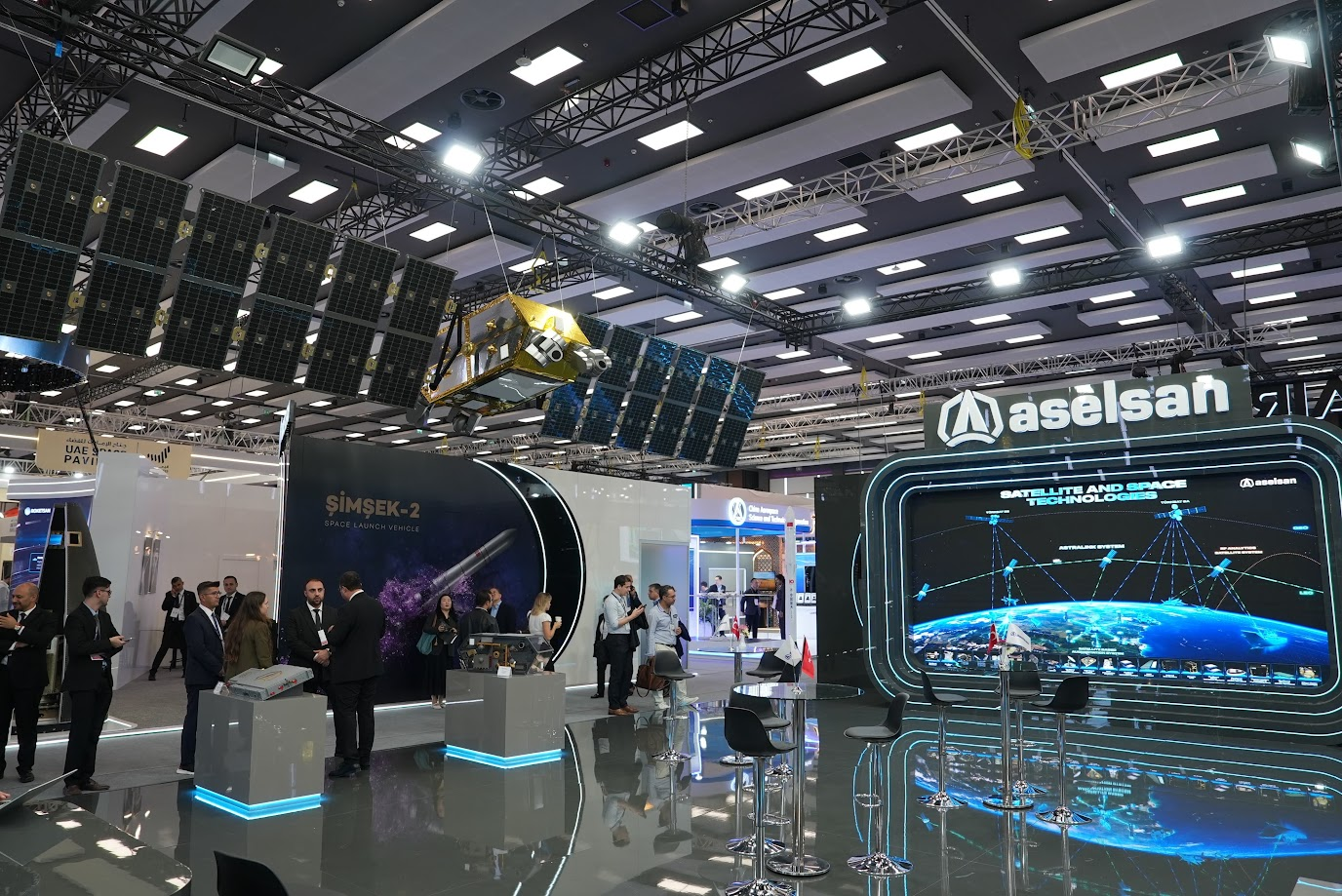
The Astralink project was discussed publicly for the first time at IAC 2026, described as being designed “from the chip level up,” including homegrown satellite receivers for tracking the constellation across the sky.
Akyol stated that the Gökbağı would be referred to as Astralink globally, implying early aspirations that the sovereign constellation would not solely serve Turkish customers. He also enthused about the application of AI technologies for Astralink, including “surveillance, communications, and navigation.”
IAC is a conference held in Antalya, in Southwest Türkiye, and is hosted by the Turkish Space Agency (TUA) and the SAHA Istanbul defense cluster, run by the Turkish Industry and Technology Ministry. Those state interests, as well as those of Türkiye’s military, would be the priority customers of Astralink, as part of a push to develop Turkish digital infrastructure.
Also on show was Aselan’s Gokturk-3 synthetic aperture radar (SAR) satellite, capable of mapping terrestrial surfaces by bouncing radio waves off terrain from above, a capability unhindered by dense cloud cover, a key dual-use space technology.
Last year, Aselan’s revenue stood at $4.2 billion (€3.7bn), of which around $200 million came from space technologies. In its June 2026 half-year results, the company announced its backlog stood at $23.2bn, up 45 percent year-over-year.
“From 2029 onwards, we plan to accelerate deployment through successive phases, initially with technology demonstration and test satellites, followed by the ramp-up of serial production satellites. This phased approach will allow us to validate key technologies, mature the system architecture and progressively expand the constellation,” Akyol said.
Is sovereign now necessary?
The news arrives just a week after fresh reports of a Starlink shut-off in Ukraine, when officials reported restrictions in the Starlink service imposed on Ukrainian Armed Forces without warning disrupted operations against Russian troops.
After previously denying that Starlink service could be disrupted in Ukraine, accusing Reuters of lying, Musk took to X to declare: "Any limits on speed or usage [of Starshield] are decided by the US military and ultimately POTUS," before adding: “Usage of Starlink is limited to civilian or defensive activities and cannot be used for offensive military action, as doing so would be inappropriate for a commercial company.”
The continued realization that deals for satellite technologies purchased from SpaceX are subject to negotiation after the deal has been made has influenced the commencement of sovereign space technologies across Europe, including Ukraine and other states facing security concerns like Taiwan.





Comments