
Airsys has launched a new liquid cooling system.
The company this week announced the next generation of LiquidRack, a rack-level liquid cooling platform designed for mid-density AI, data center, telecom, and Edge environments.
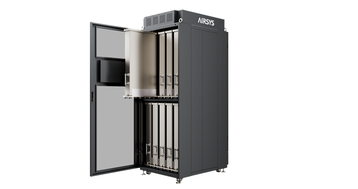
Airsys said LiquidRack integrates fluid distribution, pumping, and control directly at the server level, helping bridge the gap between air cooling and fully liquid-cooled facilities and remove the need for separate cooling distribution units.
Able to support up to 8kW per server and up to 80kW per 10U enclosure, dielectric fluid is sprayed onto vertically-mounted waterproof servers to remove heat. Heated coolant then flows back to the plate heat exchanger, dissipating the absorbed heat into the water circuit. Heated water is discharged via a dry cooler.
“Most data center operators are looking to a practical, flexible, and seamless path from air to liquid cooling to meet the challenge of high density, stranded power, and ESG goals,” said Yunshui Chen, founder and CEO of Airsys. “LiquidRack provides that path. By integrating key cooling functions at the rack, we simplify deployment and enable customers to scale performance within the constraints of their existing infrastructure."
The compressor-free design is compatible with dry coolers, adiabatic, and traditional chiller-based systems, meaning it can be deployed in existing facilities. The system reportedly uses 80 percent less fluid than immersion cooling deployments.
The company is currently accepting candidates for pilot deployments for this liquid cooling offering.
Airsys has also launched the latest addition to its UniCool air-cooled lineup, the UniCool-Max. This latest offering delivers up to 60kW of cooling capacity per unit and is targeted at modular data centers and high-heat equipment environments such as telecom facilities and equipment rooms.
“The UniCool-Max represents a significant leap forward in how we handle high-density heat loads,” said Yunshui Chen, founder and CEO of Airsys. “By eliminating the ‘takeoff and landing’ stress of traditional compressors, we are providing our clients with a system that isn’t just more efficient, but vastly more reliable over its entire lifecycle.”




Comments