
Three European heavyweights in aerospace technology, Airbus, Leonardo, and Thales, have signed a Memorandum of Understanding to combine their space activities under one umbrella.
The new company, which is expected to be operational sometime in 2027, is subject to regulatory approvals and closing conditions.
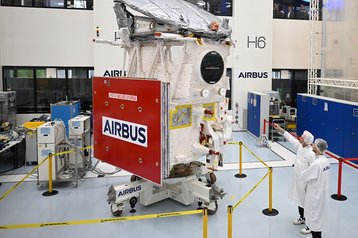
A joint statement issued by Guillame Faury, CEO of Toulouse-based Airbus; Roberto Cingolani, CEO and general manager of Rome-based Leonardo; and Patrice Caine, chairman and CEO of Paris-based Thales, said: “This proposed new company marks a pivotal milestone for Europe’s space industry.
"By pooling our talent, resources, expertise, and R&D capabilities, we aim to generate growth, accelerate innovation, and deliver greater value to our customers and stakeholders. This partnership aligns with the ambitions of European governments to strengthen their industrial and technological assets, ensuring Europe’s autonomy across the strategic space domain and its many applications.”
The hypothetical conglomerate will pool and develop technologies to compete better globally in space infrastructure as a unified European player.
It will not, as yet, design rockets.
Airbus' Space Systems and Space Digital businesses will participate, while Leonardo will contribute with its Space Division, including its shares in Telespazio and Thales Alenia Space.
Thales will participate through its shares in Thales Alenia Space, Telespazio, and Thales SESO.
The companies expect the collaboration to generate mid-triple-digit million euros of total annual synergies on operating income five years after closing and employ around 25,000 people across Europe.
"With an annual turnover of about €6.5bn (end of 2024, pro-forma) and an order backlog representing more than three years of projected sales, this new company will form a robust, innovative and competitive entity worldwide," the companies said in a statement.
Ownership of the new company will be distributed between Airbus, Leonardo, and Thales, owning 35 percent, 32.5 percent, and 32.5 percent stakes, respectively, and operating under joint control with a balanced governance structure among shareholders.
This mirrors the existing joint venture of Thales Alenia Space, a longstanding and accomplished operation shared between Thales and Leonardo (67 percent and 33 percent, respectively) that operates under similar terms.
Representatives of employees at the three industry giants will be informed and consulted on the project according to the laws of the individual countries concerned and the collective agreements at each parent company.
Massive bureaucratic interventions like these run the risk of being outpaced by the mercenary corporate leaderships of Silicon Valley and autocratic methodologies in Moscow and Beijing, resembling utopian projects that sacrifice speed for democracy, such as the European Union’s IRIS².
More in Investment / M&A / Financing
-
-

-

Episode 2027 Trends and Outlooks: Europe




Comments