
Chinese investment is a "priority" for the African space sector, the president of the African Space Agency Council has said.
Speaking during a fireside conversation at the final day of World Space Business Week - consulting group Novaspace’s landmark industry conference, H.E. Dr. Tidiane Ouattara, president of the African Space Agency Council, spoke about the formulation of the institution’s priorities for the continent.
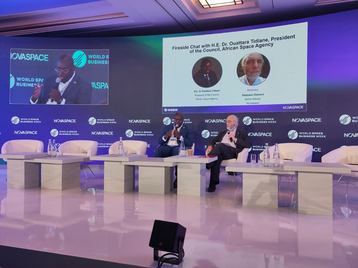
“We are a newly established organization, so there’s still lots to do. As a continental newcomer, Africa needs to address its governments’ capacity to put manpower behind shared objectives,” Dr. Ouattara told attendees. “We intend to run a number of programs and build an African private sector in space, but our institution needs to attract and integrate expertise in order to best understand where to prioritize.”
As an organ of the African Union, formed in 2002, the agency works for the interests and expectations of its 55 member states. While the president spoke of a longstanding successful relationship with Europe, the African continent is open to power blocs with which the West has seen strained relationships.
“Let’s not think the world is rushing to us; we are the ones reaching out, based on our interests. Developing Africa will require Africa in the driver’s seat; we welcome others’ support for that goal.”
China’s Belt and Road initiative has long targeted African states, at times offering zero-interest loans and sharing engineering expertise to build infrastructure, giving rise to political fears in the West that the continent was being courted by the Eastern world just as Western aid budgets and international programs are being slashed of funding and their offices hollowed out by efficiency drives.
“The Belt [and Road] has been decided on by the African head of state,” Dr. Ouattara told DCD in a follow-up conversation off-stage. “It’s one of our priorities. The kinds of infrastructure that agreement affords are more than welcome.”
From the ground segment to space and downstream services, the president explained the agency wanted to accommodate all sectors in the space industry.
“We are very interested in critical applications like agriculture, marine monitoring, and other drivers of stability,” Dr. Ouattara told DCD. “The data and processing applications that fuel that are also critical. The infrastructure that makes this possible is something that Africa doesn’t only want to benefit from, but build ourselves. This won’t solely be achieved with public money, but public/private partnerships. We are expecting investors to put capital into these growth multiplier factors as they do with cocoa, coffee, and cotton. Space is a new economic pillar, and there is a lot to build in Africa.”
Many international financial interventions in Africa have been examined as potential acts of neo-colonialism, with accusations of debt traps for hurried, expensive logistical projects being levelled at the programs from both the East and West.
The president declined to commit to any kind of deadline to establish milestones, explaining that in its infancy, the institution needed to absorb and integrate the expertise that would critically inform its directives and commitments.
“Let’s not set a timeline that commits us to hasty decisions. Africa is a massive consumer of space products and services. We are well placed to build African-owned capacity,” he said.






Comments