
In a world driven by deadlines and endless rushing around, it’s often the smallest human gestures that disappear first when desperately trying to catch up with our daily lives. A greeting to a cashier, or a word of thanks to a bus driver – tiny acknowledgements that quietly affirm our shared humanity – over time start to slip, as they are sacrificed to urgency.
Although not necessarily through malice, but rather a lack of intention, we begin to interact as though people are outputs and points of leverage, rather than members of a living community.
As organizations grow larger and more automated, that same erosion of intention shows up in leadership itself. For Karen Petersburg, senior vice president of design and engineering at PowerHouse Data Centers, this is precisely where sustainable leadership must begin:
“It’s really a shift in mindset – slowing down so we don’t lose sight of what gives life meaning. Sustainability isn’t just about the environment; it’s about caring for people, now and in the future. When you strip it back, it’s about valuing human life and how we choose to care for one another.”
What’s progress without people?
Open any digital infrastructure publication and you will see headlines crowded with announcements of new data center projects, acquisitions, and ever-larger capital commitments. The pace can feel overwhelming, but it is also a rational response to a 21st-century economy defined by digitization.
In fact, 2025 was marked less by conventional data center deals than by AI campuses, joint ventures, and complex debt packages – not because the industry wanted it, but because growth outpaced old financial and scaling models, often hidden behind the smoke and mirrors of rapid expansion.
That reality, however, does not mean digital growth is inherently corrosive or driven by malintent. What it demands is reframing in a way that makes room for the voices in the industry actively shaping infrastructure development for the better. It is this perspective that Petersburg wants the industry to focus on, as demonstrated by PowerHouse’s approach to business.
PowerHouse is a wholly owned subsidiary of American Real Estate Partners (AREP) – a self-described industry disruptor – delivering end-to-end solutions from property site selection and acquisition through design, build, and transfer to operations.
Originating in Northern Virginia’s famed ‘Data Center Alley’ – the largest data center market in the world – the company has since expanded into key US markets including Texas, Pennsylvania, and Nevada. Yet, as it scales, PowerHouse believes that progress without people at its center isn’t real progress.
Sustainability below the surface
First of all, what does sustainable data center design really mean, and what does it actually take for the sector to act as a responsible developer, rather than simply claim the label?
At its most basic level, sustainability in digital infrastructure should extend from project conception through long-term operations, translating commitments into measurable action. That means embedding sustainability directly into project KPIs, from power usage effectiveness (PUE) and water reuse to local job creation and supply chain diversity. It also requires alignment across the organization, ensuring strategies announced in the boardroom are fully implemented on the ground.
With the data center industry often criticized for prioritizing scale and speed, it’s no surprise that some developers are attempting to approach sustainability differently. For PowerHouse, that process begins with people, not with technology metrics or SLAs.
In practice, this means that while environmental performance remains essential, its sustainability strategies include community-specific initiatives shaped by local needs. At its core is a principle the company returns to: sustainability means meeting the needs of the present without sacrificing the ability of future generations to meet their own.
“In every project, we treat people as human beings. That means taking the time to understand what they care about – their passions – and building our community engagement and sustainability programs around what genuinely motivates them,” says Petersburg.
The on-the-ground reality of data centers
Too often, sustainability strategies focus on optics rather than substance. It is time to examine how data center developments address the true concerns of the communities around them.
As the AI boom has accelerated, data center-related news has entered – for the first time in the industry’s history – the mainstream conversation. Social media, local news, and advocacy publications increasingly spotlight very real and valid concerns around environmental racism, the disproportionate burden placed on marginalized neighborhoods, and the disintegration of community agency – issues powerfully articulated in reports such as Color of Change’s Black Tech Agenda.
These concerns are not abstract, nor are they unfounded. The question, then, is how data center developers can credibly argue that their projects serve the best interests of the communities in which they operate.
While misinformation and misunderstanding about the sector persist, Petersburg is quick to note that correcting the record is only part of the responsibility. More important is demonstrating – through action and transparency – that positive, community-centered outcomes are, in fact, already taking place.
She emphasizes the value of active community engagement, noting that digital infrastructure and AI developments are reshaping the way we live, and that the public has a stake in how these systems are designed and governed. Notable historians, including Rutger Bregman, have drawn parallels to past technological revolutions – industrial and agricultural – highlighting the ethical and human costs of rapid innovation. By extension, the systems that support AI and digital platforms, including data centers, deserve scrutiny.
At PowerHouse, these principles are mobilized from the earliest stages of development, starting with site selection and the entitlement process, where honesty and clarity are non-negotiable. Developers, Petersburg argues, owe communities straightforward explanations about what infrastructure actually entails – how often backup generators operate, what emissions actually look like, and which regulations govern them. A common misconception, for example, is that generators run continuously, when in reality they operate for limited periods each year under strict regulatory oversight, designed to control emissions and environmental impact.
“The data center industry is already incentivized to operate efficiently because efficiency directly affects PUE and, ultimately, revenue. The real challenge is translating what we’re already doing into language communities can understand – so they know we’re actively working to mitigate their concerns,” says Petersburg.
Credibility, she argues, is built by humanizing the conversation:
“We want people to see that we’re no different from them. We live in these communities too. We understand where the concerns are coming from, and we respect them.”
Views of responsibility
This philosophy reframes stakeholders as co-authors of a project rather than checkpoints. Treating each project as a collaborative effort, developers emphasize understanding the local ecosystem – how utilities, regulators, suppliers, and communities operate – and aligning project milestones with those realities.
So, when you bring people into the process, rather than excluding them – whether deliberately or unintentionally – you’re more likely to achieve positive outcomes that work on a human level, while also accelerating projects to more sustained success. Petersburg says:
“When you co-create something with your team, they're far more invested in the outcome. They're motivated to do what’s best for the company, the project, and the community. And they find greater fulfillment when their personal purpose aligns with what they're doing day-to-day.”
How PowerHouse’s vision manifests
PowerHouse’s organizational framework translates sustainability and community engagement into tangible action, guided by the AIA’s Framework for Design Excellence, whereby each project begins with a holistic, community-based assessment. This looks at the full landscape of risks, needs, and opportunities within each community, in order to guide equitable and informed decision-making.

So, rather than viewing sustainability solely through the lens of the natural environment, it treats ‘nature’ as the entire lived environment of a place. As Petersburg explains, the assessment integrates multiple dimensions, including:
- Social and economic conditions (e.g., poverty levels and access to essential services like healthcare and food)
- Environmental factors (climate risk, habitat quality, and access to green space)
- Community assets (local organizations, support networks, and other existing community strengths)
- Place-specific context (recognizing what makes a location unique as well as the pressures it currently faces or is likely to face in the future)
“The assessment guides how we show up for each community. It gives the entire team a shared understanding of key challenges – whether that’s food insecurity or workforce development – and helps focus where we can have the greatest impact,” she says, adding:
“Teams can then connect those priorities to existing expertise or programs within the organization, allowing us to draw on deeper resources and create meaningful change.”
Clearing the fog of collaboration in local contexts
PowerHouse’s collaborative approach also informs its decision on where to build, ensuring that development avoids encroaching on residential neighborhoods whenever possible. A good example of this is its Reno Campus development. While the facility supports the region’s growing digital infrastructure needs, it is deliberately sited within a planned industrial zone actively designated for development.
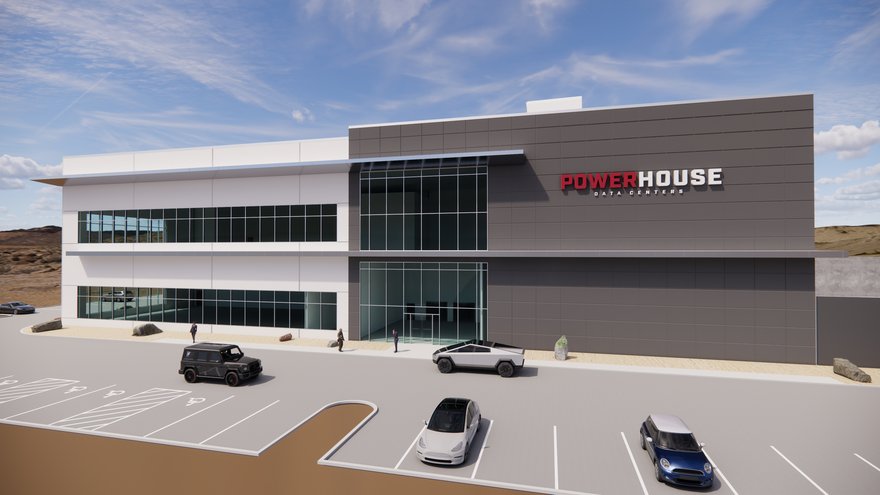


Even so, planned industrial sites come with regulatory and environmental challenges. Reno’s water scarcity, wildfire risk, and climate volatility required rethinking conventional design assumptions. By working closely with Storey County officials and local planners, the team identified solutions that balanced operational needs with regulatory requirements, as Petersburg illustrates:
“Where you might typically purchase a site with a small water allocation, this was not enough for a water-intensive cooling system. In a water-scarce environment, liquid cooling isn’t the only answer. Air cooling can still meet operational needs. We also collaborated with the county to replace a traditional planted landscape – which would require additional water – with an alternative approach.”
The solution was xeriscaping, using boulders and rocks excavated on-site rather than water-intensive plants. The result was a visually striking, low-impact landscape that conserves approximately 290,000 gallons of water per year – a significant achievement in a drought-prone area – while demonstrating how proactive collaboration with local authorities can turn regulatory constraints into practical solutions.
Where community care meets reality
Inspired by their AREP Cares social responsibility program, PowerHouse adapted a similar scheme through its Community Cares initiative but on a project-by-project basis. In this way, general contractors are brought in from the outset to ensure community needs are considered long before construction begins.
Putting this approach into practice, just 3.7 miles from the Reno Campus in Sparks, Nevada, the team identified a disproportionately high level of homelessness. Drawing on prior experience with Eddy House, a non-profit organization dedicated to supporting at-risk and homeless youth across northern Nevada, PowerHouse devised a plan to partner with Atlantis Casino to redirect surplus food and tackle local food insecurity. Through careful planning, the team established a regulated system to transport food safely in compliance with health and safety requirements.
“We want these people to be set up for success, and to do something impactful that outlasts the project itself. Eddy House has reported that this collaboration saves the organization $80,000 a year – funds that can now be redirected into programs helping people get on their feet and become active participants in the city,” says Petersburg.
PowerHouse also partnered with Reno’s Academy of Arts, Careers, and Technology (AACT) to address educational and digital access needs, working with junior high school students to spearhead a technology drive to refurbish old iPads, providing user-friendly devices to seniors to allow them to stay connected with their families and friends.
PowerHouse also partnered with the administration team at the Storey County Senior Center, inspiring the development of a career-launch course elective to educate students at Virginia City High School about career pathways and upskilling opportunities in the trades.
While these initiatives clearly support workforce development and improve the industry’s relationship with local communities, at heart, Petersburg says, it’s simply about caring for people:
“We just care about the people and our communities. When we launch a development, we want the community to be better off than when we arrived.”
Third-party accountability: Hold up the mirror
Not every company has the internal tools or resources to develop sustainability metrics that fully align with both corporate and community goals. That’s where companies like the Green Building Initiative (GBI) and Bala Consulting Engineers step in, offering guidance, frameworks, and independent verification for companies seeking to formalize their sustainability practices.
Third-party certification brings the immediate benefit of transparency and accountability, allowing developers to clearly define their objectives and track progress over time.
“Anyone can say, ‘We care about water, we recycle, we try not to waste. But it’s another thing entirely to outline exactly how you’ll make a difference – and programs like Green Globes show you the steps to move the needle, with measurable gradations in the point system,” says Petersburg.
Industry standards for sustainable building are still evolving, so programs such as Green Globes are designed to be flexible and service-oriented, incorporating participant feedback to help refine certification processes for the broader industry. As Petersburg explains, this level of accountability is bigger than any single company:
“We’re the first data center company pursuing both Green Globes and the Journey to Net Zero. Together, these programs show that sustainability is not just a snapshot – something popular to mention when launching a project – but a commitment across the entire lifecycle. Our goal is to set tenants up for success beyond our involvement, giving them the tools to operate net zero from day one. It’s essentially there on a silver platter for them.”
Upon reflection
In practice, a human-centered sustainability vision such as PowerHouse’s manifests by aligning design decisions with local realities, minimizing harm, and finding opportunities to deliver tangible, place-specific benefits alongside critical digital infrastructure.
“Put the human first in everything you do. Step into another person’s shoes – but remember, you can only do that if you first see yourself clearly. Take the time to understand who you are and what drives you, so you can truly meet others where they are,” says Petersburg.
By engaging with the people who live and work in these communities and including their perspectives in planning and execution, developers can create a project delivery approach that stands the test of time and produces meaningful, lasting outcomes for both infrastructure and community alike.
To learn more about PowerHouse’s commitment to responsible development, visit powerhousedata.com/sustainability.
More from PowerHouse
-

-

Sponsored Leveraging business partnerships for a successful data center build
The role of relationships in project success
-

Sponsored It takes a village
Data center construction isn’t just about erecting buildings, it’s about building trust
Comments