
Growth in the data center market rarely happens in a straight line. A site is identified, power is studied, relationships are built, and only then does a project begin to take shape. What starts as a land decision often becomes something much larger, with each completed development making the next one easier to deliver.
Few sectors compress time quite like digital infrastructure. Demand moves quickly, but development still depends on long lead times, utility coordination, permitting, and construction. That tension defines much of the current market.
Vardahn Chaudhry, senior vice president at American Real Estate Partners (AREP) and PowerHouse, describes it simply: “The pace is hard to fully capture. Demand for cloud and AI infrastructure continues to move faster than traditional development cycles allow. We view this as an opportunity for an enterprising, fast-moving group like ours to meet the moment.”
As the five-year-old data center infrastructure arm of AREP – an investment partner leading the mid-Atlantic real estate market for more than 20 years – PowerHouse’s growth reflects a broader shift in the industry, from steady expansion to hypergrowth.
Co-founders Douglas Fleit and Brian Katz launched AREP after long and successful careers in commercial real estate, recognizing an opportunity to move to the principal side of the business and build a platform where they serve as owners, operators, and stewards of investor capital.
Building on AREP’s decades of success across the region in multiple real estate asset classes, their early data center work centered in Ashburn, where land, power access, and connectivity made northern Virginia the center of US hyperscale development. From that foundation, AREP planted the seeds of what would eventually grow into PowerHouse.
“The legacy that AREP built in institutional risk management and capital partnerships created a kind of muscle memory that allowed PowerHouse to step into this new opportunity and open the aperture to what is now a robust, industry-leading data center platform,” says Chaudhry.
Today, PowerHouse stands as AREP’s fully integrated digital infrastructure business, shaped by the firm’s long-standing ethos while focused squarely on the next phase of hyperscale growth.
Doing data centers justice
The data center industry may be rooted in real estate, but doing it well requires far more than traditional real estate expertise.
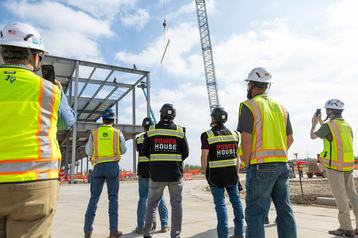
For AREP, that foundation was already in place. The firm has spent more than two decades building its reputation in asset management, overseeing the full spectrum of real estate activity, from acquisition and risk management to execution and disposition. While these principles apply broadly across asset classes, data centers introduce a level of distinct and highly nuanced construction and technical complexity.
“Real estate experience gave us a starting point, but data centers require different skills,” says Chaudhry. “We had to build a team that deeply understands the technical side of the asset class to complement existing capabilities across real estate acquisitions, development, and asset management.”
Doing data centers justice meant establishing an in-house team of world-class construction and development professionals, allowing specialized data center expertise to be integrated with AREP’s institutional real estate approach.
Underlying this strategy is the core belief that real estate ultimately houses the economy. In the AI era, that means delivering the infrastructure capable of supporting today’s magnitude of computing demand: large-scale developments that can provide speed to power and, increasingly, what the industry calls ‘instant gratification power.’
But building those campuses requires far more than engineering and capital. Utilities and regulatory bodies play a central role in the process, each operating within defined jurisdictions that shape how projects move forward.
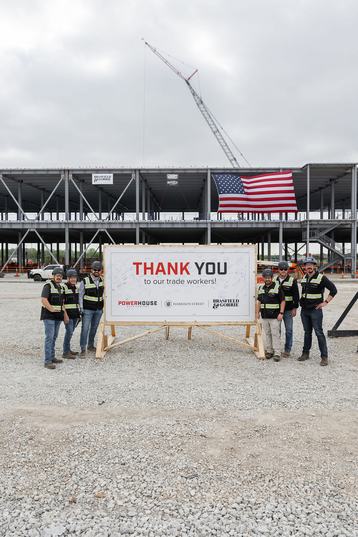


As developers enter new markets or expand campus footprints in existing ones, they face the dual challenge of establishing new relationships while maintaining and strengthening existing partnerships.
Once the first projects are delivered, those relationships begin to compound. The trust, experience, and processes developed early on create a kind of flywheel effect, allowing additional projects to move forward more efficiently, enabling growth at scale.
“The first project always takes the most work because everyone is learning how to operate together,” Chaudhry says. “Once that trust is established, the next steps usually move faster.”
The power of partnerships
Partnerships affect nearly every stage of data center development. Some begin with land acquisition. Others involve capital, utility coordination, or local execution in unfamiliar markets.
For Chaudhry, a successful partnership is built on a shared vision and common goals, trust and transparency, the ability to solve problems when challenges arise, and ultimately, the delivery of results.
That alignment matters because projects rarely unfold without friction. Interest rates change. Supply chains tighten. Local approvals take longer than expected. PowerHouse often works with regional landowners, co-developers, and capital partners whose local knowledge helps identify opportunities that might otherwise remain overlooked.
“This business depends on strategic capital,” Chaudhry says. “You need partners who understand the scale, stay aligned, and are prepared to invest as projects grow in order to deliver high-quality projects for our end-users.”
AREP’s established partnerships and long-standing business relationships have helped PowerHouse identify opportunities in markets and locations that may otherwise be overlooked. This includes site selection and acquisition in parts of the country where land remains underused even as demand for hyperscale data center campuses continues to grow. In many cases, existing landowners benefit from working with a company they already know and trust, while also gaining the focus and expertise of a dedicated data center development partner.
Still, no partnership is ever seamless. In an industry shaped by uncertainty, global events can disrupt even the most carefully planned projects. Supply chain delays, interest rate fluctuations, zoning and entitlement hurdles, and construction challenges can all affect timing and execution.
Navigating these moments requires strong alignment between partners and a clear, shared vision. Just as important is maintaining transparent communication throughout the process, especially when conditions shift. Chaudhry explains:
“People often celebrate ribbon cuttings and big milestones on projects, but what really defines a partnership is how people respond when something goes wrong before you get there.”
Growth requires people
The competition for data center talent now runs almost as hard as the competition for powered land. Developers entering multiple markets at once need construction leaders, engineers, project managers, finance teams, and operating staff who can move quickly without losing discipline.
“Growth at this pace only happens if you keep adding the right people at the right time,” Chaudhry says. “Every new market and every new project depends on having people who know how to execute.”
Attracting talent, however, is only part of the challenge. Retaining skilled professionals is just as critical, especially in a fiercely competitive labor market.
Meanwhile, the data center sector itself continues to evolve. Advances in technology – and the infrastructure required to support it – have changed how developers plan campus growth.
"Customers want larger campuses, more power, and shorter delivery times," Chaudhry adds. "Our job is to deliver."
PowerHouse has grown by combining institutional real estate discipline with data center-specific development capability. That combination continues to shape how the platform enters new markets and expands existing ones.
The work still begins the same way each time: land, power, timing, and relationships. But once those pieces align, growth tends to follow.
For more information about PowerHouse Data Centers, visit powerhousedata.com.
More from PowerHouse
-

Sponsored Through the looking glass: Re-centering human sustainability in the data center industry
Rapid digital growth can make data center expansion feel like smoke and mirrors. How can sustainability, community engagement, and transparency ensure technology serves people, not obscures them?
-

Sponsored Leveraging business partnerships for a successful data center build
The role of relationships in project success
-
Sponsored It takes a village
Data center construction isn’t just about erecting buildings, it’s about building trust
Comments