
Once largely associated with nuclear power, refinery, and petrochemical projects, engineered rigging is now playing a critical role in mission-critical construction – the infrastructure behind the digital connectivity on which modern life increasingly depends.
As equipment gets bigger, heavier, and more difficult to handle, and sites become more constrained, the demands placed on construction are changing radically. Construction is being asked to do more in every direction – to work harder, perform better, lift heavier, and deliver faster.
At the same time, the mix of power generation and energy storage equipment supporting data centers is becoming more varied. From traditional diesel generators to natural gas generation and battery energy storage systems (BESS), different technologies bring different requirements for transportation, storage, handling, and final setting.
In this way, today’s construction environment requires deep expertise, careful planning, and creative problem-solving to develop the safest, most efficient, and reliable solutions for the unique demands of AI-era data centers.
Bill Tierney, chief sales officer at ProLift Rigging, brings more than two decades of experience on the construction side of crane and rigging, giving him a valuable perspective into how engineered rigging solutions have evolved.
Power equipment is changing
Power infrastructure is becoming increasingly diverse across modern computing environments, both in terms of the equipment deployed and the way it is actually used. This adds another layer of complexity to an already sprawling logistics operation.
Tierney emphasizes that there is no one-size-fits-all logistics execution plan for a data center build. Even where facilities share similar designs, each project brings its own combination of equipment, storage requirements, and site conditions.
“The design of the OEM product might change from one building to another. For instance, generators – diesel versus natural gas generators have different characteristics for the operations that we see from a storage, hauling to site, and offloading standpoint.”
BESS units represent one of the clearest examples of how power diversification is changing the physical logistics of a data center build. As BESS technology improves and its role in data center power strategies expands, project teams are handling greater volumes of battery equipment across more sites. The quantity, sequencing, and frequency of movement create their own coordination challenges.
BESS equipment also introduces specific storage considerations, including fire risk and the associated insurance requirements. “Companies like ours usually have three different insurance policies related to the new equipment we are involved with,” says Tierney, pointing to motor truck cargo insurance for transporting equipment, warehousemen’s insurance while assets are held in storage, and riggers liability insurance for when equipment is moved, offloaded, and set onsite.
The type of power technology selected – and its associated lead time – can have a knock-on effect on the terms of each policy where storage requirements, inventory management, warranty considerations, and ultimately execution schedule are concerned.
Prefabrication has also changed what arrives on site. Mechanical and electrical prefabricated skids have helped manufacturers simplify the integration of complex equipment, with much of the construction taking place in the factory rather than in the field. But prefabrication is only as efficient as the logistics that support it.
Planning the entire equipment journey
The challenge is not simply determining whether a piece of equipment can be moved. It is planning how it will move through every stage of its journey.
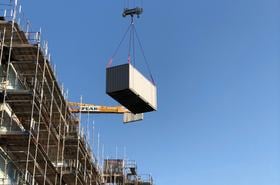
A prefabricated electrical or mechanical skid may be lifted at the fabrication facility, loaded for transport, transferred into storage, loaded again for final delivery, offloaded at the job site, moved through the facility, and ultimately set into final position. Each transition introduces different conditions and constraints.
Moving heavy modular units presents significant challenges when those factors have not been adequately addressed during the design process. Furthermore, the benefits of a well-designed prefabricated system can be undermined if the lifting locations, underside support locations, and jacking locations are not considered across the unit’s complete logistics journey – from the prefabrication floor to the final destination.
“The quantity of equipment is much greater than before. The smallest of innovations or efficiencies to a repeatable rigging plan can make significant improvements to lifting and moving risks and onsite project schedules,” Tierney explains, adding:
“Elevated offsite storage solutions can also solve for temperature control and maintenance cycles – with appropriate power access and planned load-out sequences.”
When scale compounds complexity
Managing a single piece of mission-critical equipment through its logistics journey is complex. Managing dozens across a hyperscale campus – simultaneously – is a different challenge entirely.
With hyperscale comes hypersensitivity. A single buildout can involve multiple overlapping schedules across contractors, manufacturers, field engineers, and plenty of other stakeholders. Multiply that across several simultaneous buildouts and the complexity becomes a coordination challenge of its own.
Physically delivering and lifting the equipment, as data center development expands up and out into multi-level facility buildouts and beyond saturated Tier 1 markets into more rural locations, can also become particularly difficult.
“If you’re trying to get a 100,000-pound piece of equipment through an opening that’s three stories up in the air, there are different ways you can do that, but each comes with its own challenges.”
Where location can also introduce regulatory hurdles, Tierney points to projects built in unconventional areas requiring permits and licenses for certain lifting operations. For example, sites near airports must obtain Federal Aviation Administration (FAA) permits to mitigate hazards to aircraft navigation or interference with air-traffic control systems. FAA permitting restrictions on allowable crane tip height could steer a project team’s decision on which engineered crane feasibility option makes the most sense for all project stakeholders.
More equipment, more buildings across individual campuses, and more contractors are creating additional jobsite constraints, while increasing the emphasis on safety.
“It can cause issues if schedules are not planned out well enough – field crew resources may not be accounted for, a crane that might be placed in one location might be tied up with multiple contractors – it creates onsite inefficiencies.”
For ProLift Rigging, one of the priorities in these situations is establishing clear standard operating procedures and ensuring they are strictly adhered to. Everyone onsite needs to understand not only their own responsibilities, but how their work affects the wider operation.
Tierney points to the seemingly simple example of walking a crane from one location to another. On a single buildout, that movement may be relatively straightforward, but across multiple, it can affect access, sequencing, crew availability, and the schedules of several other contractors. Planning those movements in advance becomes critical to keeping the wider operation coordinated.
Connecting data to field execution
As equipment moves through more stages and projects grow in scale, maintaining visibility across the entire journey becomes increasingly important. Through its relationship with BluePrint Supply Chain, ProLift can incorporate data on where mission-critical equipment is, when it is needed, and how changes in storage or delivery timing may affect field execution.
“We get told by our clients about the unique value of our company in proactively developing our projects and project managing our work, which involves collaborating with all the stakeholders on a particular project.”
The supply chain data provided by BluePrint can then feed into ProLift’s physical operations, helping teams adjust transportation, storage, crew, and equipment plans as project conditions change.
Bringing those capabilities together allows teams to identify constraints earlier and evaluate alternative solutions before equipment reaches the job site.
“That’s the most impactful collaboration you can have – learning how one solution might affect the project in one way, then a different solution affects the project in a different way, and what the impacts are on cost, schedule, and safety for each one of those options.”
With 24- to 36-month lead times for various types of new electrical and mechanical equipment and growing uncertainty around shipping and delivery schedules, better information gives project teams more time to respond to changing conditions. Data is most valuable when it helps teams make better decisions before those decisions reach the field.
Planning earlier preserves options
If there is one lesson from the increasingly complex world of mission-critical construction, Tierney emphasizes selecting and assembling your project team early. The time, cost, and feasibility of different solutions can all hinge on having the right expertise involved from the outset.
As the range of power equipment supporting modern data centers continues to evolve, project teams will encounter challenges that don’t always have a standard solution. Bringing in the right expertise early creates more opportunity to evaluate different approaches before project conditions limit the available options.
Complexity is easier to plan for than to react to. The earlier those conversations happen, the more options a project has.
For more information, please visit proliftrigging.com.
More from ProLift Rigging
-
Sponsored Harder, better, stronger, faster
The evolution of rigging engineering for data center construction
-

DCD Talks: Rigging engineering for data center construction with Bill Tierney, ProLift Rigging
Bill Tierney, Director of Project Development at ProLift Rigging, talks to DCD’s Emma Strutton about the evolution of rigging engineering for data center construction.
-

The Construction Supplement
Building for the future
Comments