
Today, more than ever, it’s harder to fit AI into a singular box. As the technology moves beyond development and into a growing range of enterprise and real-world applications, the infrastructure supporting it is becoming just as diverse.
As a result, rather than attempting to force a one-size-fits-all approach, AI infrastructure must follow the pattern of the workload. A model trained across a large accelerated cluster has very different requirements from an enterprise AI assistant serving thousands of users. Equally, an automated inspection system beside a production line comes with an entirely different range of constraints.
Within this varied landscape, CPUs, GPUs, and dedicated accelerators make up a distinct piece of the AI infrastructure puzzle where each individual component must align.
This conversation was a central theme at ASUS AI Tech 2026. Here, the company outlined its approach to building AI infrastructure across Intel, AMD, and a wider ecosystem of technology partners.
For ASUS, the key challenge is bringing these different technologies together to deliver infrastructure capable of supporting AI wherever it creates the greatest value – from centralized cloud and data center environments to the industrial Edge.

The shape of the workload
It’s easy to think of AI as a single category of computing. But in reality, the infrastructure requirements behind it can take on multiple shapes.
AI training relies on large-scale parallel processing and high-bandwidth connections capable of keeping accelerators supplied with data continuously. Enterprise inference introduces a different balance where latency and concurrency influence how systems are configured, alongside key considerations such as model size and cost.
HPC workloads typically place greater emphasis on floating-point performance and memory bandwidth, while data analytics can depend more heavily on CPU density and rapid access to large volumes of information.
Even inference doesn’t come with a fixed workload. The optimal architecture can change according to model size, the number of users accessing it, and the response times the application requires. Where the processing takes place can also make a significant difference.
This reality is shifting the conversation away from the idea of a standardized AI server and toward a more workload-centric infrastructure strategy.
"The objective isn’t to standardize every workload based on one type of compute," explains ASUS. "It’s to give each workload the resources it needs without introducing unnecessary cost, energy use, or complexity."
This approach means starting with the application rather than a preferred component. The nature of the model and the size of the dataset will shape infrastructure requirements, while performance expectations can determine how much memory and compute capacity are needed.
Security and data residency can introduce an additional set of requirements, particularly as AI becomes more widely distributed. The same principle applies to processor selection.
As such, selecting infrastructure aligned with the workload is critical to maintaining a consistent path to deployment, management, and future expansion.
The AI infrastructure puzzle
Assembling the complex puzzle of today’s varied AI systems requires each and every component to perform both independently and as part of the wider picture.
CPUs, for instance, are central to orchestration and data preparation, while also supporting the wider services surrounding an AI application. At the same time, GPUs excel at the highly parallel operations associated with model training and large-scale inference while dedicated accelerators can provide super-charged efficiency where needed.
While these technologies have already proved themselves critical to AI environments, viewing them as individual, isolated components misses a trick, as ASUS explains: "The key metric to pay attention to is end-to-end service performance, rather than isolated peak compute.”
In practice, a high-performance GPU still requires sufficient power and cooling to translate its full capability into useful output. Platform topology can influence how efficiently data moves through the system, while software support and utilization determine how effectively computing resources are used.
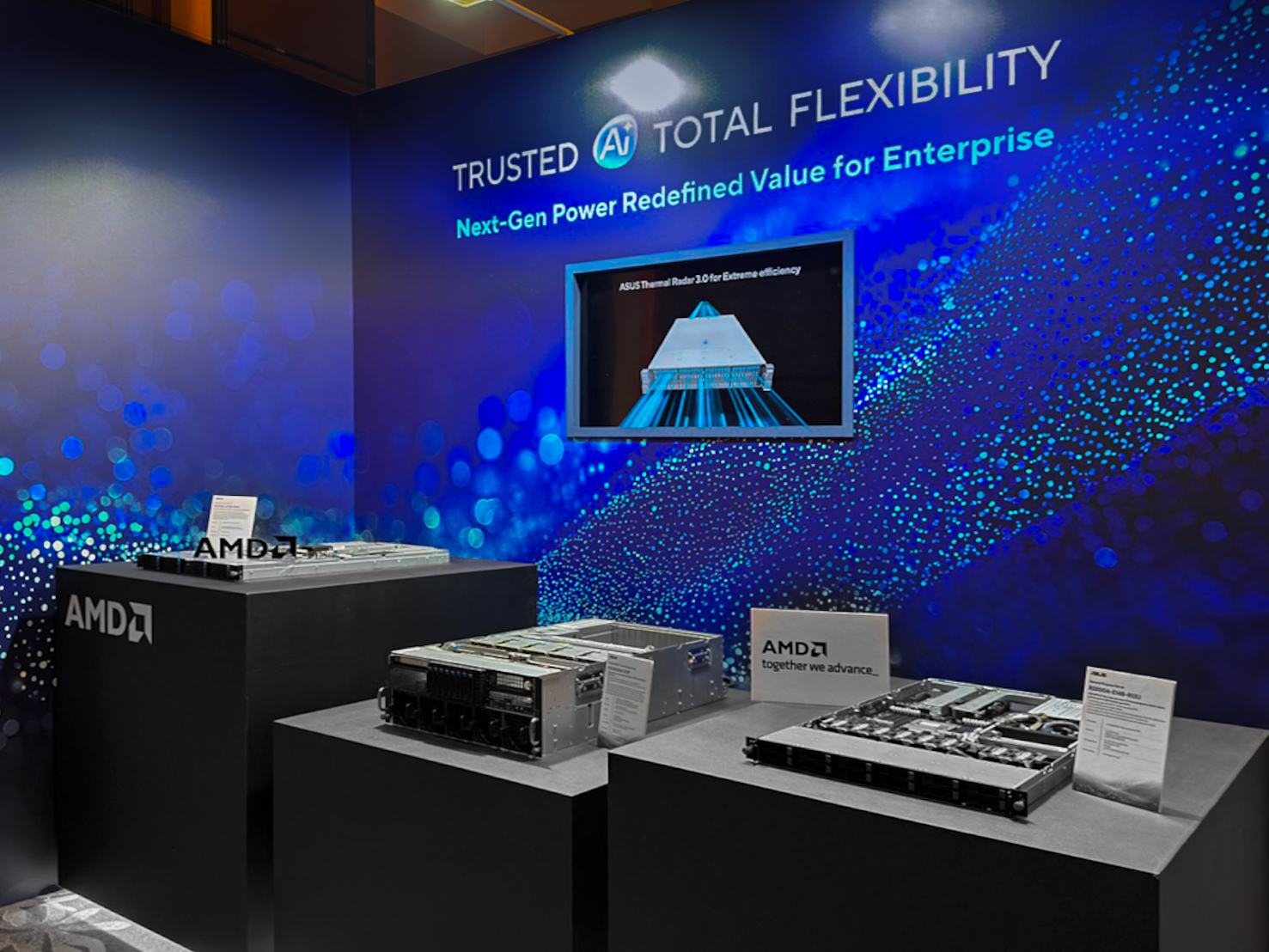
This is why ASUS focuses on complete platforms rather than evaluating processors and accelerators in isolation. The ASUS ESC8000A-E13P, for example, combines AMD Instinct MI350P accelerators with a system designed for demanding AI training, inference, and HPC workloads.
Its value lies both in the performance of the accelerators and in the ability of the wider platform to manage power and heat while sustaining performance in production. The individual technologies may perform different functions, but the overall performance is shaped by how effectively they slot together.
ASUS supports both Intel Xeon and AMD EPYC ecosystems across its infrastructure portfolio, supporting functions such as data preparation and virtualization while also playing an important role in storage and networking. Its AMD EPYC-based systems provide additional options for modern enterprise and data center applications.
Beyond the silicon: Scalable, production-ready infrastructure
Published silicon performance can often be looked to as a key metric to help drive AI infrastructure decisions. Yet, it’s crucial to recognize that this number represents potential rather than sustained application performance.
“Turning potential into useful output depends on the full infrastructure surrounding it,” says ASUS. “Power needs to be delivered consistently, thermal systems must remove heat effectively, while memory and storage also need to keep data moving at the rate the application demands.”
If any of these elements fall out of balance, the result can be thermal throttling or underutilized accelerators, with inconsistent performance following closely behind.
For ASUS, this is where system engineering becomes an important part of the complete AI infrastructure picture. The company's AMD EPYC 9006-based platforms use a DC-MHS modular architecture that separates I/O and host processor zones from other system components, helping improve airflow and module-level serviceability. ASUS DIMM.2 also relocates M.2 storage away from high-heat CPU areas to help reduce thermal throttling.
Thermal Radar 3.0 adds another layer of control by using PID technology to regulate fan speeds according to real-time operating conditions. High-speed memory and PCIe 6.0 further support the platform's ability to move data efficiently, while dense storage and redundant power are designed to support reliability over the system's lifecycle.
These details can be easily overlooked when infrastructure decisions are framed primarily around processor generations and accelerator counts, yet they can have a direct impact on utilization and uptime.
Taking intelligence to the data with Edge AI
The growing diversity of AI infrastructure doesn’t end at the data center door. Growing volumes of data are generated by cameras and sensors, plus vehicles and industrial systems operating outside centralized facilities at the Edge. In many cases, this data needs to be processed quickly enough to support immediate decision-making.
Sending every input to a cloud or central data center can introduce latency issues and consume bandwidth, create a greater dependency on network availability, and raise questions around confidentiality and data residency.
“In some applications, raw data delivers the greatest value the moment it’s generated, making it more efficient to process information locally and send selected insights upstream,” explains ASUS. “This is helping drive the expansion of Edge AI.”
Local processing can be particularly valuable where response times are operationally critical or sensitive data needs to remain on site. It can also help maintain essential operations when connectivity is disrupted.
Automated optical inspection provides a clear example. A manufacturing line may generate a continuous stream of high-resolution video, but a decision about whether a product is defective may need to be made within milliseconds.
An Edge platform can run the vision model right beside the production line, identify defects locally, and send only the most relevant results back to centralized systems.
The data center and Edge therefore form different sections of the same infrastructure puzzle. Centralized systems can support model training and long-term analysis, while Edge systems simultaneously handle the immediate decisions that need to happen close to where data is generated.
Built for the real world
Taking AI beyond the data center also changes the requirements of the hardware itself.
Traditional enterprise systems are typically deployed in carefully controlled environments with predictable temperatures and power conditions. A platform installed beside machinery or inside a vehicle can encounter a different kind of heat, vibration, dust, or an inconsistent power supply.
This means industrial AI infrastructure must combine computing performance with environmental resilience. Compact design is also important, particularly where systems need to be deployed in confined spaces or locations with limited access.
Depending on the application, this could look like fanless operation or ensuring the flexibility to accommodate a wide range of temperatures. Protection against shock or vibration may be equally important, particularly when infrastructure is deployed inside vehicles or alongside industrial machinery.

ASUS is addressing these requirements via its industrial Edge platforms – such as the RUC-2000 series, powered by Intel Core Ultra Series 3 processors, designed to deliver up to 180 AI TOPS for applications including machine vision, video analytics, and in-vehicle AI.
Its rugged, fanless design reflects the realities of deploying AI in environments where reliability is directly connected to an application's ability to continue operating.
From cloud to Edge
Looking ahead, AI infrastructure is set to become increasingly diverse and distributed. Large-scale training and complex inference will continue to drive demand for dense, accelerated computing inside data centers.
Enterprise applications will create opportunities for AI running closer to business data, while physical AI will extend intelligence across a growing range of real-world environments.
The critical challenge will be managing these resources as part of an interconnected infrastructure strategy rather than as isolated technology decisions.
For ASUS, the answer lies in combining infrastructure choices with system-level integration.
Working alongside Intel, AMD, and a wider ecosystem of technology partners, the company is translating new generations of processors and accelerators into platforms designed around the needs of specific workloads.
This provides operators with an evolutionary path from AI experimentation to production – validating a use case before selecting the right architecture and scaling it as requirements grow. From there, intelligence can extend beyond centralized infrastructure and into the environments where real-time processing creates the greatest value.
Under its vision of ‘ubiquitous AI. Incredible possibilities,’ ASUS is building an infrastructure ecosystem around the idea that AI will not be deployed in one place or on one type of architecture.
For more information visit ASUS – Expands AI Infrastructure Ecosystem from Cloud to Edge
More from ASUS
-

Sponsored AI governance starts before the first token
The shift from being ‘all in on AI’ to ‘AI in all’
-

Sponsored The recipe for AI readiness
Deploying AI infrastructure from scratch requires more than just the best individual ingredients. It demands the right methodologies to make them work as one
-

Asus to build 250-petaflops Nvidia-powered supercomputer in Taiwan
First phase of the project slated to go live in December 2025
Comments