
Reza Azizian was convinced to start his cooling company, Ferveret, after his first visit to a data center.
“I first walked into a data center in 2016 and thought to myself, ‘ok, this is not how this facility has to work’,” he recalls. “It was very clear that, from a heat transfer perspective at least, data centers were not very efficient and air cooling was not going to be effective for much longer.”

The Cooling Supplement
Next generation cooling
Data center cooling has witnessed a step change since 2016, with the rise of AI making liquid cooling a reality for many operators and forcing them to assess alternatives to traditional air-based systems. And though cooling has undoubtedly become more efficient since Azizian first stepped into a data hall a decade ago, there is still work to do to help operators become more efficient and prepare for future generations of power-hungry AI chips.
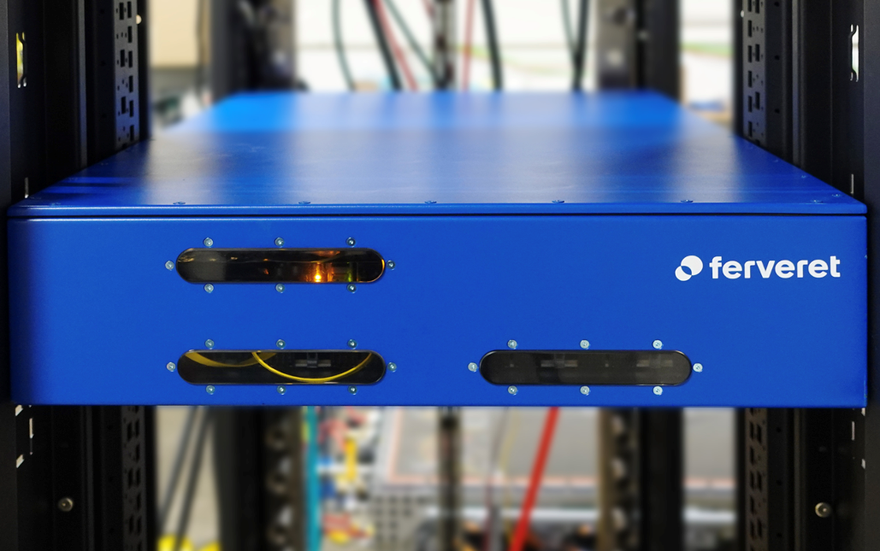
Ferveret is one of several vendors looking to harness the potential of immersion cooling. It proposes to solve some of the form factor and reliability challenges associated with immersion by using a cold box, which encases the hardware and its cooling system in a single package that can be slotted into a traditional rack. By using what it describes as adaptive immersion cooling within this cold box, Ferveret hopes to offer an efficient option for data centers looking to bring down their cooling bills.
The rise of immersion
Liquid cooling for data centers falls into two broad categories: Direct-to-chip cooling, where cooling fluid flows across the hardware via a cold plate heat exchanger – housed within standard vertical racks – and immersion cooling, where servers are dunked into vats of cooling fluid.
So far, direct-to-chip cooling is the more widely adopted of the two, with immersion remaining less popular. This is for a number of reasons, one being reticence among operators to sink their expensive equipment into cooling fluid, while another is the form factor. Immersion cooling tends to occur in large tanks that resemble chest freezers, and fitting these tanks into a traditional data center setup can be challenging.
But times are changing. Speaking on a recent DCD broadcast on the state of the liquid cooling market, Samantha Yates, principal engineer at chipmaker Intel, said: “There are some very large-scale deployments of immersion because it offers benefits with certain workloads and use cases. It hasn’t hit an inflection point yet, like AI was for direct-to-chip, but it’s steadily growing, and it’s not a niche technology.”
Yates points to work being undertaken within the Open Compute Project (OCP) to drive standards in immersion cooling as one of the factors that is leading to growing adoption. She said: “The immersion community in OCP is very large and very motivated, and an incredible amount of work is being done very rapidly to proliferate immersion as a capable cooling technology that has its specific benefits and has a place in data centers.”

Ferveret hopes to take advantage of this growing interest in immersion. Azizian is an engineer with a PhD from MIT who spent the early part of his career focusing on heat transfer in nuclear reactors. From there, he moved into consumer technology, working as the lead thermal engineer on Microsoft’s HoloLens headset. He recalls: “We couldn’t put a fan in it, so we had to use natural convection, but we couldn’t use copper as the material for this because it would have been too heavy. So we ended up building an ultra-thin, ultra-light, titanium vapor chamber that took the heat from the electronics close to your eyes and spread it across the band that goes around your head, using that large surface area.”
Whether this stood Azizian in good stead to tackle the challenges of data center cooling is unclear, but he went on to work for GPU king Nvidia and chip manufacturing behemoth TSMC before founding Ferveret. He met his Ferveret co-founder, Matteo Bucci, at MIT, and the pair had collaborated on a project, funded by French utility provider EDF, looking at effective ways to cool nuclear reactors.
“I could see the challenge of electronics getting smaller and smaller and generating more heat,” he says. "I started looking at different ways to cool a data center, and two-phase immersion cooling was particularly interesting to me because it resembled some of the processes I was familiar with from nuclear reactors.”
Two-phase immersion cooling involves boiling the cooling liquid in the tanks, causing heat to be dispersed as gas, which is then condensed and recirculated. This differs from less efficient single-phase cooling, where the fluid remains in a liquid state at all times.
Azizian continues: “What stood out to me was that people in the data center cooling space had no idea how to make this process work in an efficient way, and I felt there was a gap that could be filled with some of the knowledge we had from the nuclear industry.”
Boxing clever
Despite the progress that has been made in developing immersion cooling systems, Azizian contends there are still “a bunch of fundamental challenges” with the technology, “the biggest one being the change in infrastructure” that it requires. “If you want to use the large tank form factor, you can’t just drop that into a typical data center,” he says.
Another is that cooling fluid escapes during the two-phase process. “When the gas bubbles come out of the bulk of your liquid, you generally build up pressure in the system,” Azizian explains. “No matter how good a seal you have, over time you end up losing fluid.”
Ferveret describes its cooling system as adaptive immersion, sitting somewhere between single- and two-phase. This is essentially because it involves boiling liquid, but trapping the resulting gas within the system rather than allowing it to escape, which is the point when pressure starts to build in a normal two-phase system.
It is inspired by a technique used in nuclear reactor systems known as subcooled boiling, and Azizian explains that the company’s system produces much smaller bubbles that detach more frequently and condense rapidly in the surrounding subcooled liquid.
“Our heat exchanger has a unique design that sits in the fluid and keeps the top layer cool,” he says. “That means the bubbles get collapsed in the bulk of the liquid, so we get the benefits of two-phase without having to deal with the challenges of pressure and other issues you typically get with two-phase. The beauty here is that this fundamental difference in basic physics opens up a lot of doors for us.”
One of these doors relates to size. Without the need to deal with pressure, Ferveret can make its system a lot smaller, meaning it can fit in a small box that can slot into a typical rack, allowing each server to have its own individual immersion cooling system. Each box is 4U in size, meaning up to ten could fit in a standard 42U rack. Such a set-up could provide 600kW of cooling, Ferveret claims.
“The box sits in a typical rack, with a single inlet and outlet manifold,” Azizian says. “The idea is that you can have a rack that is half direct-to-chip, half Ferveret’s solution, so it’s truly plug-and-play in that sense.”
The company claims its boxes do not weigh significantly more than a direct-to-chip alternative. “We don’t have any of the copper cold plates and heat sinks you find in direct-to-chip systems,” Azizian says. “And the amount of fluid you need in our boxes is a lot smaller than you need for a big tank.”
Ferveret could also address another widely-held concern about two-phase immersion cooling - the type of fluid used. Two-phase has historically relied on fluids containing polyfluoroalkyl substances, or PFAS, chemicals, which are damaging to the environment and are being increasingly controlled and even banned by regulators around the world. Azizian says his firm’s system can run on standard PG25, a glycol-based fluid that is readily available and less damaging to the planet.
“The fluid we use has a low boiling point, somewhere between 45-50°C (113-122°F),” he says. “If you put that in a large tank, you would start building up pressure and losing fluid very fast. Our tanks are smaller, and we don’t have that pressure build-up challenge.”
When it comes to maintenance, Azizian says servers can easily be removed from the boxes to allow for any required repairs. One reservation many data center operators have about immersion is that cleaning servers once they are removed from the coolant can be challenging, but using a glycol-based fluid apparently avoids this issue. “One beauty of our system is that, by using this kind of dielectric fluid, when you take the server out, it is completely dry,” he says. “That’s very different to single-phase, where an oil-based solution is circulated, and you have to leave the server to dry out for 24 hours.”
Into the field
Based in the US, Ferveret was founded in 2021 and was part of Y Combinator, the Google-backed startup accelerator. Azizian is the company’s CEO, while Bucci, who is also Esther and Harold E. Edgerton Associate Professor in the Department of Nuclear Science and Engineering at MIT, serves as CTO. Last year, the company raised $9.3 million in seed funding from backers including Aramco Ventures, the VC arm of Saudi Arabian oil company Aramco, to help develop its system further.
It is currently undertaking trials with Aramco, as well as data center operator Switch and neocloud FarmGPU, and Azizian points to the results of a study, carried out in association with academics at UCLA in California, as proof that his firm’s system could be a cost-effective alternative to others on the market.
“We did testing on Nvidia H200 GPUs and measured teraflops per watt,” he says. “Compared to direct-to-chip cooling, we can offer a 15 percent uplift in teraflops per watt. Roughly 5 percent of this comes from the fact that the chip runs at a lower temperature, so you can use more of the power for useful compute. The other part of that is because, at least for now, direct-to-chip also needs a bank of fans to cool other components in the server. We’re able to remove those fans.
“Our priority for the rest of this year is to finish the pilots we currently have running, and hopefully some of them will turn into longer contracts, as well as bringing partnerships with server companies to fruition.”
Like Intel’s Yates, Azizian is confident that wider adoption of immersion is just around the corner and, perhaps unsurprisingly, believes small, modular solutions like the one offered by Ferveret will be helpful in achieving this.
“Data centers are facing problems getting power, and will do anything they can to squeeze more juice out of their servers,” he says. “Of course, if I’m using direct-to-chip and it’s giving me the performance I want, then I’m not going to move away from that. But I believe many will have no choice but to look to new technologies because they are being squeezed from all sides [to improve performance].
“The problem is that a lot of people have had a bad taste of immersion, especially two-phase, in the past, so getting past that initial barrier can be hard. But we’ve found that once we spend some time with customers, get our product in their hands, and run a pilot, they convert pretty fast.”







Comments