
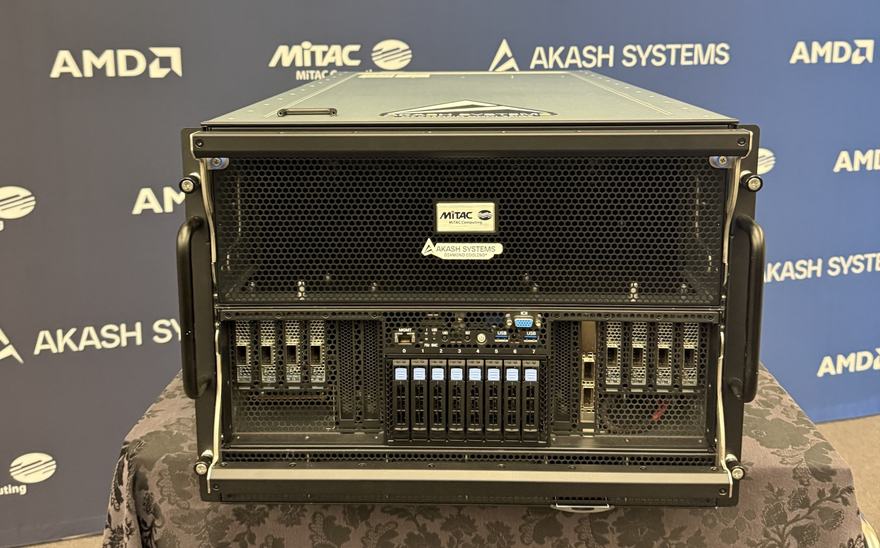
Pamit Surana has a trick up his sleeve.
As the co-founder and CCO of Akash Systems, a company that specializes in using diamonds to cool data center servers, Surana says that he and his colleagues always carry a diamond with them.
This is not the diamond of engagement rings or necklaces – it’s shaped like a pebble and its edges are soft, not sharp and sparkly – and at face-to-face interviews, when asked to explain what their technology does, Pamit will take the diamond, grip it between his fingers, and cut through a block of ice as if it were room-temperature butter.

The Cooling Supplement
Next generation cooling
"The reason [the trick] got popular is because [our CEO] Felix showed it to me, and I go, ‘I understand this. I'm the non-PHD, and I get it.’ So now, every executive carries diamonds in their pocket," says Pamit.
The trick, imported from the high school physics classroom, is meant to demonstrate the thermal conductivity of diamond and to illustrate its commercial viability in the context of cooling electronics.
Diamond is one of the world’s most thermally conductive materials – about five times more thermally conductive than copper, its closest rival – and Akash is betting that every data center operator will want to put a bit of that sparkle into their hardware.
Diamonds, meet gallium nitride
Akash Systems was the brainchild of Felix Ejeckam, an entrepreneur and materials scientist with a PhD in electrical engineering and computer science with a minor in materials science from Cornell University.
Ejeckam demonstrated the utility of merging diamonds with gallium nitride, a widely used semiconductor material, and in 2013, he sold the patents for the technology – called Gallium Nitride-on-Diamond (GaN-on-Diamond) – to Element Six, a synthetic diamond company founded by global diamond giant De Beers.
But De Beers “shifted its strategy”, according to Ejeckam, and he and his co-founders bought the patents back in 2016 to commercialize the technology themselves.
Akash Systems was founded a year later, and venture capital firm Khosla Ventures provided $3.1 million in funding the year after that.
Their first attempt to commercialize the technology came in the form of space-qualified satellite radios. Because space has no air, dissipating heat is a problem for satellite electronics, limiting the speed at which they can transmit data to Earth. Akash argued that diamond cooling would let the radios operate more efficiently, allowing satellite operators to get better use of their equipment.
Although these began shipping in 2023, Akash was already turning its gaze towards data centers. Like many other companies across a variety of industries, Akash spotted an opportunity after the debut of ChatGPT in November 2022.
“We started to see the AI space pick up, and we saw an opportunity with the GPUs having a heat problem,” he says. “Our heritage is solving heat on electronics, and the GPU was the next opportunity for us.”
Other companies and researchers have successfully used the GaN-on-diamond technology before. Fujitsu Laboratories said in December 2019 that it was able to use Gan-on-diamond for heat dissipation on weather radars and communications equipment. The South China Morning Post reported back in February 2024 that a group of Chinese scientists working for China’s largest electronic warfare weapon supplier had used diamond-based chips for electronic weapons. Qorvo, an communications hardware firm, also touts GaN-on-diamond wafers for military radios and amplifiers.
But Akash seems to be the first to apply this to data centers.
There are two parts to Akash’s value proposition. The first is at the server level. Given that diamond is more conductive than copper, which is the material’s closest rival, data center operators will be able to get more compute out of their chips because they won’t overheat as easily, the company claims, meaning they can operate without thermal throttling. This means you can get more out of your existing chips and, in the case of AI data centers, you can increase your tokens per watt.
The second is at the data center level, Surana says that their “servers can operate in an environment that goes up to 120°F (48.8°C).
“We call it diamonds in the desert,” he says. “You could literally put our servers in the middle of Dubai, in the summer heat of Texas or Arizona. And we do not throttle.
“For air-cooled data centers, this represents a material impact in their power usage effectiveness (PUE), because now, anybody who buys our diamond cold servers can operate their data center at a higher temperature, and thus, reduce PUE, and thus open up and unlock more power out of an existing data center. That is in addition to the 70 percent at the server level,” says Surana.
Reducing energy consumption
Akash says its cooling technology is projected to reduce data center energy consumption and increase FLOPs/Watt by up to 15 percent per server in facilities running at temperatures up to 50°C (122°F), compared to the common standard of 24-29°C (75-85°F).
Surana has said in interviews that the diamond-cooled server could generate $1 million in incremental cash over four years – that’s around 250,000 per server per year – based on an analysis done by two major unnamed Wall Street banks.
Things started picking up for the company in 2024. It secured a $68 million grant under the CHIPS Act, launched its first diamond-cooled servers, and it signed a $27m contract with Indian data center and sovereign cloud operator NxtGen.
These servers were delivered to NxtGen in February of this year, and it announced in March that it had launched AMD-powered diamond-cooled AI servers. These servers would come equipped with Akash’s technology and include eight AMD Instinct MI350X GPUs, two AMD Epyc 9005 CPUs, AMD Pensando Pollara 400 AI NICs, and the latest ROCm software stack. Akash also announced that it had received a $300m initial order for the AMD-powered servers in the US.
Although Akash is betting that every kind of data center will want diamond-cooled servers at some point, like any business, it needs capital to make its dreams come true, and in order to get the company off the ground, it is looking to shake up the air-cooled data center market first.
The reason for this, Surana says, is simple economics. While many of the enormous AI data centers announced in recent years are still under construction, air-cooled facilities are commonplace across the US and around the world.
“The reason we deploy [at an air-cooled data center] is because you don’t have to wait for a data center to be built,” he says. “Air-cooled data centers… those are sales that you can register today.
“The key is, we offer more compute today. And that's at the server level. And then in the cumulative amount, you get more in a fixed data center. So if you own an air-cooled data center, diamond will give you absolute maximum output because you don't have to build another data center. You don't have to wait for approvals. You get that today, no permit needed.”
Surana added that they were looking to target two kinds of air-cooled customers; those who were already looking to get their hardware replaced, as well as operators seeking to get more out of their existing equipment.
In the first case, the customers would simply buy the new server pre-loaded with diamonds, but in the second, Akash would “go to the facility, open [the server] up, add our diamond, close it, and turn it back on,” says Surana. This replacement process takes two to three weeks, the company claims.
“Clients are eager to get our air-cooled options because of the headwinds of new data center construction,” Surana says. “We’re solving the legacy air-cooled data center constraint by unlocking a whole data center. It’s not just tokens per watt in the classic sense – it’s more tokens per data center, because you can densify with us.”
Akash targets liquid-cooled data centers
Surana emphasizes that they are not limiting themselves to the air-cooled market.
“Everyone's building liquid-cooled data centers,” he says. “But I would have to wait till 2027 or 2028 for that revenue. It's not that we're avoiding liquid, I'd rather take revenue today because 90 percent of installed bases are air-cooled. That's where the business is, and the AI market wants stuff today. So we meet the market where it is.”
He told DCD that the company was debuting its Nvidia Vera Reuben cooling option in Q4 of this year.
Akash emphasizes that it is a global company. It sources its diamonds from Asia, Europe, and the United States, and is also looking to build its own diamond reactors to synthesize artificial diamonds domestically in America. The company is also open to opportunities in Europe, Asia, and the Middle East.
“Every server that is sold, we can add diamond to it, Nvidia or AMD,” Surana says. “So our market is the appetite for hyperscaler, neoclouds, and enterprise. It’s a really big market.”
But Akash is tight-lipped about the exact cost of the diamond-cooled server. When asked how much it would cost to add a diamond to an existing server, a representative told DCD that Akash would take “a percentage of the additional cash value.”
Interestingly, Akash’s promotional material does not emphasize environmentalism. Surana is happy to emphasize that the product could help data center operators and customers get more juice out of their hardware, but whether that will satisfy the insatiable demand for capacity is another question entirely.
“We’re using carbon and diamonds to decarbonize,” he argues. “We're using nature to help nature. If you think about it, if I can bring 70 percent more tokens out of the same megawatt, I just reduced the carbon footprint of another data center by 70 percent.”
Many would argue that the likelihood of this happening is small, and that making servers more efficient simply encourages operators to buy more chips and build more data centers, such is the insatiable appetite for compute in the age of AI. But Surana concludes: “What I can say is I have less carbon impact or token with my server, and that is sustainable. Honestly, if you solve the sustainability issue, which is power, then everyone benefits.
“It’s literally green – green for the environment, and green for money.”



Comments