
Liquid cooling is old hat. It’s not really, but the industry has learned to accommodate direct-to-chip liquid cooling (and rear-door heat exchangers) without too much hassle in a few short years.
Not too much hassle, of course, meaning new facility designs, new skills, new supply chains, and a range of new vendors entering the market. All the while meeting the growth demand of an industry exploding in a way few could ever have predicted in classic building-the-plane-while-flying style.
But the change has been made. And in 2026, a customer saying they need liquid cooling won’t create the same sort of stress it might have done even five years ago.
Now, however, an even bigger change could be on the horizon. During a recent event in Buffalo, New York, Schneider Electric set out its stall on the future of high-density racks, firmly planting a flag by saying that 1MW racks are coming, and that at least some of the industry will need to accommodate 800V DC.
Denser and denser
Steven Carlini, chief advocate of data centers and AI for Schneider Electric, said that while the average rack densities are still around the 15kW range – though there will be massive variances depending on use case – he predicted the average power density per IT rack of all racks installed could reach 150kW by 2050. That’s a long way off, but could have huge repercussions for an industry already working hard to accommodate today’s needs.
While 150kW rack densities are high, they are well within the envelope the industry should be able to cater for, even if entire facilities of such high numbers will be incredibly power-hungry. The problem, however, lies in the high-density hardware Nvidia says we will need to cater to.
With its upcoming Feynman architecture, Nvidia could be releasing 1MW GPU rack systems as early as 2028.
Manish Kumar, Schneider Electric’s EVP of secure power & data centers, noted that data centers designed to cope with 1MW racks will bring “turmoil” that will force a reimagining of how we build design and operate data centers. No big deal, eh?
1MW racks and the move to 800v DC
1MW racks will require a complete re-engineering of how we approach power architecture within the data center. Most notably, such rack densities will require a shift from AC power to DC power – 800V DC to be precise.
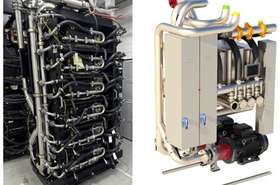
Hyperscalers prepare for 1MW racks at OCP EMEA; Google announces new CDU
Hyperscalers look to disaggregate power from IT to reach 1MW racks
Rob Bunger, Schneider Electric’s cloud and service providers technical and solutions director, said 48-54 VDC rack power distribution and 480 VAC supply voltage approaches reach practical limits beyond ~400kW per rack because of the amount of congestion from feeds & connectors inside the IT rack; the amount of rack-space that ends up being consumed by power shelves & BBUs; and power capabilities of the busbar at low voltage.
While we’re not there yet, Nvidia hopes to deliver a 600kW rack system by 2027.
The current 72 GPU rack systems, which can demand around 150kW per rack, demand eight whips or power feeds. But rack systems with 144 GPUs and demanding 1MW of power might need 32 such feeds, which becomes unmanageable.
In the short term, Bunger predicts greater adoption of power rack sidecars, as these can be installed in existing AC-oriented data centers, reduce failure zones to a single rack, can be more quickly deployed, and utilize existing supply chains established for the electric vehicle industry. These, the company says, can be “dropped into place” to accommodate a handful of these extreme-density racks in existing facilities.
While it is Nvidia pushing the envelope in terms of chips power, the major hyperscalers seem on board with the idea of sidecars and Jensen Huang's roadmaps.
Meta, Microsoft, and Google are working with the Open Compute Project on designs for Mount Diablo, an AC-to-DC sidecar power rack that disaggregates power components from the IT rack into a neighboring unit. Vendors in the supply chain are quickly falling in line to meet those needs.
When talking about this at the OCP EMEA event in Dublin last year, predictions said that we will see densities of greater than 500kW in a rack by 2030. Those timelines seem to have been shifted forward in the interim 12 months or so.
Facility-wide DC power
While sidecars can allow legacy facilities to accommodate high-density DC-powered racks without a complete internal refit, Bunger expects to see the first facility-level DC distribution data centers by 2028 or 2029.
After a certain point, he says, too many DC sidecars become impractical, and operators will have to start centralizing DC power – at first to the data hall and then perhaps even facility-wide.

Nvidia prepares data center industry for 1MW racks and 800-volt DC power architectures
More than 20 companies announce partnerships with Nvidia in preparation of next wave of rack density jumps
The switch to liquid cooling has been a tectonic shift in how data centers are built and operated. And that's even though we’ve had liquid cooling in the data center in some form or another for decades. And just as the industry seemed be coming increasingly comfortable with the demands of liquid, it's now being expected to at least consider a wholesale electrical shift if it wants to cater to the extreme end of AI workloads.
Google has been using 48V DC in many of its racks for more than a decade, and telecoms firms have been using 48V DC since the early days of copper phone networks. But Bunger tells DCD that the move to 800V DC has more learnings from the solar and EV world than the realm of legacy telecoms.
Facility-wide 800V DC data centers might well require solid-state transformers or transformer rectifier units, as well as a rethink and redesign of power distribution equipment.
In a blog on the topic, the company said that while this equipment may be air-cooled in the same way as traditional electrical room equipment, “pressure on power density will eventually bring about liquid-cooled power infrastructure,” and in some cases, actually require localized or smaller CDUs to manage thermal conditions between servers and power systems.
Networking and support equipment may also require companies to maintain AC powertrains in the whitespace to power smaller cooling equipment, such as CDUs and CRAHs. Schneider has published a white paper, 5 Principles for 800 VDC in AI Data Centers, on the topic.
But the company notes 800 VDC will not be a single architecture and will vary depending on things like workload composition, facility constraints, resiliency objectives, and regulatory environments. We could see different pod, data hall, and facility-level architectures appear.
In the paper, Schneider notes that supply chain standardization across complete 800 VDC systems remains limited. It also notes fewer electricians, technicians, and service organizations have direct experience with installing and commissioning higher-voltage DC systems – there are also fewer mature industry standards, tools, and methodologies for assessing DC-specific hazards.
Don’t expect a lot of efficiency gains from switching to DC either – Schneider said that despite the reduction in conversions between AC and DC in an 800V DC environment, the company would only expect the reduction in inefficiency losses to be in the low single-digits – maybe a 1.5 percent improvement.
When challenged that the design of data centers – especially when it comes to the ratio of white space vs grey space – will likely look very different if a 100MW facility only has 100 racks of IT gear, Bunger concedes that the ratio of facility equipment will likely change. He notes, however, we could also end up with a world of high-density DC-power data halls sat within larger, primarily AC-powered facilities.
Switch claims it will be able to even serve 2MW racks – but few other colo firms have talked on the issue publicly yet, as far as DCD has seen.

Assuming GPUs scale forever
DCD will no doubt continue to cover the industry’s push towards DC distribution more and more in the coming years. DCD wonders though, is the industry ready to change the electrical topology of its facilities simply because Nvidia told them to?
During a factory tour of its CDUs and rear door heat exchangers, Rich Whitmore, CEO of Motivair by Schneider Electric, told DCD the company has already seen 400kW per rack in some HPC environments with government customers, suggesting there may well be demand to go beyond that 400kW mark where AC distribution becomes a challenge.
When asked if there truly will be demand for such dense compute, Manish Kumar, Schneider Electric’s EVP for secure power and data centers, tells DCD that’s a question best asked to the chip firms, simply saying his company wants to support that.
Kumar does reaffirms that the company predicts to see the first 1MW racks deployed – and 800V DC by proxy – by 2028/2029. It will be a small percentage of the high performance compute market for the first few years, he concedes, while the supply chain for such systems scales.
“Liquid cooling wasn’t used by most data centers three years ago, now it’s the base condition,” he says. “Rack densities used to be 15kW, not they are 140kW. The Nvidia ecosystem of neocloud players will be the first adopters, then the large language model players, the hyperscalers. The colos probably will be the ones that will get on board once those are things are proven at scale, and it becomes a mass application.”
But how much wider demand will there be for such extreme densities? Schneider’s Bunger suggest 10 percent of AI workloads might be at the sort of densities that needs 800V DC by 2030. Almost all of that will be for the extreme edge of training, deployed by the very leading-edge firms.
Schneider says AI workloads will account for 70 percent of IT deployments going forward – no small change in an industry expecting to bring tens of gigawatts of capacity online in the next few years. Even a small percentage of that overall figure needing DC power would represent a notable step change in the sector.
But all this assumes the world keeps moving according to Nvidia’s will.
Will Nvidia keep being able to keep up with ‘Huang's law’ and the idea that GPU performance more than doubles every two years or so? And even if the company can keep scaling, will AI relentlessly need ongoing cycles or increasingly dense GPUs?
Companies such as Cerebras, SambaNova, and d-Matrix are developing specialist silicon that doesn’t require the same kind of power as Nvidia’s GPUs. Google’s TPUs, while no slouch, are known to have lower thermal design points than compatible GPUs. Even Nvidia itself is starting to offer LPUs in combination with GPUs to perform certain tasks more effectively than simply brute forcing problems with more Blackwells or Rubins.
We can no doubt expect more efficient specialist silicon in the future specifically designed for training. And if the industry moves to wide-scale inferencing as many predict, many AI workloads will function well enough on less powerful hardware. We won’t need 1MW racks to ask ChatGPT to do maths homework or power an AI girlfriend.
And perhaps training models will hit a limit that hardware can’t fix. There’s only so much human-generated data in the world on which to train models, and too much synthetic training data can lead to model collapse. Improvements between each new generation of LLM also seem to be narrowing, and perhaps there will be a ceiling for how good LLMs can be without radical change on how they are programmed, which could change the equation on hardware needs.
Are we planning to over-engineer for a super-dense future that will never come? Or at least one that will be so niche that that its barely worth considering for 99 percent of the industry?
I could well be wrong. I won’t ape Thomas Watson and say there’ll only ever be a need for maybe five 1MW rack-level facilities. The past often informs the future, and the past tells us this industry will always need more power.
Being an early mover to build an all-DC data center could well be very brave and lucrative for anyone with the nerves to try.
But asking for a complete rethink of an industry based on one company’s product roadmap and the assumption of no industry disruption in the interim feels like a risky bet.




Comments