

There is some debate as to whether “the cloud” is a well-asccribed name. It has certainly left much of the general public under the impression that the Internet is somehow suspended in the sky.
DCD prefers to think of it more literally. Clouds are huge networks of water droplets, suspended and connected to form one semi-tangible mass. In the digital world, those droplets are the data centers, Points of Presence, cable landing stations, and so on. The cloud condensation nuclei, which keep the water suspended and connected, are our networks.
In Connecting the cloud, part I we explored the networking infrastructure used by Amazon Web Services (AWS) inside the data center. Now, we step into the outside world.

Issue 60 - Quantum of promise
Building the chips to power quantum computers
AWS, Amazon’s cloud platform, splits its network outside the data center into three subcategories, Robert Kennedy, VP of network services, explains: Metro, long-haul, and, in a separate bucket, subsea networks.
Metro networks are those that link data centers within a single region – the various availability zones – and data centers can be located at distances up to 400km, while long-haul connections can span thousands of kilometers and connect different regions.
For the first two, Kennedy says, much of the networking approach is the same. Both are simply “point-to-point” networks, but there can be “differences in the amount of capacity you can light up on a shorter fiber versus a longer pair,” and long-haul networks – simply due to the sheer distance covered – require repeaters to amplify the signal.
It can be easy to think of the AWS network as merely a long highway, but it is more like the circulatory system within the human body. Arteries, veins, and blood vessels blossom and branch seemingly at random but with perfect intentionality. The network spans various interconnections, smaller offshoots, and manifold endpoints, spread across the globe.
“If you look at our terrestrial backbone, we will hop out at various locations. It's a very dynamic set of source-destination traffic that’s being routed around the network; it’s not just going from, say, US East One to US West Two. There are all our Edge locations and local zones as part of the network,” Kennedy explains.
Of that network, AWS owns and operates the vast majority. Kennedy estimates that in the US, more than 80 percent is in its grasp, but that there are “some Edge nodes where it’s not a huge amount of capacity,” and are thus leased.
“It’s really a case of, ‘Is there a lot of traffic there?’ If not, it’s probably more cost-effective to lease capacity from other folks,” he says. Additionally, when standing up new data centers, sometimes AWS will lease capacity to get the facility “up and running” quickly.
Most importantly, however, is that there are always multiple diverse paths – a minimum of three – for redundancy purposes.
At the time of writing Connecting the cloud, part I, AWS boasted some 117 Availability Zones in 37 regions. When interviewing Kennedy nearly a year later, AWS had just announced the successful standing up of 3.8GW of new data center capacity over the course of 2025, and a leaked report had surfaced suggesting the firm runs more than 900 data centers - a number AWS has declined to comment on or confirm.
Needless to say, the sheer scale of the network brings with it complexities and challenges. AWS also has to deal with external data – or inbound traffic. In 2024, the cloud received more than 150 exabytes of data from external networks, transit providers, and Internet exchanges. With the proliferation of AI workloads, this is only continuing to grow, and rapidly.
Go custom or go home
In November 2025, AWS revealed that it had developed a custom-built Dense Wavelength Division Multiplexing (DWDM) transponder for its networks.
AWS’ VP of core networking, Matt Rehder, explained it in a blog post as being like a “sophisticated high-speed rail system.”
“Just as a railway network can transport multiple trains simultaneously on parallel tracks, this device securely moves different streams of data through a single fiber optic cable using different wavelengths of light, like dedicated tracks that can carry different types of cargo without interference,” Rehder wrote.
“While traditional transponders offer standard transportation systems that serve general purposes, we built our own custom networking pathways specifically optimized for our unique delivery needs, resulting in better performance and value for our customers.”
This was something of a unique revelation. While cloud providers in general do indeed use DWDM transponders, they typically turn to third-party solutions. According to AWS, it is the only cloud provider with its own custom system.
Given the number of bespoke components in its network, custom-made might as well be AWS’ catchphrase. For Kennedy, this is for the simple reason that when operating at the cloud platform’s scale (and a scale that is continuing to grow), it becomes time to “take control of this and optimize from both scale and cost.”
“That spans all of the network devices and operating systems that go on them. We’ve done each layer of the network, starting in the data center, and now we have done the global backbone,” he says.
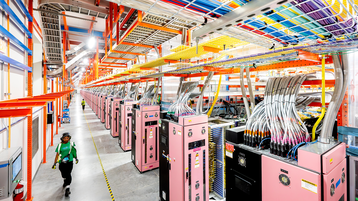
The first successful long-haul DWDM deployment was for a 1,500km (932-mile) connection, and enabled AWS to deliver 73 percent more bandwidth at the same cost, and reduce power consumption by nearly 35 percent.
Naturally, the details of how this was done are shrouded in mystery – Rehder notes the use of “recent advancements in electrical and photonics chip manufacturing technology,” and the DWDM’s ability to adjust data transmission rates in 100-gigabit increments.
Speaking to DCD about the company’s DWDM innovations, Kennedy said: “We’ve seen this technology continue to evolve over the years. The old DWDM systems used to be a full rack and do tens of gigabits, but now we’ve got it down to a single small optic driving 800 gigabits in each channel. It's pretty remarkable to see how that has evolved and the power efficiency that has come with that. It means we are going to be able to get rid of tons of this older technology.”
Kennedy explains that the technology started with the company’s metro network, but AWS has since been rolling it out across the long-haul network as well.
Additionally, as the need for bandwidth increases, because AWS uses a “point-to-point system,” it can simply add more nodes to the network. Kennedy was also keen to point out that the company does not use RODENT solutions – Routing Over Different Existing Network Technologies – which can also enable you to move between different “paths,” as AWS prefers the reliability of owning its network
Climbing the mountain
If we want to look at a subset of AWS’ network, an obvious place to turn is the company’s enormous Project Rainier data center cluster.
Developed for Anthropic, and named after the 14,410-foot (4,392-meter) stratovolcano near Seattle, Project Rainier is a massive cluster of AWS’ custom (of course) Trainium2 UltraServers connected on an UltraServer level by NeuronLinks (custom), and by an Elastic Fabric Adapter (EFA, custom) networking technology within data centers and across data centers.
Brought online in October 2025 with some 500,000 UltraServers and aiming for one million by year-end, the cluster spans not only buildings but multiple states. Currently confirmed as part of the project are Mississippi, Indiana, and Pennsylvania; in total, some 30 data center buildings are set to be part of the mega cluster in Indiana alone.
As noted by Kennedy, when it comes to AI workloads, typically you want to try and keep the “data and AI accelerators pretty close to one another,” as latency can cause challenges from a training perspective.
On a campus level between the data centers, AWS’ EFA can handle the load. As previously divulged to DCD sister publication SDxCentral, the EFA is developed on a multipathing fabric protocol with real-time path optimization capabilities. In other words, it tracks latency between source and destination and can immediately re-route where necessary.
But what if a workload demanded not only a single proximal cluster of buildings to work together, but one across the other side of the state as well, or even across all three Rainier locations simultaneously?
Indiana, Mississippi, and Pennsylvania are not close to one another, with the locations chosen because of the sheer amount of power such campuses require.
AWS hasn’t made any public statements about the specific optical transport layer underlying the cluster's inter-building connectivity - including whether this would be possible across long distances. However, it can be theorized that through AWS’ DWDM technology, the significant step up in bandwidth could one day enable something of this scale – thirty-plus buildings and three states, all tackling the same problem.
DWDM is not AWS’ only big move to grasp hold of more bandwidth. In 2025, the company embarked on its first self-driven quest under the sea.
Under the sea
Naturally, with a network spanning the globe, the use of subsea cables has long been necessary, and AWS is a part of many consortia behind cables in operation and others under development, for example, the upcoming Asia United Gateway East.
But in January 2025, Amazon’s Irish unit filed an application form with the Irish Maritime Area Regulatory Authority that detailed plans for a cable landing in County Cork, Ireland, thus marking the company’s first such solo foray.
The subsea cable wasn’t officially confirmed until November 2025, and will span between County Cork and Maryland, in the US.
The ninth smallest state in the US, Maryland doesn’t have a small subsea cable-landing presence; it doesn’t have any. This was, according to Kennedy, a very intentional choice.
“We wanted to create a completely different place behind the cable, because diversity is absolutely critical,” he explains. “Subsea cables might all follow different paths along the seabed, but if they all land in the same place, then you’ve created a single point where multiple cables can go out all at once.”
Currently, the majority of the transatlantic cables connecting the UK and Europe to the US are in New York State, New Jersey, Virginia, or South Carolina. Maryland’s complete lack of subsea presence made it extremely attractive.
The AWS cable has been dubbed “Fastnet” and is aimed to be operational in 2028. The system will offer more than 320Tbps of capacity, every last bit of which is for AWS’ dedicated use.

Earlier this year, it was revealed that Globalinx would be developing the cable landing station on the Maryland side, a 24,000 sq ft (2,230 sqm) facility that will be able to scale up to 5MW and be located next to the Ocean City Municipal Airport.
According to Kennedy, AWS will not put any servers in the building. The facility will serve purely for “terminating them [the subsea cables] from an optical perspective and then bringing them back to the location we desire.” As for where the company will then lay fiber from the cable landing station, Kennedy was naturally somewhat vague, but told DCD the decision will depend on “making sure it will be separate from other terrestrial routes.”
It is this emphasis on redundancy that is crucial across AWS’ network. In data centers, we often talk of redundancy in algebraic terms – N+1, 2N, etc., and within AWS’ data centers, this was also clearly demonstrated. In Connecting the cloud, part I, AWS’ Rehder put it eloquently: “Everything fails. Everything will fail more than you expect it to, and it will fail in unique and exciting and creative ways.”
Inside the data center, this saw AWS turn to simplicity to help guarantee continuity. But when it comes to AWS’ global backbone, the rule is a minimum of threes: three routes for any one connection.
And whether this requires AWS to criss-cross the US, or dig out trenches in the ocean, the company prioritizes minimizing the risk of failure – whatever the cost.


Comments