
Amazon Web Services (AWS) has detailed a new cloud networking architecture based on random graph theory that it says is now the default fabric for its general-purpose cloud infrastructure worldwide.
The architecture, known as Resilient Network Graphs (RNG), replaces traditional hierarchical "fat-tree" network designs with a flatter topology intended to improve resilience, throughput, and efficiency at hyperscale.
According to AWS, the design reduces the number of routers required in aggregation fabrics by 69 percent, delivers 33 percent higher throughput, and cuts network equipment power consumption by 40 percent compared with conventional architectures.
The company said RNG has already been deployed in data centers in Spain and Germany and is being rolled out more broadly across its global infrastructure.
The announcement marks the culmination of years of research into applying random graph theory to data center networking. While the theoretical benefits of flat network topologies have long been understood, practical challenges around cabling, routing, and operations have historically prevented deployment at hyperscale.
"The theoretical case for flat networks has been settled for decades," said AWS applied scientist, Dr. Giacomo Bernardi. "For decades, random graph topologies have been known to be optimal for routing. They maximize path diversity, distribute load evenly, and degrade gracefully under disruptions."
To overcome those deployment challenges, AWS developed two technologies that underpin the RNG architecture.
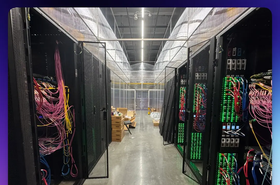
The first, known as ShuffleBox, is an optical device that standardizes physical cabling while internally creating the quasi-random connectivity required by the network design. The second, Spraypoint, is a routing protocol designed to distribute traffic across the fabric without requiring routers to maintain large amounts of forwarding state.
AWS said the architecture uses the same routers, switches, optics, and fiber infrastructure already deployed in its data centers, allowing the company to implement the design without requiring a wholesale hardware redesign.
"In a data center, the goal is to maximize the power available to servers doing useful work, and the network is necessary overhead," Bernardi said.
"By adopting a flat topology, we reduce the number of routers in our aggregation fabrics by 69 percent, which cuts their power consumption by 40 percent. That freed-up power translates directly into additional racks of servers per building."
The company said the reduced equipment count also improves resilience by decreasing the number of potential failure points within the network while increasing available path diversity.
AWS added that RNG is now the default fabric for its general-purpose cloud infrastructure worldwide. Specialized AI environments will continue to use dedicated networking architectures, including the UltraCluster infrastructure underpinning large-scale Trainium deployments such as Project Rainier.
According to AWS, future cloud deployments will continue to use RNG as the company expands its global data center footprint.





Comments