

As AI adoption accelerates, the challenge is no longer limited to increasing computing capacity. It is also becoming an energy infrastructure challenge. Higher-density AI workloads are driving data centers to require significantly more power, while their rapidly changing demand profiles place new requirements on the infrastructure supplying that power. As a result, access to reliable, affordable, and resilient energy is becoming an increasingly important factor in determining how successfully organizations can scale AI initiatives.
Compute capacity has little value without dependable power behind it. This is prompting greater interest in integrated and hybrid power approaches that combine grid power with on-site generation, energy storage and renewable sources to provide the reliability, flexibility and resilience that AI infrastructure requires. Within the data center, the same shift is taking place at the level of back-up power. As rack power continues to increase and liquid cooling becomes necessary to manage higher heat loads, conventional back-up architectures face new technical challenges.
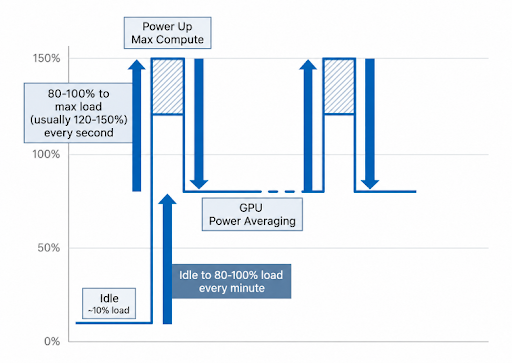
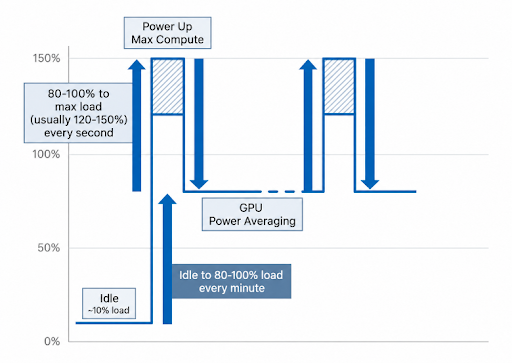
AI data centers feature a highly volatile, intermittent load profile with massive power swings occurring in seconds, breaking traditional load profiles. The increase in rack power accelerated the adoption of liquid cooling in AI data centers, which also provides additional stress to conventional backup power solutions due to the inductive nature of liquid-cooling equipment.
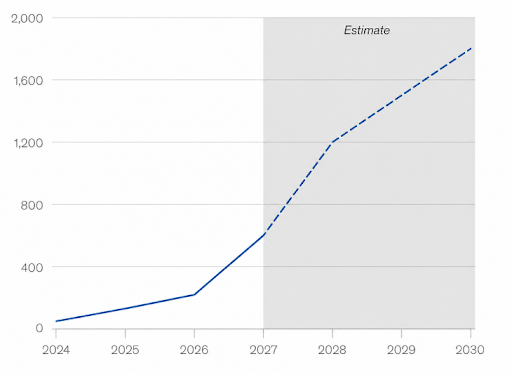
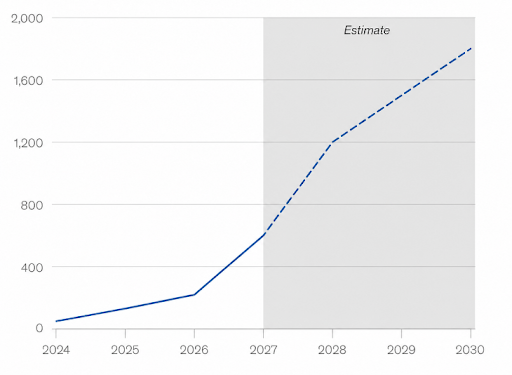
AI-focused data center rack power is increasing day after day, with estimates to go beyond 1,600 kilowatts in the upcoming four years, compared to less than 50 kilowatts only two years ago. As AI-focused data centers continue to drive rack densities beyond traditional limits, data centers require precise thermal management across the infrastructure, which can be provided by using liquid cooling architecture.
Back-up power solution providers for AI-focused data centers face two major issues, which are:
- Intermittent load profile: AI loads are characterized by rapid fluctuations and massive power swings occurring in seconds. These fluctuations can occur every few seconds, with load jumping from idle (Nearly 20 percent) to full capacity.
- Inductive nature of liquid cooling systems: Computer room air-conditioning/air-handling (CRAC/CRAH) systems can’t fit the increased rack power of AI-focused data centers, shifting the architecture to liquid cooling systems. Liquid cooling systems include electrically driven pumps, introducing heavy inductive loads that require high inrush currents.
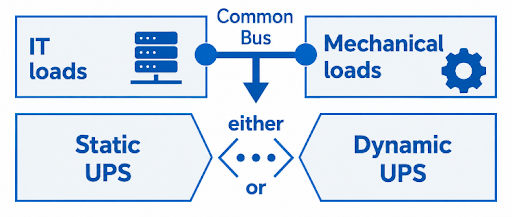
Traditional data center designs utilize either static or dynamic UPS architectures to provide uninterrupted power supply to data center critical loads.
Static UPS systems store the required backup energy as chemical energy in batteries. As batteries charging/discharging occur on the DC bus, static UPS systems require inverter/converter sets to convert the power from AC to DC and vice versa. Power electronics have limited capability in responding to the inrush starting current required for inductive loads.
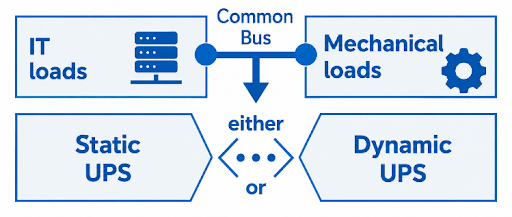
Unlike static UPS systems, dynamic (rotary) UPS systems store the backup energy as kinetic energy in flywheels/accumulators. Such systems don’t require power electronics to provide power to critical loads, as they use synchronous alternators to provide the required power. Accordingly, such systems are more robust in responding to the inrush starting current required for liquid cooling systems' inductive loads.
Dynamic UPS systems can better support mechanical loads like cooling fans, pumps, and ventilation systems used to ensure optimal cooling of computer loads. Dynamic UPS systems can provide up to 17 times the nominal current.
Both static and dynamic UPS solution providers developed several methodologies to overcome the intermittent nature of AI loads, such as a load-smoothing feature for static UPS and a flywheel support feature for dynamic UPS.
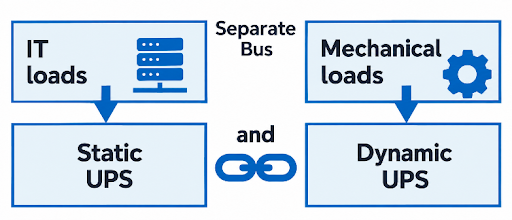
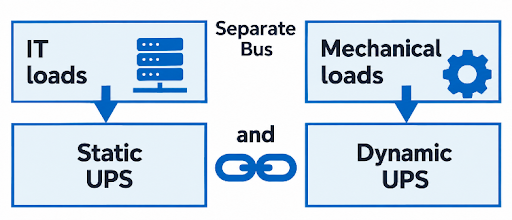
Recent designs suggest the use of both static and dynamic UPS systems together for AI-focused data centers. The new principle uses separate buses for supporting IT (Computer) loads and auxiliary systems' mechanical loads. Static UPS systems are recommended to be used for IT loads, while dynamic (rotary) UPS systems are recommended for auxiliary mechanical loads (Liquid cooling systems).
Summary
AI-focused data centers require new backup power strategies as their rack power density is rising sharply and their workloads fluctuate rapidly. AI loads can jump from low utilization to full capacity within seconds, creating stress on conventional backup power systems. At the same time, liquid cooling is becoming necessary to manage higher heat levels, but its pumps and related mechanical equipment are inductive loads with high inrush current. Static UPS systems are suitable for IT loads but may struggle with mechanical loads. Dynamic UPS systems can handle pumps and fan loads with high inrush currents. A hybrid design using both UPS types is therefore recommended.
Comments