

Imagine two data centers. Each is supplied with 20MW of utility power. Each reports a PUE of 1.3. Each passes every efficiency benchmark typically used by operators, investors, and regulators. On paper, they are twins.
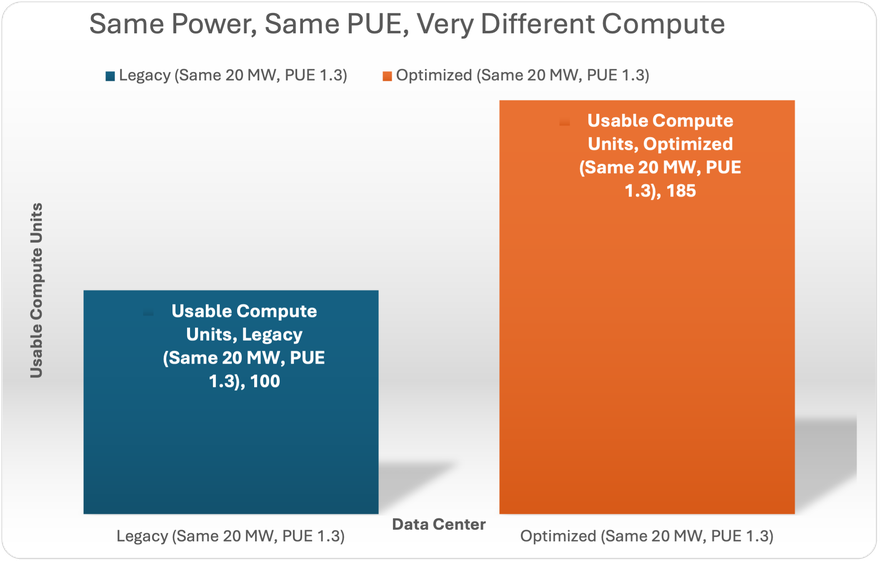
Two facilities supplied with the same 20MW of utility power and reporting identical PUE values can produce very different levels of usable compute. While efficiency metrics show them as equivalent, thermal constraints determine how much IT power can actually be converted into sustained compute, leaving a significant portion of available power stranded in legacy architectures.
In reality, one produces nearly twice the usable compute of the other.
This is not a hypothetical edge case. It is increasingly common in AI-driven facilities, and it exposes a growing blind spot in how the industry measures progress. Efficiency metrics can tell us how neatly a data center operates, but they no longer tell us how effectively power is converted into compute. As grid access tightens globally, that distinction is becoming decisive.
The stranded power problem hiding in plain sight
The industry conversation today is dominated by megawatts. New substations. New interconnects. New campuses. A race to secure the next five gigawatts of capacity has become the defining narrative of AI infrastructure.
But while attention is fixed on new power, an uncomfortable reality is being overlooked: a massive amount of power already inside existing data centers is stranded. Stranded not because it is unavailable, but because it cannot be effectively used.
Thermal bottlenecks, compressor-dependent cooling architectures, and legacy air designs are preventing operators from converting contracted and delivered power into productive compute. The result is facilities that are thermally “full” long before they are truly utilized.
This is how two identical PUEs can hide radically different outcomes.
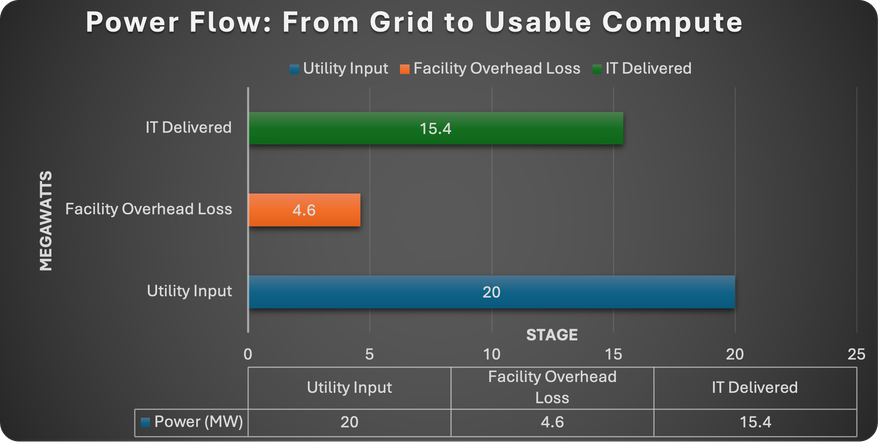
Power usage effectiveness (PUE) quantifies the energy required to support IT load but does not measure how effectively that IT power produces usable work. As shown, two data centers can appear identical through a PUE lens while delivering sharply different levels of compute due to thermal and architectural constraints downstream of the metric.
Why PUE no longer tells the full story
PUE has served the industry well. It brought discipline, transparency, and real efficiency gains over the past decade.
Although PUE is formally described as an effectiveness metric, in practice it functions as a measure of operational efficiency. It quantifies how much overhead energy is required to support a given IT load. What it does not measure is output.
PUE tells us how much extra energy is consumed to deliver power to IT equipment, but it says nothing about how much useful work that IT load actually produces. Two facilities can report identical PUE values while supporting vastly different rack densities, GPU utilization rates, and levels of sustained compute.
As AI workloads push power densities beyond what air-based cooling architectures were designed to handle, this gap widens. Operators are discovering that the primary constraint is no longer electrical efficiency, but thermal effectiveness.
Power that cannot be cooled cannot be used for compute.
Introducing effectiveness, not just efficiency
To understand stranded power, a different lens is required, one focused on outcomes rather than ratios.
Power compute effectiveness (PCE) reframes the question. Instead of asking how efficiently energy is distributed, it asks how much usable, sustained compute is produced per unit of power consumed.
Viewed this way, the difference between the two identical-PUE data centers becomes obvious. One is constrained by legacy thermal architecture. The other has aligned its cooling strategy with modern AI heat profiles.
The power did not change. The effectiveness did. When effectiveness changes, revenue potential changes, even if power input does not.
Once effectiveness is visible, the economic consequences follow naturally. Capital, grid allocations, and timelines all favor the facility that can convert watts into compute without waste.
The fastest path to more compute is by freeing up the power you already own
New power is slow. Permitting, interconnection queues, grid upgrades, and political friction ensure that it will remain slow. Recovered power is fast, and immediately monetizable.
Across the global data center estate, there are thousands of megawatts already contracted, permitted, and delivered that cannot be fully monetized due to thermal constraints. This is the “Powered and Permitted” segment of the market, and it represents one of the largest near-term opportunities in AI infrastructure.
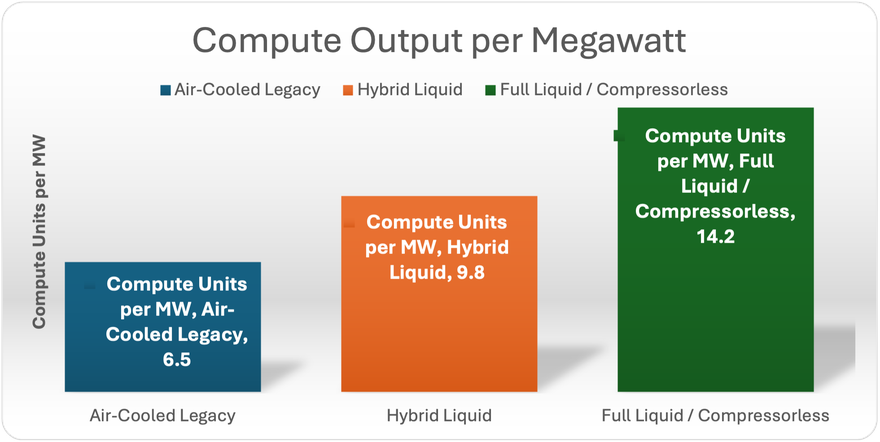


New power development is constrained by permitting, interconnection queues, and grid upgrades that often take years. By contrast, liberating stranded power within powered and permitted facilities through improved thermal architectures can bring additional compute online in months rather than years.
Liberating this stranded power does not require new land, new substations, new permits or new transmission lines. It requires liquid-based cooling strategies that can remove heat without adding complexity, water risk, or long downtime windows.
The legacy bridge becomes the strategic battleground
Most existing facilities were not designed for 40, 60, or 100kW racks. Rebuilding them from scratch is rarely economical or timely.
The winning strategies are emerging around legacy-bridge solutions: liquid cooling architectures that can be deployed within existing envelopes, integrate with current electrical systems, and dramatically raise thermal headroom without compressors or wholesale redesign. The result is not just higher density, but higher sustained utilization. Power that once sat idle becomes productive. Facilities once considered “maxed out” find new life.
Why effectiveness matters more than new gigawatts
In an environment where grid access is the gating factor for growth, effectiveness becomes a competitive weapon.
Operators that can extract more compute from the same power footprint move faster, deploy capital more efficiently, and reduce exposure to regulatory and infrastructure delays. Investors increasingly recognize that two data centers with identical MW profiles can have radically different revenue potential.
The future will favor those who treat power as a scarce resource to be stewarded, not merely acquired.
A shift already underway
This is anything but a rejection of efficiency metrics. It is an evolution.
PUE still matters. Always has, always will. But it is no longer sufficient on its own. As AI reshapes load profiles and thermal realities, the industry must expand its measurement framework to include effectiveness and outcomes. The next phase of data center growth will not be won by those who secure the most power, but by those who waste the least.
In many cases, the most valuable megawatts are already inside the fence, waiting to be unlocked.
Comments