

After decades of being a poorly understood McGuffin – think back to instances in which you’ve heard lines about ‘hacking the mainframe’ – data centers have returned to the silver screen.
This is rather surprising considering that data center companies have traditionally desired an inoffensive, subtle existence (there are exceptions). Depriving their assets of aesthetic self-confidence is a conscious decision: it costs more to make something look good, planning regulations can stipulate against the use of certain colors and designs, and any form of attention or interest, good or bad, has the potential to metastasize into a security risk.
But in doing so spectacularly well, as in the case of AWS, Meta, Google, Azure, CoreWeave, Fermi, and Stargate, the data center industry has been forced to confront the most pernicious of reputational threats: its own success.
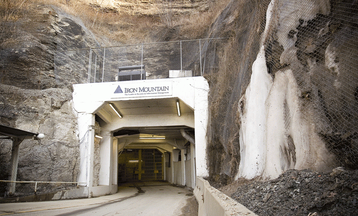
Data center-loving aliens
Case in point: poor public perception has trickled down from local communities and rights groups into cinemas, and the two films covered in this post – a modern adaptation of H.G Wells’ classic sci-fi novel War of the Worlds that takes place entirely on various digital conferencing apps, and Eddington, a neo-Western directed by horror auteur Ari Aster – designate data centers as an object of criticism despite disagreeing in their overall attitude towards technological progress.
Take War of the Worlds. In this iteration of H.G. Wells' sci-fi classic, the invading aliens come to Earth because they feed on data. The largest source of this data comes from a US government surveillance program, titled ‘Goliath,’ that produces large amounts of information about its citizens. This government, aware of the aliens’ existence and their feeding habits, green-lit the program in spite of the potential extraterrestrial risk and stored the data in data centers, which serve as the primary target of the invading alien force throughout the film.
It is worth mentioning that the film, which wrapped production in 15 days after being shot remotely during the peak of the Covid-19 lockdown, has been widely panned by critics and audiences alike. Those who use Instagram or TikTok might have already hate-watched snippets of the film, and it has earned many a sarcastic review on Rotten Tomatoes, Letterboxd, and Metacritic. Here is a characteristic example on Google:
“War of the Worlds (2025) is not just a movie. It is a cinematic earthquake that reshapes the entire landscape of film as we know it. I have seen great films before, but nothing prepared me for the raw, unstoppable brilliance of this masterpiece. It is more than entertainment. It is a revelation.”
This tongue-in-cheek review is just as unserious as the film, and it actually would have been more surprising if its depiction of data centers, negative or otherwise, ended up being realistic. But alas, the film’s lack of knowledge about data centers bears itself out in its various plot points.
For one, the aliens do not seem to understand that their invasion, which begins with the decimation of the globe’s energy infrastructure, would put their precious data centers in serious jeopardy. One might also question the strategic wisdom of firing lasers in the general vicinity of a data center, given that governments do not have a great track record of backing up their data in the event of a catastrophic fire (see: South Korea).
A generous viewer might argue that the screenwriter knew enough about the current state of on-site power generation to assume that the aliens could paralyze the administrative and military functions of a state without harming their precious data, but that would rest on the assumption that the screenwriter took the time to learn about the current state of off-grid generation and battery storage systems. Highly unlikely.
Moreover, the data center in this film could functionally be replaced with a giant vault, given that there is no mention of a data center’s utility beyond storage. As a piece of symbolism, it serves as the physical manifestation of the shadowy surveillance apparatus erected by the American government post-9/11, and the fact that the film designates it as the primary target of alien invasion makes it out to be a sort of mea culpa for the government’s sins. The data center represents the bad thing, and the alien invasion is our cosmic punishment.
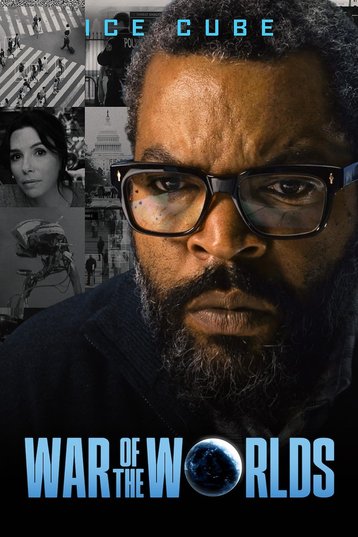
The point of this is to set up the data center as the antithesis of what our protagonists stand for. If the data center represents what bad people can do with tech, our heroes are good people with tech who can learn from the bad people’s mistakes.
The protagonist, played by Ice Cube, is introduced to the audience as a Department of Homeland Security officer abusing his powers to benevolently surveil his daughter and his son as they go through their lives, but by the end of the film, his disillusionment with the government and the Goliath program causes him to switch sides, stating that he will now be surveilling government officials. Ice Cube is joined by his son, a hacker-anarchist in the vein of Anonymous, who discovers the Goliath program; his daughter, a scientist incidentally conducting research on a virus that manages to destroy the invaders from within; and his daughter’s boyfriend, an Amazon delivery driver/drone operator whose abilities allow him to navigate a drone past the grasping tendrils of the invading alien spacecraft in a pivotal moment in the final act.
By the end of the film, it is clear that its real concern is with government surveillance, which is erroneously and misguidedly symbolized by data centers. They belong to a worse, but irrelevant past, pushed aside by our heroes, who have a stronger civic and moral sense of what tech is supposed to be used for. As time goes on, we will become wiser and more deserving of its powers. To War of the Worlds, data centers are merely a useful way of illustrating this point because the film sees the public profile of the industry as a form of moral and symbolic shorthand.
If the film were written two decades ago, then the aliens might have been ripping up fiber; if it were written during the Cold War, then they might have been attacking a uranium enrichment facility. To be clear, there is nothing wrong with adapting a story for different ages – previous adaptations of War of the Worlds have done so – but how a piece of tech works is just as important as its cultural relevance and popularity.
The film’s prioritization of the latter becomes evident when one considers that the film’s Whiggish, liberal view of humanity’s relationship with technology relies on the demonization of the data center when, in fact, those who share that liberal view in real life, like Sam Altman or Marc Andreessen, need data centers more than ever.
Small town, big data center
By contrast, Ari Aster has really done his data center homework. Aster has taken the time to study and understand the idiosyncrasies and dynamics of data center development in rural towns, and Eddington’s portrayal of data centers – still negative – is informed and grounded in reality.
Eddington is named after the eponymous fictional southwestern town in which the film is set. It sees two big egos – the sheriff, played by Joaquin Phoenix, and the mayor, played by Pedro Pascal – face off against one another in an election amidst the Covid-19 pandemic and the Black Lives Matter movement. Tensions stemming from the town’s masking policy, its racial divisions, and allegations of sexual assault are amplified by communication technologies, with the film devoting a not-insignificant portion of its runtime to shots of people’s text messages, livestreams, broadcasts, and YouTube conspiracy videos, culminating in deaths, life-changing injuries, false accusations, and estranged families.
This occurs against the backdrop of a data center project belonging to a fictitious company by the name of “XSolidGoldMagikarp,” named after an infamous ChatGPT prompt that would elicit incoherent and unrelated responses. As the psychodrama between the sheriff and mayor plays out, the data center is announced, scrutinized in a Zoom meeting, and an inauguration ceremony is hosted by the end of the film.
It is a remarkably true-to-life depiction. The film includes a virtual council meeting attended by a citizen angry about the data center's water and electricity usage and the NDAs signed between local authorities and developers; accusations of corruption; scepticism and confusion towards Industrial Revenue Bonds, a common financing mechanism used by data center companies; and features turns of phrase about investment, digitalization, and growth evoking the rhetorical style of those in support of data center projects.
But this is somewhat of an anachronism. The film draws on events set in 2020, but the quirky ins and outs of data center development clearly belong to a post-November 2022, post-ChatGPT world.
Think of the shift from primary to secondary markets; from urban to rural; from megawatt-scale to gigawatt-scale; from low to high-density racks. Data centers were being built prior to the AI boom, but cryptomining and the move to the cloud never catalyzed a buildout comparable to the current one, which is unprecedented in its scale, size, and speed. Eddington’s data center is an AI data center, and that is a child of the present, not of the 2020s.
This inclusion, if intentional, helps us understand how the general approach taken by these two films differs. If War of the Worlds tells us that the tech-pocalypse has ended, Eddington posits that we’re living it. Eddington’s verdict is that nothing has felt quite right since 2020. Everyone feels angrier, more agitated, and conspiratorial as a result of modern communications technologies, and people feel more distant from one another ever since Covid-19 forced us to move more of our lives online.
Aster has squashed the half-decade between Covid and our present into a hazy, fuzzy ‘now’. There is no happy ending, and the tragedies that strike the town are not resolved with justice or catharsis. Eddington sees the data center as the next phase in an ongoing enshittening, the dynamics of which have remained fundamentally unchanged since Covid. The world has gone mad, and there is no light at the end of the server room.
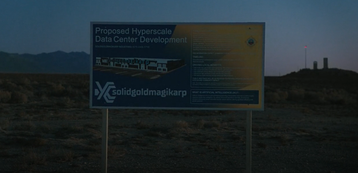
Here is a flavor of this pessimism, as delivered in a speech during the data center inauguration ceremony at the film's end:
"But today is about a major step forward in the tech industry here in New Mexico... We are now, both and together, one of the privileged places where the future is being built. And at this moment... We are now home to an advanced supercomputing infrastructure powering the future of a technology that will indeed change everything and solve problems we've never been able to solve, and all the while using the least amount of energy and water as any data complex in the southwest!
"And that's because of what we're doing in solar. And what the Pueblo's doing too! They got their new wind farm building up, taking part in New Mexico's $370 billion investment in renewable energy."
Visions of America
So how do two films, unalike in their attitudes, converge on a uniformly negative view of data centers?
Perhaps it is because these are both American films delimited by American perspectives. War of the Worlds makes explicit reference to the American government, and Eddington takes place in that most quintessentially American of settings – the small town on the frontier – and adopts the most American of film genres – the Western.
But data centers are everywhere now, and America’s experience is not the world’s. Both films are inextricably tied to and informed by the broader history of the US’s past two decades, and filmgoers should expect an altogether different portrayal of data centers coming from China, India, or Malaysia, all of which are non-Western states with growing data center markets but markedly different modern histories and attitudes to tech.
I submit that the question of whether these negative portrayals of data centers are attributable to the data center industry – or the broader socio-economic and political climate of America – must be answered with the inauguration of a new data center multiverse.





Comments