

By 2035, Deloitte estimates that power demand from artificial intelligence (AI) data centers in the United States could grow more than thirtyfold. The digital economy, fueled by cloud computing and AI, has created a sense of urgency among hyperscalers and colocation providers competing to seize market share. The result? A race to build data centers at a pace typically unheard of in construction.
Most of us see data centers seemingly appear overnight, but few understand the coordination, expertise, and technology required to achieve such rapid deployment.
Balancing speed, scale, and scarcity
Hyperscalers, AI firms, cloud providers, and data center operators are pushing for data centers to be operational in 12 to 14 months, nearly double the pace of a typical construction project.
To keep pace with demand, Meta is housing servers in massive temporary tents while permanent data centers are under construction. These structures enable the company to deploy racks of servers and start training AI models months before traditional brick-and-mortar campuses are ready. Outfitted with power, cooling systems, and networking infrastructure, the tents are engineered to handle high-density workloads in the short term. Meta’s strategy underscores the urgency of scaling and the constraints developers face in new data center construction and expansion.
Not only are timelines accelerated, but their complexity is underscored by the construction industry’s shortage of skilled labor. While the details may vary, the perspective of most construction teams follows the same plot; “we have (insert hyperscaler/provider) that is building a new data center complex outside of (insert a town you've never heard of) in the middle of (insert remote state/province) and we need to start in one week with 150 people, scale up to 500 people in 60 days, and peak at 1,500 plus craft workers in the next six months.”
The coordination required to quickly assemble subcontractors, material, equipment, and labor, all with varying skill sets and experience, in remote locations in a matter of days or weeks, to then mobilize hundreds of craft workers at a time, is nothing short of herculean.

No room for interpretation or errors
On the construction site, the pace is relentless. Delivering projects on time means that work never stops or stalls. Losing even a few days of production can equate to millions in lost revenue opportunities.
There is no time to pause for lengthy debates about how work should be done. Crews working in the field have to trust that every design is constructible and that each task is executed exactly as planned. To keep the project on track, any changes that arise during construction have to be captured immediately and communicated broadly to all stakeholders.
Any misstep in one area can cause a cascading delay across the entire project. At the same time, productivity challenges and delays due to missing or incorrect data, project mistakes, and field conflicts can derail projects quickly.
Overcoming these challenges requires breaking down silos to improve communication and transparency, leading many contractors to work in a cloud-based common data environment (CDE) that unifies 3D models, drawings, layout information, and scan data into a single source of truth. Within it, everyone has real-time access to the most current information for informed decision making, tighter collaboration, and fewer errors in the field.
Most data center projects have dozens of layout engineers, not to mention hundreds or thousands of craft workers. A CDE is the conduit between them, removing the need for manual communication methods and enabling them to work quickly with confidence.
Connecting technology, people, and processes enables real-time progress tracking, giving every stakeholder a clear understanding of a project's current status. Issues are resolved faster because challenges are identified and resolved in real-time and before they escalate. Teams make decisions, from daily operations to strategic planning, based on timely, accurate data. Resources are optimized to avoid idle time and increase productivity across the board. And, jobsites run more smoothly because everyone involved has a comprehensive understanding of the work to be done at any given moment.
Digital tools driving data center delivery
It isn’t just CDEs that are vital to delivering data centers efficiently; a wide range of technologies, such as robotic layout, 3D scanning, and augmented reality, all play a role in delivering these complex projects quickly.
Building Information Modeling (BIM): BIM is the digital backbone of complex data center projects. Data-rich 3D models bring together architectural, structural, and mechanical systems for coordination and detailing. Design changes are immediately propagated across 3D models and accessible to all team members, which prevents outdated information from leading to errors that delay work. The metadata within the model is used both upstream and downstream throughout the project and after project completion, for operations and maintenance.
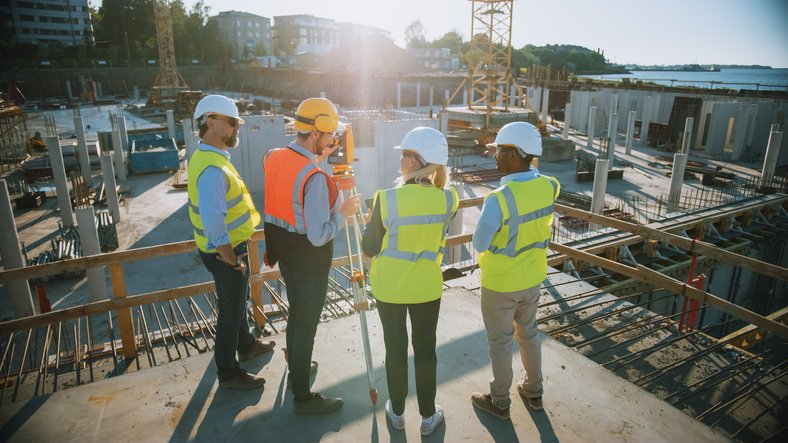
Field technology: Robotic total stations and GPS-enabled survey equipment, driven by design data from the model, ensure precise and efficient layout of foundations, walls, utilities, and more. Field teams can access design files directly from their devices, which ensures everyone is working from updated and accurate information. 3D laser scanners then capture highly accurate point cloud data as the work is put into place. Point clouds are compared to 3D models to verify accuracy, detect deviations, and track progress.
Information gathered in the field via connected equipment is then sent to the office, where 3D models are updated based on as-built information, which is continuously made available to the multitude of teams installing the work.
Project management software: Project managers have access, both in the office and in the field, to the information they need to track progress against the master schedule, identify potential delays, make proactive adjustments, and resolve issues fast. With real-time financial visibility, project managers monitor budgets, track expenses, and manage change orders. Project documents, drawings, Requests for Information (RFIs), and submittals are centralized and accessible, which ensures everyone is working from the latest versions.
Field data captured from daily logs, machine telematics, and progress photos gives project managers a holistic view of jobsite performance, so they can make data-driven decisions that keep the project on track and within budget.
Teams in the field can simply open their tablet and, in seconds, visualize and validate if work is correct and on track, down to every embed plate, piece of rebar, conduit, pipe, and cable tray.
A blueprint for speed and accuracy
The race to build data centers is not just about working faster; it's about working smarter. Compressed timelines, complex systems, and high stakes require a coordinated technology-enabled approach. By improving collaboration, accuracy, and predictability, technology is helping the industry meet growing demand without sacrificing quality or performance.
The forces behind faster data center builds are people and technologies that enable coordinated digital workflows, teams, and data. Although the industry isn’t often seen as leading in technology adoption, the intense speed and complexity of data center projects paint a clear picture of how construction businesses are advancing through technology.

Comments