

The next phase of data center evolution will not be defined only by compute scale, but by how effectively infrastructure can absorb and manage increasingly volatile power demand. As AI workloads scale across training and inference environments, power systems are being pushed into a fundamentally different operating regime.
What is emerging is not simply higher energy consumption, but a shift in the nature of load behavior itself. AI-driven infrastructure introduces rapid fluctuations driven by high-density GPU clusters, dynamic workload scheduling, and frequent scaling events. In some cases, rack densities exceeding 100kW are becoming more common, with millisecond-level power spikes during training cycles.
These characteristics differ significantly from traditional data center load profiles, which were largely stable and predictable. These characteristics differ significantly from traditional data center load profiles, which were largely stable and predictable.

Energy as a structural constraint in AI infrastructure
Energy is no longer a supporting layer in data center design – it has become a primary structural constraint. To compensate for peak demand uncertainty, infrastructure oversizing is increasingly adopted, while grid connections face growing instability challenges.
At the same time, onsite generation systems, including gas-powered backup assets, are subject to greater operational stress due to more frequent and irregular power transitions.
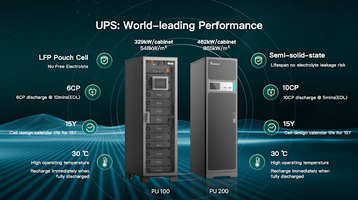
In response, lithium-based system architectures – including those developed by Ampace – are being designed to operate across multiple layers of the power stack, from cell-level storage to UPS-integrated applications. This enables more coordinated management of peak demand, load variability, and backup requirements, while reducing reliance on excessive overprovisioning.
From backup systems to dynamic stabilizers
This shift is driving a fundamental rethinking of the role of power subsystems within the data center. Traditionally, uninterruptible power supply (UPS) systems and battery energy storage systems (BESS) have been positioned as backup resources, activated only during grid interruption events. Under AI workload conditions, this static model is becoming less effective.
Instead, UPS and BESS are increasingly functioning as dynamic smoothing layers within the power architecture. Integrated into operational energy flows, they help stabilize rapid load fluctuations, mitigate peak demand stress, and support more efficient infrastructure utilization.
In practice, this evolution is enabled by lithium battery systems capable of high-frequency cycling and fast charge-discharge response. These systems can actively participate in real-time load balancing, supporting more adaptive and responsive power architectures in AI-driven environments.
New requirements for AI-ready battery systems
This transition introduces a new set of technical requirements for battery systems in AI data center environments. Beyond traditional metrics such as energy density or backup duration, systems must support high-frequency charge and discharge cycles aligned with AI workload behavior, while maintaining stability under continuous partial cycling conditions.
Safety and lifecycle performance are therefore becoming central design considerations. In high-density environments with more dynamic thermal and electrical stress, intrinsic system safety is increasingly prioritized. Standards such as UL9540A are being used to evaluate performance at the cabinet and system level, reflecting the growing complexity of integrated power systems.
At the same time, lifecycle expectations are extending. Under workload-relevant cycling conditions, Ampace lithium battery architectures have demonstrated operational lifespans of up to 15 years, reducing performance degradation and replacement frequency. This contributes to lower operational disruption and improved total cost of ownership in large-scale deployments.
Evolving lithium architectures for AI workloads
Battery technologies are also evolving to better match workload-specific requirements. Semi-solid or low-electrolyte designs are being explored to improve intrinsic safety by reducing leakage risk and limiting thermal runaway propagation.
In parallel, advancements in battery management systems are enabling higher-resolution monitoring and more adaptive state-of-charge estimation. These capabilities allow systems to respond more precisely to rapid and irregular load patterns, supporting greater stability under AI training and inference conditions.
Lifecycle sustainability as a system design principle
Beyond performance and safety, lifecycle sustainability is also becoming an integral part of system design. In AI infrastructure environments, sustainability is increasingly defined not only by operational energy efficiency, but also by equipment longevity and replacement frequency.
Full-lifecycle design approaches in advanced lithium systems have demonstrated extended operational durability under AI workload conditions, reducing the need for frequent replacement cycles. This improves system reliability while lowering overall environmental impact across the infrastructure lifecycle – an important consideration for large-scale deployments.
This transition is also reflected at the manufacturing level, with increasing adoption of low-carbon production and energy-efficient practices across the battery supply chain.
Toward a more dynamic power architecture
As AI data center infrastructure scales, the challenge is no longer just delivering sufficient power, but ensuring systems can respond to increasingly dynamic and unpredictable workloads. This is accelerating a transition toward architectures that prioritize responsiveness, efficiency, and deployment flexibility.
In this context, batteries are evolving from backup assets into active components of a broader energy ecosystem. By supporting real-time load balancing and reducing infrastructure stress, they are becoming a foundational layer in enabling stable and scalable AI data center operations.
Solutions developed by Ampace reflect how this transition is taking shape in practice, with battery systems operating across layers from cell-level technologies to UPS-integrated applications. As this model continues to mature, batteries will play an increasingly central role in supporting resilient and efficient AI infrastructure.
For operators rethinking how to stabilize AI power demand, follow Ampace as we continue sharing further perspectives, technologies, and practical solutions shaping the future of AI data center power.
June 6, 2026, 11:26 a.m. - Dr. Tesfaye Abebe Workagegnehu
It should be backed up by Atomic Battery long staying with out being charged high energy density Dr Tesfaye Abebe Workagegnehu