

As data centers continue to scale in size, density and complexity, cooling system performance has become a defining factor in overall facility resiliency, speed and reliability. From enterprise environments retrofitting legacy infrastructure to hyperscale campuses deploying advanced liquid cooling architectures, operators are under growing pressure to measure, manage and optimize cooling water flows with greater precision.
Accurate flow measurement plays a critical role in maintaining thermal stability, supporting energy efficiency initiatives and enabling future expansion. However, traditional flow instrumentation approaches are increasingly challenged with the physical and operational realities of modern data center design.
Cooling system diversity creates measurement challenges
Data center cooling architectures vary widely depending on facility size, cooling strategy and stage of maturity. Smaller enterprise facilities may rely on compact secondary loops with limited mechanical room space, while hyperscale and campus-style data centers often operate large primary cooling loops, central utility plants and extensive distribution networks.
This diversity creates a fundamental challenge for standardizing flow measurement. Pipe diameters, flow rates and installation layouts can change significantly across applications – and even within the same facility as capacity is expanded over time. In many cases, traditional flowmeters introduce constraints that complicate system design, including requirements for long upstream and downstream straight pipe runs or pressure losses that reduce overall cooling efficiency.
As mechanical spaces become more crowded and cooling infrastructure more modular, these limitations can restrict equipment placement, increase engineering complexity and consume valuable footprint that could otherwise be used for IT or support systems.
Space constraints and installation flexibility
Modern data centers are increasingly designed with compact mechanical layouts to maximize usable space and reduce construction costs. This trend places added emphasis on instrumentation that can be installed flexibly without compromising measurement accuracy.
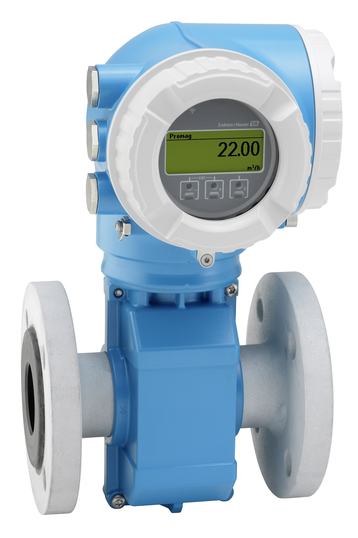
Flow measurement solutions that depend on ideal piping conditions are often difficult to accommodate in real-world installations, where elbows, valves and reducers are unavoidable. The ability to install flowmeters like Endress+Hauser’s Proline Promag W 300 0xDN (Figure 1) option directly in-line – without strict straight-run requirements – simplifies system design and allows operators to adapt instrumentation placement as cooling systems evolve.
For large-scale facilities, this flexibility also reduces the need to finalize exact flowmeter locations early in the design phase, supporting more agile engineering and procurement processes.
Security considerations in instrumentation selection
Beyond physical constraints, cybersecurity requirements are playing a growing role in instrumentation decisions. Many data centers operate under strict security policies that limit or prohibit the use of devices with active wireless communication capabilities.
While wireless connectivity can offer convenience during commissioning or diagnostics, it may be unsuitable for environments where minimizing potential access points is a priority. In these cases, operators require flow measurement solutions that deliver full functionality through hardwired interfaces, with any wireless features fully disabled.
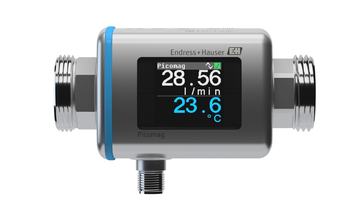
Instrumentation designed with factory-deactivated wireless options, such as Endress+Hauser’s Picomag variant in the US (Figure 2), allows data center operators to maintain compliance with internal security standards while still achieving accurate, reliable measurement and system visibility.
Supporting cooling performance at scale
Electromagnetic flow measurement technology has become a common choice for liquid cooling applications due to its ability to deliver accurate, bidirectional flow measurement without introducing pressure loss. Because the measurement principle is largely independent of pressure, temperature, density and viscosity, it performs consistently across a wide range of operating conditions.
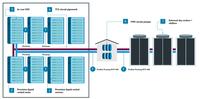
For smaller data centers and secondary cooling loops, compact electromagnetic flowmeters enable reliable measurement in tight mechanical spaces (Figure 3), supporting scalable architectures and efficient system operation. In larger environments, flowmeters capable of handling large nominal diameters and high flow rates are essential for monitoring primary cooling loops, utility water distribution and central plant infrastructure.
The ability to size flowmeters directly to the pipe diameter – without compensating for installation constraints – simplifies specification and supports long-term system adaptability as facilities expand.
Reliability, diagnostics and operational confidence
As cooling systems grow more complex, maintaining long-term measurement stability becomes increasingly important. Robust sensor construction, corrosion-resistant materials, and high ingress protection ratings help ensure reliable operation in demanding mechanical environments.
Integrated diagnostics and verification capabilities further support uptime by allowing operators to confirm measurement performance without interrupting operations. Digital connectivity and embedded web interfaces provide additional visibility into system behavior, enabling proactive maintenance and data-driven optimization strategies.
Together, these capabilities help data center operators maintain cooling efficiency, reduce operational risk and support sustainability goals across the lifecycle of the facility.


Enabling future-ready cooling infrastructure
Flow measurement may represent a small component of the overall data center ecosystem, but its impact on cooling performance, energy efficiency and operational insight is significant. As data centers continue to adopt advanced cooling technologies and scale to meet growing demand, instrumentation must evolve alongside them.
Measurement technologies that combine installation flexibility, measurement accuracy, security-conscious design and long-term reliability are well positioned to support both today’s cooling challenges and tomorrow’s expansion requirements. By aligning flow measurement technology with modern data center realities, operators can build cooling systems that are not only efficient and resilient, but also ready for the next generation of digital infrastructure.
Comments