

AI-driven workloads are pushing rack densities into a new category of infrastructure design. What was once considered high density is rapidly becoming standard, with AI deployments now typically starting at around 80kW per rack and scaling towards 100-200kW in leading environments.
This shift is not only increasing power demand but also redefining the speed at which capacity must be deployed and how effectively power and cooling systems must integrate to support these loads.
These changes are forcing a rethink of traditional infrastructure design. Technologies originally designed for relatively stable environments are now being reevaluated based on how well they support scalability, deployment speed, and long-term flexibility.
One area receiving increasing attention is power distribution within the white space. The choice between Remote Power Panels (RPPs) and busway systems can influence how easily a facility can respond to changing capacity requirements over time.

Both approaches are well established, but their suitability varies depending on operational priorities and growth expectations.
Understanding the two approaches
Remote Power Panels distribute power from upstream switchgear to server cabinets via branch circuits. Typically located on the data hall floor, RPPs connect to racks using flexible cabling routed beneath raised floors or via overhead containment systems. This architecture has been widely adopted, primarily in environments where rack layouts and densities remain relatively predictable.
Busway systems distribute power via overhead track systems with enclosed copper or aluminum busbars, enabling power delivery via tap-off units positioned at multiple points along the track. Because connection points are not fixed and can be relocated, power can be provisioned where required without needing significant electrical modification. This can provide greater flexibility where rack layouts evolve over time.
Flexibility for changing rack densities
Forecasting long-term rack power requirements is becoming more complex as AI workloads continue to evolve. Hardware refresh cycles are shortening, and density requirements can change significantly between deployments.
Expanding an RPP-based system typically involves installing additional cabling and circuit protection, often requiring careful planning in live environments and potentially causing operational disruption. In larger facilities, this can increase both installation time and project complexity.
Busway systems allow tap-off units to be added or repositioned along the track without major infrastructure changes. This can make it easier to adapt layouts as requirements evolve and support incremental expansion without extensive reconfiguration. In colocation and fast-scaling AI environments, where customer requirements can shift rapidly, this flexibility can reduce the need to lock in excess capacity too early and support a more phased, demand-led build strategy.
Installation speed and project timelines
Speed of deployment has become a key consideration as operators work to deliver capacity more quickly.
RPP installations can require extensive underfloor cabling and coordination among electrical, mechanical, and raised floor contractors. As rack densities increase, cable routing and management can become more complex.
Busway systems reduce reliance on large volumes of branch circuit cabling. Modular sections can typically be installed in sequence, allowing power distribution infrastructure to be deployed alongside other building services. Because connection points can be added where and as needed, layouts can often be finalized later in the project schedule, enabling more flexible deployment strategies.
Monitoring power usage at the circuit level
Detailed visibility of power usage is becoming increasingly important as operators look to optimize utilization and support customer reporting requirements.
In many RPP environments, monitoring is delivered across multiple devices, which can increase integration complexity.
Busway systems can integrate monitoring directly within tap-off units or end feeds. The latest critical power monitoring technology provides revenue-grade energy data and real-time visibility into electrical parameters, including current, voltage, power consumption, and insight into circuit utilization, load levels, and temperature conditions at a highly granular level.
Monitoring embedded within the distribution layer can help operators improve load balancing, identify unused capacity, and support more informed planning of future expansion.
Operational risk, maintenance, and arc flash considerations
As rack power densities increase, electrical safety and operational risk are becoming more prominent design considerations.
RPP environments rely on branch circuit cabling between floor-mounted distribution panels and server racks. This introduces multiple connection points that must be installed and maintained correctly throughout the facility’s lifecycle. Any modifications to the distribution infrastructure typically call for careful planning to maintain service continuity.
Busway systems simplify distribution pathways through overhead track systems with integrated conductors, reducing the need for extensive additional cabling across the white space. Connection points are typically visible and accessible, helping streamline installation and reduce the likelihood of errors when modifying layouts.
Industry-leading busway solutions also support circuit additions without major disruption to existing infrastructure. Solutions such as remote plug-in actuators enable tap-off units to be engaged or disengaged from outside the arc-flash boundary, reducing the need for direct interaction with energized components and adding an extra layer of protection during reconfiguration tasks.
As infrastructure becomes more dynamic, making changes to live electrical systems simpler and safer is becoming increasingly important.
White space utilization and airflow management
Floor space remains a valuable commodity, particularly in colocation environments where revenue is closely linked to usable rack capacity.
RPPs occupy space that could otherwise be used to support IT equipment. As densities increase, optimizing available white space becomes more important.
Overhead power distribution can free up floor area and provide greater flexibility in rack placement. Reducing underfloor cable congestion may also support more even airflow distribution, helping cooling systems operate more efficiently.
Total cost of ownership considerations
While upfront cost remains an important consideration, total cost of ownership is increasingly shaped by how efficiently infrastructure can adapt to evolving density and deployment requirements.
In higher-density environments, operators must account not only for equipment and installation costs, but also for the impact of future reconfiguration, deployment delays, and operational disruption.
Expanding RPP-based architectures can require additional cabling, electrical labor, and planned maintenance windows. Over time, incremental changes can increase operational costs and complexity.

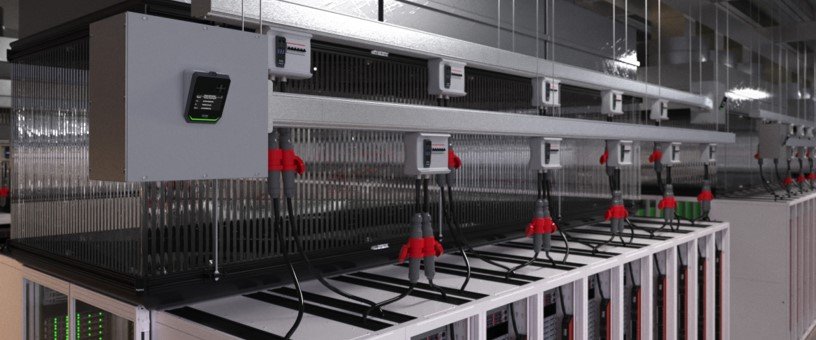

Overhead busway systems can enable a more flexible white-space design by reducing reliance on underfloor cabling, which may help improve airflow management and cooling effectiveness, depending on facility design.
In parallel, modular expansion capabilities allow capacity to be deployed incrementally, reducing the need for upfront overprovisioning and enabling a more demand-driven investment approach.
As AI-driven projects accelerate, the ability to bring capacity online quickly – while minimizing rework and coordination across trades – can directly impact time-to-revenue, making deployability and execution speed critical components of long-term cost efficiency.
Digital configuration tools, such as dedicated busway power monitoring and meter configuration platforms, can further streamline design and commissioning by reducing engineering effort, minimizing configuration errors, and accelerating standardized deployment across multiple sites.
Planning for long-term adaptability
AI and high-density compute are continuing to influence data center design across both power and cooling infrastructure. As requirements evolve, infrastructure must be able to adapt to rapidly changing rack densities and layouts.
Both RPP and busway solutions are widely deployed, but operators are increasingly prioritizing power distribution solutions that simplify deployment, reduce installation complexity, costs, and labor, while maintaining flexibility, efficiency, and long-term scalability.
Designing infrastructure that can adapt over time can help ensure facilities remain capable of supporting future technology requirements.
To learn more about the benefits of track busway, visit the Legrand website.
More from Legrand
-

Sponsored The necessity, practicality, and scalability of two-phase liquid cooling
As chip TDPs and heat flux rise beyond known limits, the viability of conventional cooling is uncertain, positioning two-phase as a stable foundation for ultra-high-density computing
-

Sponsored Top ten reasons to consider rear door heat exchangers when refurbishing data centers
For operators looking to modernize without a fundamental redesign, rear door heat exchangers are emerging as a practical, technically robust solution
-

Sponsored The future of rack power for high-density environments
Is Open Compute the key to unlocking the potential of DC architectures?
Comments