

Capital is flowing into digital infrastructure at an unprecedented pace – driving a new era of risk that stakeholders must manage across the data center lifecycle.
Propelled by the increasing power density needs of artificial intelligence (AI), campuses and portfolios now routinely reach $10-50 billion in total replacement value, sometimes concentrated at a single site. The race to finance and build these mega‑projects is rewriting the rules of risk transfer: Total insured values often exhaust the capacity of any single insurer – and in some cases, stretch the limits of the traditional insurance market altogether.
As project values rise, stakeholders increasingly require more than traditional insurance. Instead, they need a connected risk strategy that begins before land is acquired, continues through design and construction, and supports reliable long‑term operations. With the right alignment from the outset, projects become more insurable, bankable and resilient – even in the face of extreme weather, grid constraints, supply chain shocks and sometimes complicated phased handovers.
“With most data centers yet to be built, stakeholders have a unique opportunity to set the right foundation from the start – because if essential elements aren’t addressed early, they cannot truly be fixed later,” says Jon Chapman, Aon’s head of construction & infrastructure industry specialty, Europe, the Middle East and Africa.
Below, we explore three critical phases where stakeholders can leverage risk management to unlock capital, protect schedules and support long-term operational continuity:
7 Constraints in the Data Center Surge
01) Power Dependency: Mega-scale data centers consume massive amounts of power due to the rising demands of AI computing hardware. This also affects the local power supply, so many operators are opting to be self‑powered rather than rely on the grid.
02) Speed to Market: Developers must secure permits, power, critical equipment, capital and adequate insurance within compressed timelines.
03) Supply Chain Pressures: Global manufacturing capacity for generators, switchgear, transformers and even copper wire is now a major constraint. Competition for these components across power infrastructure markets is driving longer lead times and greater delivery risk for data center construction.
04) Concentrated Value: Capital deployment for aggregated assets (e.g., owner infrastructure, tenant equipment, digital operations and power sources) requires creative risk structures that reflect how these assets interact and concentrate.
05) Lender and Investor Demands: Completed operation full values often exceed the maximum foreseeable loss (MFL), and lenders can require coverage up to the full value prior to the Final Investment Decision. This creates friction in financing and requires more sophisticated risk modeling.
06) Sustainability and Regulatory Pressures: Sustainability targets and regional regulations can add material cost and extend timelines. Access to alternative energy sources, ability to cool facilities in an energy-efficient manner and complex permitting regimes are now central considerations in site selection.
07) Phasing Complexity: Large campuses require concurrent construction and operations. Insurers must provide limits that cover both phases at once, raising total limit requirements and creating potential gaps if not structured carefully.
Pre‑construction phase: Design for insurability and bankability at site selection
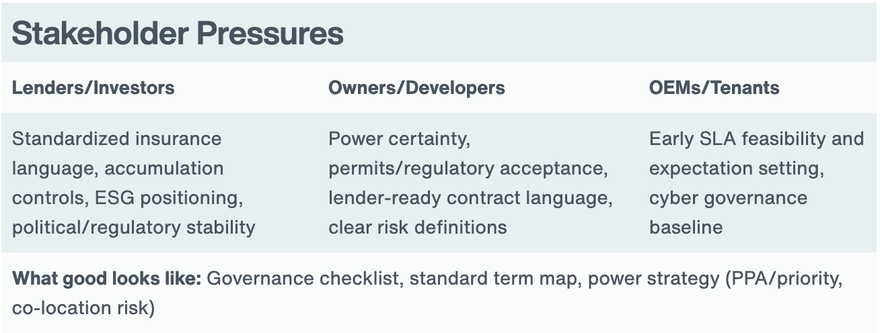
Key pain points: Before breaking ground, stakeholders must secure enough project capital and a site with access to critical resources – processes that demand robust risk management. Insurer‑aligned design choices – non‑combustible assemblies, building separation, robust compartmentation, code‑plus suppression, deconcentrated electrical systems and avoiding water above white space – reduce MFL and improve capacity.
Insuring the uninsurable
Private capital markets, traditional banks and the asset-backed securities market continue to show strong appetite for data center financing – but insurance is now a structural gating issue. Loan documentation often requires insurance limits equal to the full replacement cost or total insured value of collateral. “The global reinsurance and insurance markets cannot deliver limits anywhere near these values for mega-campus developments,” explains Ryan Barber, Aon’s global head of property, commercial risk solutions. “This creates structural tension that increasingly threatens deal execution.”
Service-level agreement (SLA) breaches present another barrier for financiers: Outages can trigger substantial financial penalties even when no physical damage occurs. Bespoke insurance solutions, including parametric SLA penalty cover, can offer limits that align with lender risk appetite and project size, protecting the physical assets underpinning a loan. Stable cash flow also ensures operational continuity, protecting revenue streams and loan repayments.
The MFL-based insurance framework is another solution increasingly accepted by private credit and sophisticated banks. Industry-recognized engineers that specialize in data centers model realistic loss scenarios by fire compartment, power segment and building cluster. Tying insurance limits to the MFL – rather than full project value – aligns protection with actual exposure. Progressive transactions pair MFL‑anchored studies with insurance‑aware loan language (e.g., “commercially available” capacity tests), reducing waiver cycles without compromising credit discipline.
Success begins from strategic site selection
Site selection sets the trajectory for the entire data center project, shaping access to power, infrastructure, labor, and permitting and regulatory pathways. Getting the location right early dramatically improves project viability – and determines long-term risk exposure.
Site due diligence can involve:
- Natural catastrophe and climate hazards: Stakeholders must model the future impacts of both acute (e.g., earthquakes, tropical cyclones) and chronic (e.g., extreme heat, drought) risks.
- Power availability: Delays in securing sufficient power can impact project timelines, financing and insurability.
- Access to renewable energy: Some developers now co-locate data centers with renewable energy sources like solar, which brings additional due diligence requirements for location assessment.
- Water availability: New data centers put strain on the existing water infrastructure by shifting toward liquid cooling.
- Land acquisition: Clarifying title insurance, mergers and acquisitions exposure and warranty risks helps mitigate legal and financial fallout.
- Regulations: Local reforms can influence market access and project feasibility. For example, Singapore’s pause on issuing new data center licenses to manage growth and resource consumption has shifted development to neighboring countries, such as Malaysia and Indonesia.
Construction phase: Protect the schedule and your hyperscaler commitments
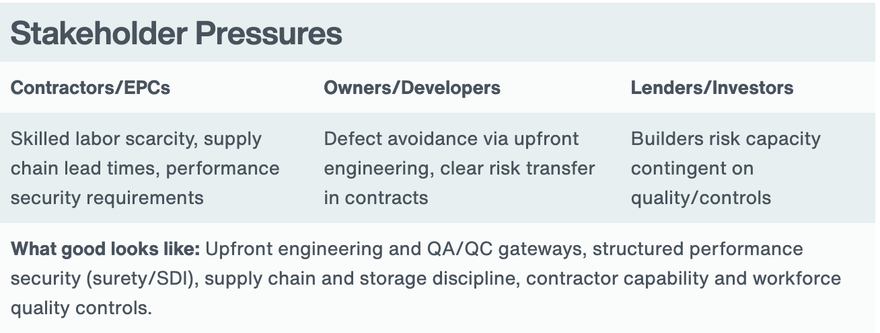
Key pain points: As data center projects multiply, so does competition for materials and people during construction. Missed milestones when critical equipment and skilled labor are unavailable can lead to contractual breaches and financial penalties.
The supply chain squeeze
A multi‑layered supply chain feeds into data center construction – from hard‑to‑secure raw materials to the warehousing, testing and logistics networks keeping projects on track. This complexity increases the probability of disruption. “Critical equipment is customized for each location due to differences in electrical networks and grid characteristics,” says Wee Teck Tea, head of commercial risk solutions, Aon Singapore. “Replacing these components is not straightforward; obtaining a new transformer can take 9-12 months.”
Material challenges don’t end on arrival. Once in the contractor’s possession, owner-furnished equipment can face warranty risks if improperly stored or exposed to moisture before installation.
Tailored insurance and reinsurance solutions play a crucial role in managing project delays and equipment handling, allowing stakeholders to pursue growth with greater confidence and resilience.
Workforce: Competing for capability
There is an urgent need for talent with deep expertise in data center construction. Demand for qualified electrical, plumbing and specialty subcontractors continues to outpace supply as the industry booms – an issue that persists after construction.
Competition for experienced personnel in ongoing data center operations and maintenance has led to acute talent shortages in roles like on-site technicians and managing agents. Replacing staff quickly can be challenged with high penalties imposed for unfilled positions. This creates upward pressure on wages and staff turnover, and fierce competition for skilled workers.
Data center stakeholders must carefully manage workforce needs for each phase of the lifecycle and stay competitive to recruit new talent.
Construction-to-operation phase: Turn uptime risk into balance sheet strategy
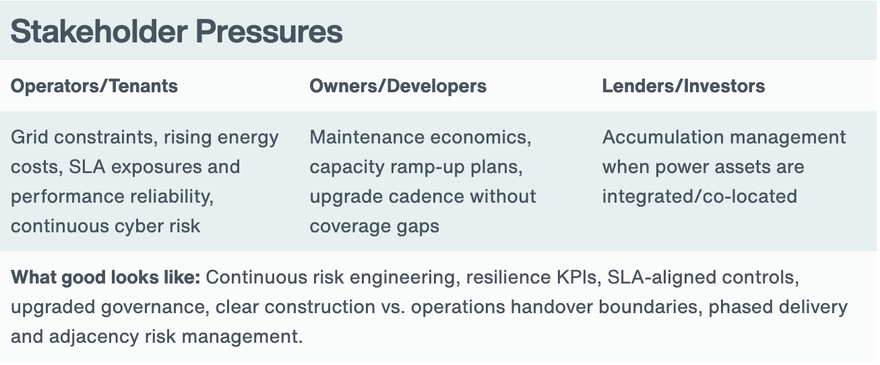


Key pain points: The construction‑to‑operation phase is fraught with unique challenges that require thoughtful planning and execution. Strategic risk management can give operators, investors and insurers confidence that a facility will operate reliably and as promised.
Securing the right construction-to-operation insurance
The availability and practicality of data center insurance shifts in the transition to operations. Risk profiles stabilize once a campus is fully operational, but during construction, capacity is at its most constrained. Asset values escalate quickly, while fire protection, redundancy and other safeguards are still being phased in.
“Lenders could require full-value insurance during the transition to operations,” says Barber. “When those expectations collide with capacity constraints, projects face delays, repeated waiver cycles and unnecessary friction that has little to do with the actual risk on-site.”
Many lending frameworks and rating agency interpretations remain tied to traditional insurance expectations – a tension that’s strained further by the growing prevalence of non‑physical loss exposures. Business interruption and revenue continuity are top lender concerns, yet insurers frequently limit or exclude coverage for cyber‑triggered outages, grid instability and latency‑driven disruption.
Alternative solutions like parametric insurance and captives can fill the gaps left by standard indemnity, while creative approaches – like MFL‑based limits and zoned insurance structures – can better reflect how large, compartmentalized data centers could realistically fail. Where non‑physical triggers (e.g., cyber, grid instability, latency) span towers, coordinate property, cyber and parametric layers to avoid gaps at handover.
Managing adjacency risks
Construction occurring next to operational data halls governed by strict SLAs heightens liability, risking equipment damage, operational disruption and costly downtime. “Program ambiguity around whether construction-related incidents affecting live loads are project losses or operational outages can expose stakeholders to contractual penalties,” explains Caroline St. Clair, Aon’s data center practice leader, North America.
Insurance programs and the underlying contracts must be carefully structured to address the transition period, accounting for potential impacts like equipment damage, business interruption or delays in bringing new capacity online – and clarifying who bears responsibility.
Adjacency risks also arise during simultaneous construction of a data center’s core and shell, and its on‑site power generation facilities. Some programs can push the core and shell into traditional contractors all risks insurance/builders risk markets, and the generation assets into energy construction markets. “But without unified coverage, a single major loss affecting both sides can trigger multiple carriers, conflicting policies and inevitable finger‑pointing,” says Brian Hearst, managing director of data centers and life sciences builders risk leader for Aon in North America. Solutions like Aon's Data Center Lifecycle Program can insure both projects under a single form with one lead carrier.
Equip your projects for success in the data center boom
Organizations must pair strong risk management with creative operational strategies to secure sufficient insurance capacity in the fast-moving data center space. Aon’s industry-leading experience in both traditional and alternative risk transfer markets allows teams to deliver solutions that match your needs. The key? Engage risk advisors early in the data center lifecycle.
A proactive approach enables more strategic decision-making, reduces the likelihood of delays or operational failures, and ensures that data center projects are set up for long-term success. Find out how we can help on your data center build.
More from Aon
-

Sponsored The AI data center boom: Strategies for sustainable growth and risk management
Engaging risk advisory partners early on is crucial to managing complex risks through each phase of the data center project life cycle
-

Sponsored Aon unveils full-life cycle insurance facility to help clients manage risk, and deliver cloud and AI infrastructure faster
The firm’s Global Data Center Lifecycle Program provides seamless coverage from construction through operational readiness under a single integrated facility
-

Sponsored Mitigating construction risk for data center developments
Aon’s Construction and Infrastructure and Technology and Communications practices deliver market-leading solutions and risk management expertise
Comments