
ViaSat is getting ready to launch operations of the last of its F3 geostationary satellites.
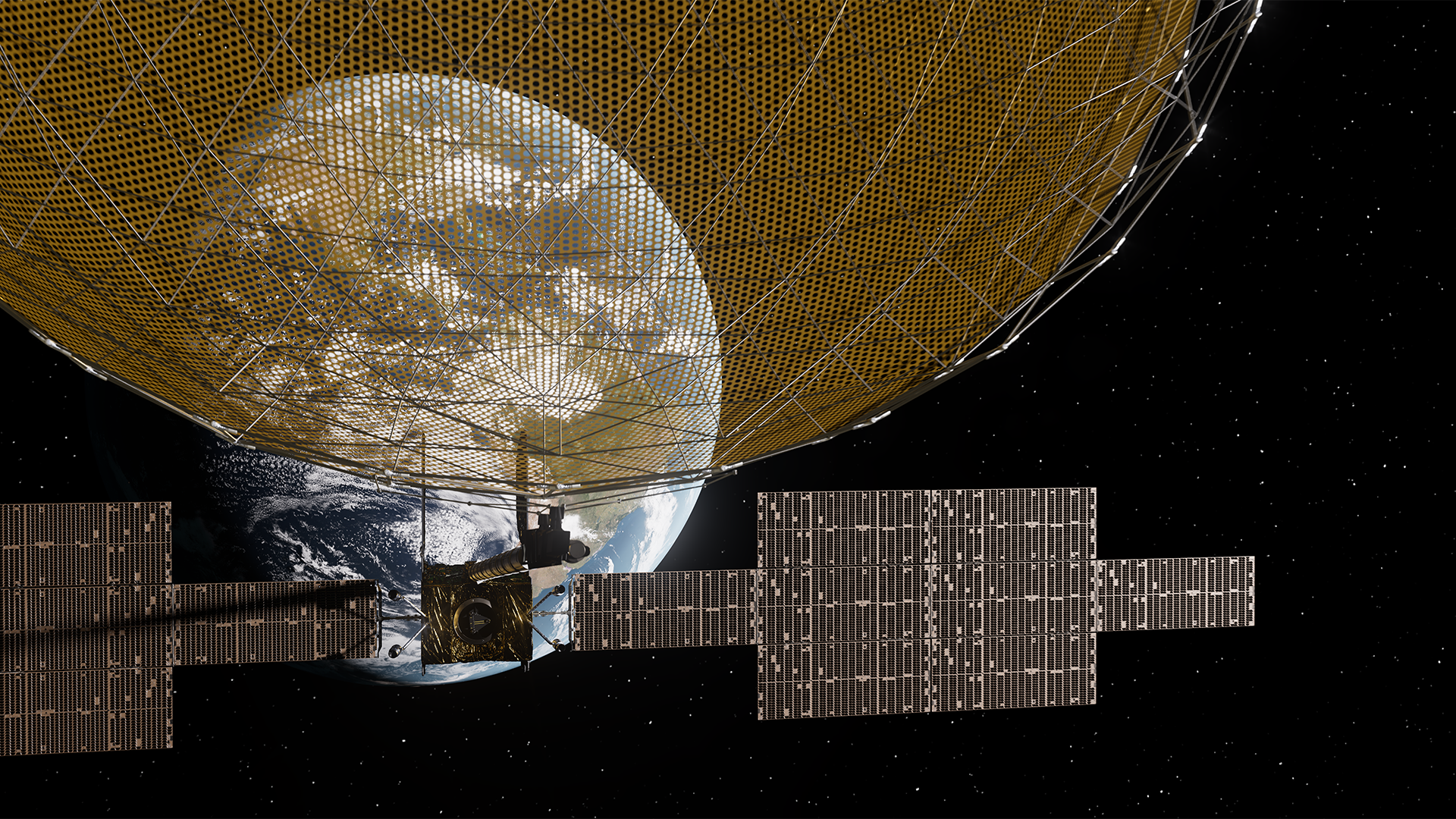
The April 29 launch of Viasat’s third and final satellite (VS-3 F3) in its set of three ViaSat-3 geostationary (GEO) satellites has been successful, after the 6,400-kilogram satellite reached its 35,786 km altitude and deployed its reflector and boom.
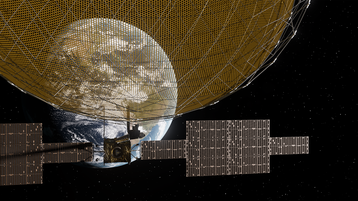
In-orbit testing has now begun, but the nail-biting moments of truth have already passed for the F3 satellite, having cleared the stages during and post-launch when most failures occur.
“ViaSat-3 F3 will provide greater resilience for government and commercial mobility users, leveraging powerful beamforming capabilities to quickly deliver bandwidth in and around commercial, enterprise, geopolitical and other hot spots,” said Mark Dankberg, chairman and CEO of Viasat, in an April statement, when the satellite set off for geostationary space. “As we look forward, our ViaSat-3 satellites will significantly scale our overall network’s performance, strengthening our ability to deliver the capacity for key growth initiatives globally.”
The ViaSat-3 constellation is composed of just three massive Ka-band GEO satellites designed to flexibly handle demand across whole continents for their long lifespans. The third and final satellite adds more than 1Tbps of capacity to Viasat’s network.
The third flight satellite that has now successfully deployed uses an antenna from L3Harris, a different design to that used in the first two satellites, F1 and F2, the former of which ended up being one of the most noteworthy failures in recent space history.
After a successful and uneventful launch, ViaSat-3 F1’s antenna failed to deploy, rendering the functional satellite's transmission capabilities severely crippled, leading to the activation of a $420 million insurance claim. Combined with another failure in its I6-F2 satellite through its Inmarsat subsidiary, Viasat-Inmarsat introduced a $768 million insurance bill in 2023, with major impacts on the global space insurance market.
The F1 remains in operation today, functioning at 10 percent of its intended capacity, complemented by a repositioned F2 satellite, which was originally intended to cover Europe, the Middle East, and Africa, instead pivoting to cover the Americas to make up for F1’s issues.
The downstream results of the anomaly led to Viasat scrapping plans for ViaSat-4, signaling a shift for the company away from massive, expensive geostationary satellites. Dankberg has previously spoken to the company exploring the potential of smaller spacecraft that can be built faster and cheaper.
The F3’s antenna was not packed up for launch under tension the same way the F1 and F2 were, Dankberg previously assured the press, though it wasn’t clear if this was the source of the problem.
The correction of those crises three years later goes some way to redeem Viasat’s status as a reliable legacy satellite operator focused on hard revenue and reliable technologies at a time of hype and froth in the space market.
In late July, Northrop Grumman announced the launch of its mission robotic vehicle, an orbital drone designed for satellite refueling missions, aspirationally thought to one day be capable of repairing, servicing, and updating satellites, to grant them a degree of sustainability granted by reusable rockets.
Despite Northrop’s confidence in the burgeoning world of satellite servicing, having first proved it in 2019, Viasat has said nothing of manually deploying F1’s antenna using orbital servicing technology.





Comments