
The US Army Engineer Research and Development Center (ERDC) has deployed a new supercomputer at its Information Technology Laboratory (ITL) in Vicksburg, Mississippi.
Dubbed Barfoot, the HPE Cray EX4000 system will be used for advanced military research, climate modeling, and simulations.
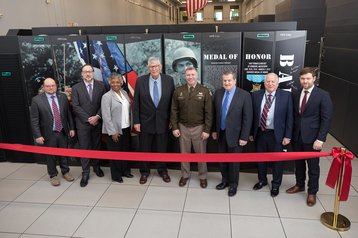
Barfoot is named after Col. Van Barfoot, a recipient of the Medal of Honor during World War II. It is the fourth system owned by the ERDC to be named after Mississippi natives who received the Medal of Honor.
No further information about the supercomputer’s technical specifications has been released beyond the fact that it has 212,000 compute cores. The ERDC’s Carpenter system, installed in 2023, is also a Cray system and comprises AMD Epyc 9654 CPUs, interconnected in Slingshot networking technology.
“Col. Barfoot is an American hero, and it’s our special privilege to honor his courage, his valor, and his impact on our nation,” said ERDC deputy director Patricia Sullivan. “This supercomputer will be used to provide cutting-edge solutions to some of the toughest challenges facing the nation and the Warfighter.”
Kelly Dalton, director of the high-performance computing modernization program (HPCMP), added: “These supercomputers are very important to the future and defense of the country. This is truly an investment in our security, our prosperity, and the future of our great nation.”
The inauguration of Barfoot took place just over a month after ERDC announced it was installing new generators to double the capacity of backup power available to the ITL facility.
As part of the center’s ongoing partnership with Entergy of Mississippi, ITL will provide ERDC with an additional 3.2MW of backup power. The utility company will be responsible for the installation and maintenance of the generators.
ERDC has also undertaken a joint project with GTI Energy and Cummins to install four 1.4-megawatt mobile power generation (MPG) units to further supplement backup power capability at the lab.
According to the center, that installation will be used to develop, test, and evaluate technology that can be used alongside other critical energy supply systems to deliver uninterrupted backup power supply and energy resilience to respond to disasters and remote applications.





Comments