
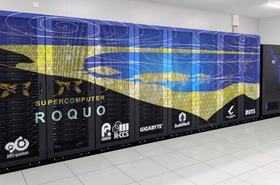
The second phase of the Isambard-AI supercomputer has gone live at the Bristol Centre for Supercomputing (BriCS), just over a year after Phase I was first brought online.
The 5MW, £225 million ($302m) system was built by HPE in partnership with Nvidia and the University of Bristol and boasts 23 exaflops of AI performance, a figure the university said makes it the sixth-fastest supercomputer in Europe, and the 11th globally.

Speaking at the inauguration today (July 17), Professor Simon McIntosh-Smith, director of the Isambard National Research Facility at the University of Bristol, said the UK government has a commitment to fund the supercomputer for five years, and BriCS has capacity for a deployment of up to 30MW at the site, something which he is keen to pursue.
Named after Isambard Kingdom Brunel, the famous British civil engineer who designed Bristol’s Clifton Suspension Bridge, Isambard-AI is based on HPE Cray EX supercomputer technology. Powered by 5,448 Nvidia GH200 Grace Hopper Superchips, the system also incorporates HPE Slingshot 11 interconnect and nearly 25 petabytes of storage using the Cray ClusterStor E1000.
Each of Isambard-AI’s 12 cabinets houses 440 GPUs, offering the same compute power – approximately 20 petaflops – as the Dawn supercomputer cluster at the University of Cambridge – the UK’s second most powerful system.
Housed in a low-carbon, modular data center that was put together in 48 hours in November 2024, the system is cooled by HPE’s 100 percent fan-less, direct liquid cooling technology, which the company says delivers up to 90 percent reduction in cooling power consumption, while hybrid cooling towers allow for a more than 90 percent dry, waterless operation.
As a result, the system ranks fourth on the Green500 list of most energy-efficient supercomputers globally.
There is also potential to recycle the waste heat output for nearby homes and businesses, the university said, although initially it will just heat the BriCS building adjacent to the system – “we’re not there on day one,” McIntosh-Smith said of the long-term district heating plans.
Isambard-AI will eventually connect with the Dawn supercomputer, itself the result of a two-year collaboration between Dell and Intel. That system became operational in February 2024 and currently offers 19 petaflops of FP64 performance.
Access to Isambard-AI will be jointly managed by the UK government’s Department for Science, Innovation, and Technology (DSIT) and UK Research and Innovation (UKRI), with an emphasis on aligning usage with national priorities and supporting smaller institutions and startups looking to use the system for both research and commercial use cases.
Citing an example of the system’s use cases, the government said researchers from University College London are already using the supercomputer to develop scalable AI models for medical imaging, using prostate cancer screening as an initial test case.
Around five percent of the system’s compute capacity will be reserved exclusively for University of Bristol research projects.
“Isambard-AI places Bristol at the center of the AI revolution, spearheading AI innovation and scientific discovery in important areas such as drug discovery and climate research,” McIntosh-Smith said.
“I’m incredibly proud of our team and how we’ve worked so closely with partners to develop this national facility, which will establish Bristol and the UK as an international hub for AI research.”





Comments