
Six years after its commercial launch, 5G was still a hot topic during last month's Techritory event in Riga, Latvia.
Techritory was held for the eighth time in Latvia’s capital, where telcos, vendors, politicians, and more gathered to examine the market's challenges and opportunities.
Private 5G networks
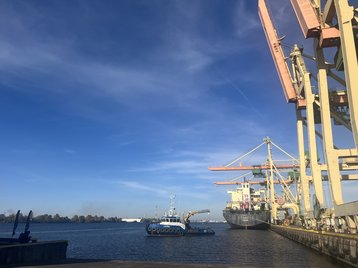
Prior to the two-day event kicking off, DCD attended day zero, which took place at the Freeport of Riga, a key maritime port for the country.
During which, Latvian Mobile Telephone (LMT) showcased its private 5G network, and a host of use cases. These use cases included drone-based crane inspection, underwater drones for water quality inspection and oil spill collection, and unloading and loading dual-use Unmanned Surface Vehicles (USVs).
LMT first launched its private 5G network in March at the Baltic Container Terminal (BCT) within the Freeport of Riga, claiming it to be the first private 5G network in the Baltic region.
Some of the demo use cases that utilized LMT's private 5G network included real-time hydrography sensor data transmission from ship to land, using machine vision and AI to analyze irregularities.
Beyond this, automated infrastructure inspections were carried out by drones and analyzed via machine vision in partnership with the autonomous drone platform Beyron.
USVs were also deployed and piloted from a ship in partnership with LVR Flote, while the network supported an underwater intruder detection system used with Submerge Baltic and USV Spark maritime drones, which were again remotely piloted.
Ingmārs Pūķis, vice president, member of the board, LMT, told DCD, that the private 5G network deployment at the port is the embodiment of what 5G should be.
Pūķis added that a lot of the early ideas for 5G deployments were born out of fantasy as opposed to being practical.
“At the onset of 5G, one of the promises we took seriously was that 5G was industrial," added Pūķis.
"One of the ideas was that 5G is the industrial standard, because historically 2G, 3G, and 4G have all been mass market standards. But 5G is not needed by consumers."
Is 5G just another G?
While the event, formerly 5G Techritory, dropped the '5G' in favor of just 'Techritory,' discussion around 5G continued at great length.
6G was mentioned during the event, but 5G is still very much the here and now and, as such, the technology’s success, or lack thereof, was again being marked by the jury of panelists.
Long-time 5G skeptic Professor William Webb, CEO of Commcisive, was typically unmoved by the technology.
Webb previously wrote a book on 5G, titled The 5G Myth: When vision decoupled from reality. The book was published in 2016, a good two and a bit years before the technology launched.
“I essentially said 5G is not really successful, because 4G delivers everything we need, and there's no benefit,” Webb noted.
“There's nothing out there that is a useful attribute that people will pay more for that is delivered by 5G, and I think that's exactly where we're at now. There's no killer application out there.”
He added that the industry’s hopes are pinned on 5G Standalone (5G SA), and even then, these hopes might be misplaced.
5G SA is a network that is not reliant on older mobile generations and solely uses a 5G core network. A lot of the early 5G networks were 5G Non-Standalone, which is reliant on 4G core.
“Operators don't want to invest, typically, a billion dollars to upgrade their network when there's absolutely no evidence out there that it results in any greater revenue stream than a Non Standalone network.”
He wasn’t the only one to judge 5G negatively. Dean Bubley, tech industry analyst, Disruptive Analysis, also expressed an opinion that the technology has been somewhat overhyped.
“I said seven years ago that it’s just another G, and I’m pretty much sticking with that now,” Bubley stated.
Bubley, who attended the private 5G network deployment at the Freeport of Riga, said the Freeport deployment showcased a good use of the technology, but noted that 5G is better supported for these sorts of use cases, rather than that of the average user.

The 6G future must learn from 5G’s shortcomings
Work is underway on 6G networks. Whether the industry needs them is another matter
Don’t give up on 5G yet, otherwise, 6G could suffer
Not everyone shared those views, however.
“I think to some extent we are trying to judge too early,” said Colin Willcock, chairman of the 6G Industry Association.
“Let's give the technology a chance. I mean, it is a technology that is the fastest rolled out cellular technology in history."
Though Willcock accepted that a killer use case for the technology has been missing.
According to the GSMA, 5G accounted for 30 percent of mobile connections in Europe at the end of 2024, or the equivalent of around 200 million users.
Willcock added that, although 6G is on the horizon, it won’t be here until 2030 at the earliest and, more realistically, later than that, so there’s still a need to push 5G.
“It [6G] is the future, but it's not now. If we’re not successful with 5G, we’re not likely to be successful with 6G either,” he added.
Although the industry standards for 6G are still being determined by the 3GPP, technology vendors such as Nokia and Ericsson are already talking about 6G, notably striking early partnerships with carriers to research the technology at the lab level.




Comments