
Electronic design automation (EDA) company Synopsys has announced a number of new design, verification, and simulation solutions that president and CEO Sassine Ghazi said would deliver “next-generation AI-powered products.”
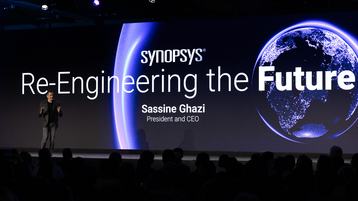
The offerings were unveiled at the company’s annual Converge conference, which took place in California this week, and included the first EDA solutions to integrate Synopsys and Ansys technologies since the $35 billion acquisition of the latter was closed in July 2025.
In an effort to address chip design problems caused by electromagnetics, thermal, and mechanical effects, Synopsys has launched Multiphysics-Fusion technology to help accurately identify and resolve issues related to voltage drop, thermal effects, and electromagnetic coupling earlier in the design process.
According to the company, the technology reduces design iterations and improves power, performance, and area (PPA) metrics, with the first solutions incorporating these capabilities targeting timing signoff, multi-die design, design closure, and analog and mixed signal design.
These first Multiphysics-Fusion capabilities are currently active in beta with early access to customers, and production availability is expected in the coming months.
Elsewhere, Synopsys said it was “pioneering AI capabilities” to increase levels of autonomy across its EDA product portfolio. This includes solutions that leverage reinforcement learning, generative AI, and agentic AI, with the company stating that it is currently building an “open agentic AI stack centered on orchestrated, multiagent workflows to address use cases from silicon to systems.”
Consequently, Synopsys demonstrated a design and verification workflow powered by Synopsys AgentEngineer agentic AI technology. Described by the company as an “industry first,” it claims the technology can “augment human engineers and accelerate highly complex chip design tasks beyond traditional methods,” helping to improve productivity by up to 5x in “select cases,” when compared to traditional front-end design processes.
Synopsys noted that its agentic stack is built on industry-standard SDKs and APIs, adding that the company is collaborating with chip designers like AMD to develop differentiated, agentic capabilities with increasing levels of autonomy over time.
The company has also introduced generative and agentic AI capabilities to Ansys’ simulation product portfolio. This includes adding a Mesh Agent feature to the company’s Ansys Mechanical software, alongside the rollout of Ansys GeomAI for generating, evaluating, and refining geometry concepts, and Discovery Validation Agent to identify setup issues using contextual intelligence and industry best practices.
A number of further Synopsys technology integrations, including the addition of its VC Functional Safety Manager (VC FSM) with Ansys medini analyze software for chip-level safety analysis; the Synopsys QuantumATK and Ansys Granta MI platform for material management; and the Synopsys OptoCompiler and Ansys Lumerical FDTD software to connect photonic device design to system-level optical simulation, were also announced.
Finally, Synopsys unveiled a number of advancements across its hardware-assisted verification (HAV) portfolio in order to keep pace with demand for AI compute and deliver “multi-die and AI chips from the data center to the Edge.”
The company claims its updated HAV platforms set new performance, scalability, and flexibility benchmarks across the portfolio, with its software-defined approach providing up to 2x higher performance on ZeBu Server 5 high-capacity emulator for System-on-Chip verification, and up to 2x capacity scaling for modular HAV systems targeting “AI-era mega designs.”
Synopsys also launched the HAPS-200 12 FPGA and ZeBu-200 12 FPGA platforms for mainstream designs, offering Emulation and Prototyping-Ready (EP-Ready) Hardware, 2x capacity, and Register Transfer Level (RTL) verification.
"The complexity of next-generation intelligent systems requires a completely new engineering approach,” said Ghazi in comments posted alongside the announcements. “By integrating co-design of software and hardware, electronics and physics, by harnessing digital twins to design, test, and refine products before physical production, and using AI to enhance human capabilities, customers’ R&D teams can accelerate time to market of their intelligent systems. At Synopsys Converge, we’re demonstrating the power of our silicon-to-systems engineering solutions that make us the best partner for engineering the future.”
Synopsys’ Converge conference took place three months after Nvidia announced plans to invest $2 billion in the company through a common stock purchase, as part of a multi-year deal between the two companies to boost AI chip engineering and design.
The companies said at the time that the agreement would focus on Nvidia’s CUDA-accelerated computing, agentic and physical AI, and Omniverse digital twins offerings, with Synopsys using the chip company’s CUDA-X libraries and AI physics technology to optimize its applications, including chip design, physical verification, and optical simulation.
The two companies also plan to collaborate on virtual design, testing, and validation through the use of digital twins in industries such as semiconductor, robotics, aerospace, and energy; work together to provide cloud access for GPU-accelerated engineering solutions; and develop joint go-to-market initiatives to drive further market adoption.
At the start of 2026, Synopsys announced it had sold its processor IP solutions business to GlobalFoundries (GF) for an undisclosed amount, saying the sale would allow the EDA company to focus on extending its leadership in interface and foundation IP and pursue the “highest-value, AI-driven opportunities from cloud to Edge.”





Comments