
The space sector supply chain is a "mess," according to a Honeywell exec.
Speaking during a panel at Novaspace’s World Space Business Week on new industrial strategies for the satellite manufacturing market, Honeywell’s Lisa Napolitano spoke to the lasting skills challenges of a post-pandemic manufacturing labor market.
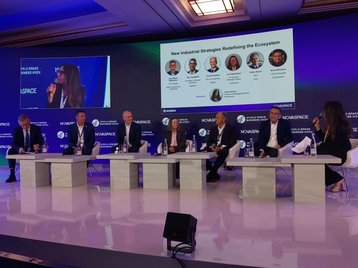
“For Honeywell, the supply chain is a mess, whether it’s in Europe or the US,” said Napolitano, vice general manager of space at Honeywell. “We’ve come at it a number of different ways. We’ve been looking at insourcing where we think we can assemble the right knowledge and IP, as well as dual-sourcing. The labor in the US just never came back after Covid, and too much of the kinds of knowledge we needed just disappeared. We’re trying to work out the best strategy - we’re looking for stronger partnerships with our suppliers rather than purely transactional ones.”
Napolitano spoke to the need to balance their order book, which is a challenge for speciality high-tech machinery and components, unlike in consumer electronics, where a strong expectation of demand exists.
On September 16, the company announced that its spinoff, Solstice Advanced Materials, due to be completed in the fourth quarter of this year, had priced a private offering of $1 billion aggregate principal amount of senior notes. It’s one of the three companies that Honeywell would be split into, as announced on February 6, dividing its aerospace, automation, and advanced materials segments into separate concerns.
Solstice will be a differentiated advanced materials company and a provider of semiconductor materials, protective fibers, refrigerants, and healthcare packaging.
At the Fortune Brainstorm Tech Conference in Park City, Utah, Honeywell CTO and president of the company’s software division, Honeywell Connected Enterprise, Suresh Venkatarayalu, spoke about easing the labor gaps at the company with the use of AI and automation.
“The only way to offset the labor shortage and a skills shortage is to augment with something, and that something is AI,” said Venkatarayalu. “What has changed is the type of developer skill sets needed,” he told attendees, referring to his software developers, suggesting that less time coding allowed developers to perform more complex work, or spend more time in the field with customers.






Comments