
SpaceX expects to end the year with more than 2GW of compute, CEO Elon Musk claims.
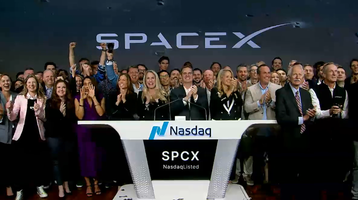
In the company's first earnings report since its blockbuster IPO earlier this year, the company posted quarterly revenues of $7.8 billion, up 92 percent over last year and above analyst expectations. The company reported a net loss of $541 million, again beating expectations.
But also above expectations was AI compute infrastructure capex costs of $16bn, twice that of the previous quarter. SpaceX expects to continue high capex spending for at least two more quarters. Shares in the company fell more than 10 percent in pre-market trading.
In an earnings call, Musk said that the capex spend meant that the company expected "to end this year with over 2GW of compute," up from 1.4GW of nameplate compute at the end of this quarter, 1GW in Q1, and 400MW a year ago.
He added: "And probably our cumulative compute online by the end of next year will be several times higher. So it may, let's say, be closer to 10GW of compute than 5GW of compute."
Following analyst questions, Musk added that the company plans "to far exceed that gigawatt number in terms of power online, power cooling and electrical equipment. So our tentative target is to actually have 20GW at the power and cooling level online by the end of next year."
He admitted: "Now I don't think we're going to achieve 20GW, but we want to have a series of projects that cumulatively come to 20GW by the end of next year. Some of them won't pan out exactly on time, but I would expect that we still probably have at the power plant level, something close to 15GW."
The company this week revealed that it has begun development on a fourth data center around Memphis, Tennessee.
It is important to note that Musk and his businesses have a habit of making bold pronouncements with tight deadlines and failing to hit them.
The SpaceX and Tesla CEO claimed that the company's experience in building reusable rockets made developing terrestrial data centers comparatively easy.
"If you apply a small amount of the engineering skill that goes into making gigantic rockets reach orbit on a regular basis reliably to terrestrial data centers, this is like, frankly, the New York Yankees going in and playing a little league team," he said. "And it's kind of ridiculous, frankly."
Despite the company's rocket endeavors, AI compute deals remain a significant source of revenue, as part of its acquisition of xAI. SpaceX CFO Bret Johnsen said that incremental leasing of compute capacity to companies including Anthropic, Google, and Reflection AI, helped contribute $1.6bn in revenue for the company.
Starmind to launch next year
SpaceX plans to begin launching its 'Starmind' data center satellites next year, "which will be essentially an optimized Vera Rubin NVL72 computer," Musk said.
Despite plans to partner with Tesla on chip development as part of Terafab, the company is currently planning to use Nvidia chips exclusively.
Musk said: "Going forward, we've decided to build exclusively on Nvidia because we think the Vera Rubin architecture is the best architecture. We think it's the best AI computer, and we greatly value our close cooperation and partnership on many levels with Nvidia. So we're exclusive to Nvidia."
As for the company's current satellite fleet, the low-Earth orbit Internet constellation Starlink accounted for more than half of total revenue, up 66 percent over last year.
"It's not out of the question that at some point Starlink will deliver a majority of the world's Internet, at least in countries where we're allowed to operate, which is the vast majority of countries… in less than 10 years," Musk claimed.
Starlink operates in more than 160 countries and territories, and has 12 million subscribers around the world, double this time last year. 1.7 million joined in the past quarter.
"As of June 30, our constellation of operational Starlink broadband and mobile satellites in orbit grew to roughly 10,200 with our 9,600 broadband satellites delivering roughly 800 terabits per second of total downlink capacity," president Gwynne Shotwell said.
"Following a successful speed run test of the V3 Starlink satellites on the most recent Starship launch, during which we connected every satellite through every laser link, we intend to deploy V3 satellites into the constellation for operational use on the upcoming Starship missions.
Last September, SpaceX acquired AWS-4 and H-block spectrum licenses from EchoStar in a $17 billion deal. "The spectrum that we purchased from EchoStar does have terrestrial components," Shotwell said. "So we definitely intend to build out the terrestrial component. So you will have not only the capacity from the satellites themselves, but you will have a build-out of the terrestrial, basically the hardware and systems necessary to make a true mobile service exactly what you want it to be."
She added: "You could put a base station, a cellular base station, on the gear that holds a Starlink broadband dish. You can have kind of these little femtocells around the country, and you deploy that as you need it.
"You don't have to necessarily spend many billions of dollars in low-band spectrum all upfront before you deploy your system. So that's why I don't want to talk about the capex for building out the terrestrial, because we have a lot of really great and new ideas for how we're going to do that. And I think it will be quite capex efficient."
More in Investment / M&A / Financing
-

-

-

Episode 2027 Trends and Outlooks: Europe



Comments