
Two of Spain’s largest space companies, satcoms operator Sateliot and rocket developer PLD Space, have signed their first commercial contract for a dedicated low-Earth orbit (LEO) launch, agreeing to orbit two 160kg direct-to-device (D2D) Tritó satellites in 2027.
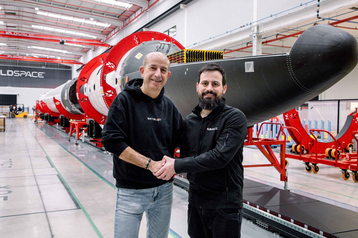
“With this agreement, we fulfill two core principles we have upheld since launching Sateliot: autonomy and national and European sovereignty,” Jaume Sanpera, co-founder and CEO of Sateliot, said in a statement. “By launching our satellites with a Spanish company like ours, we are supporting the ‘Marca España’ and ensuring D2D connectivity worldwide and in any scenario, with enhanced capabilities for defense and security as well as civil use. This positions us as a strategic backup when terrestrial networks are unavailable or fail.”
Sateliot’s new Tritó satellites provide dual connectivity for IoT devices, enabling D2D services for mobile devices, supplying data, voice, and video to the 5G standard. The company says these applications can support mission-critical performance for defense, security, and civil protection.
Spanish sovereignty
The contract is the first fully Spanish private space mission, encompassing manufacturing, space launch, satellite operation, and service delivery, a capability which has become a major industrial goal for European and Gulf powers.
Momentum on sovereign launches was long driven by European frustrations about de-prioritization on SpaceX manifests, as the company was believed to be driving a pro-American bias in payload scheduling. A tentative understanding that national launch would one day become a military or intelligence necessity later in the century has spurred well-subsidised projects such as PLD Space.
“I founded PLD Space 14 years ago to make this happen,” said Raúl Verdú, co-founder and chief business development officer of PLD Space, in a statement. “Our alliance with Sateliot is a key milestone for the Spanish and European space ecosystem. It demonstrates the ability of two national companies to break new ground and deliver unprecedented vertically integrated solutions. The level of competitiveness of this approach is unmatched in our sector.”
The MIURA 5 rocket has been in development since the mid-2010s, when it was initially named Arion 2, becoming MIURA 5 following a 2018 redesign. The rocket is capable of inserting 1,000kg in low-Earth orbit, which it will demonstrate for the first time in early 2026. These specs resemble a mid-range small-lift launch vehicle.
For reference, SpaceX's Falcon 9, a medium-lift industry leader, is able to lift payloads as heavy as 16,850kg to LEO, and has orbited payloads to GEO (geostationary Earth orbit) as heavy as 7,075kg across more than 600 successful launches. Starship aims to be able to carry a “100-ton” payload to orbit. This is to say nothing of cost advantages, which were long discussed comparing Paris-based Arianespace launches to SpaceX’ service.
PLD Space and the MIURA 5 rocket were recipients of recent EU funding through the European Launcher Challenge in 2025, beating out a set of 12 initial proposals for access to a €900 million ($1.07bn) fund as of November 2025. Another finalist of the initiative, Scottish microlauncher Orbex, the sole UK rocket developer to be considered, collapsed on the 11th of February, after frenzied negotiations to be acquired by a German startup, The Exploration Company.
Britain is presently the only nation on Earth to develop sovereign launch capability and abandon it, after successfully launching the 144kg Prospero satellite in 1964. In the wake of the initial success, the Ministry of Defence deemed it cheaper to begin buying flights aboard American Scout rockets rather than finance the sustainment of a successful space launch capability that they’d already funded from scratch.







Comments