
Three weeks after Samsung announced its Q4 2024 earnings were likely to be “significantly below market expectations,” the company announced that its quarter-on-quarter (QoQ) operating profit fell by almost 30 percent to KRW 6.5 trillion ($4.65 billion), with revenue for the same period declining by four percent to KRW 75.8 trillion ($54.18 billion).
However, despite the quarterly downturn, yearly revenue rose by around 12 percent, with the company’s operating profit for FY24 increasing by 130 percent year-on-year (YoY), totaling KRW 300.9 trillion ($207.6bn) and KRW 32.7 trillion ($22.6bn), respectively.
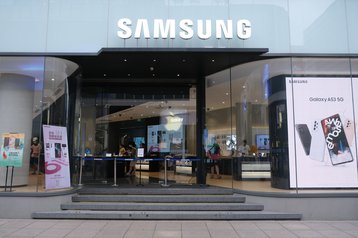
“Although fourth-quarter revenue and operating profit decreased on a quarter-on-quarter (QoQ) basis, annual revenue reached the second-highest on record, surpassed only in 2022,” Samsung said in its statement.
As expected, Samsung Electronic’s memory business achieved record-breaking revenue of KRW 30.1 trillion ($20.8bn) for the quarter, driven by growing demand for AI memory products, including high-bandwidth memory (HBM) and high-density DDR5 for servers. However, due to increased R&D expenses and “the initial ramp-up costs to secure production capacity for cutting-edge nodes,” operating profit “decreased slightly.”
Results were also more muted for the company’s chip division as a whole, with Samsung’s Device Solutions (DS) unit posting Q4 2024 operating profits of KRW 2.9 trillion ($2bn), a 25 percent decrease on the previous quarter.
Referencing the slump, the company added that for Q1 2025, while an improvement in its overall earnings “may be limited due to weakness in the semiconductors business,” Samsung intends to “pursue growth through increased sales of smartphones with differentiated AI experiences, as well as premium products in the Device eXperience (DX) Division.”
In its earnings presentation, Samsung said it is working towards having 2nm process nodes in mass production in 2025, noting that its first version PDK (process design kit) was sent to clients in H1 2024. The company added that its second-generation 2nm was slated to be in mass production in 2026, with that PDK due in the first half of this year.
For 2025 as a whole, Samsung said it plans to “enhance technological and product advantages in AI, continue to meet future demand for high-value-added products, and drive sales growth in premium segments.”
This includes plans to develop advanced robotics for consumers and the manufacturing and service industries, including a humanoid robot, and boosting its AI and software technology development.




Comments