
Quantum Motion has delivered a full-stack quantum computer to the National Quantum Computing Centre (NQCC) in Harwell, UK.
The system is the first quantum computer to use 300mm silicon CMOS (Complementary Metal-Oxide-Semiconductor) wafer technology that can be mass produced using a standard silicon CMOS chip fabrication process in commercial chip foundries.
It is also the first silicon spin-qubit computer installed as part of the center’s quantum testbed program.
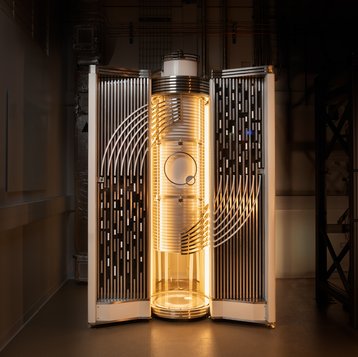
According to Quantum Motion, the system consists of three 19-inch racks that house both the dilution refrigerator and integrated control electronics, while the auxiliary equipment is designed to sit separately, enabling it to fit in standard data center environments.
Its QPU is based on a scalable tile architecture that integrates all the necessary compute, readout, and control elements into a dense array that can be repeatedly printed onto a chip. Quantum Motion says this approach enables the future expansion to millions of qubits per QPU, with the system’s design also able to support upgrades to much larger QPUs without any change to the system footprint.
“This is quantum computing’s silicon moment,” said James Palles-Dimmock, CEO, Quantum Motion. “Today’s announcement demonstrates you can build a robust, functional quantum computer using the world’s most scalable technology, with the ability to be mass-produced.”
Dr Michael Cuthbert, director of NQCC, added: “The NQCC is accelerating UK quantum capabilities by evaluating a number of diverse hardware platforms by leading companies worldwide. The successful installation of Quantum Motion’s system marks an important step forward in the NQCC's quantum computing testbeds initiative. The NQCC team are really excited to start test and validation of the system and better understand how real-world applications will map onto its silicon architecture.”
Quantum Motion was founded in 2017 by Professor John Morton and Professor Simon Benjamin with the aim of developing quantum computers using traditional CMOS chips. Spun out from University College London and Oxford University, where the two professors worked, the company raised $50.8 million in 2023.
In April 2025, it was one of 18 companies selected for the first phase of the United States’ Defence Advanced Research Projects Agency’s (DARPA) Quantum Benchmarking Initiative (QBI).




Comments