
UK quantum computing company Orca has unveiled a plan for integrating photonic quantum AI into data centers.
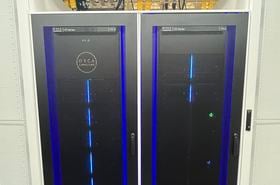
During a demonstration at the Poznań Supercomputing and Networking Center (PCSS) in Poland, in collaboration with Imperial College London, Orca integrated two of its PT-1 photonic quantum processors with Nvidia Hopper GPUs.

The deployment is housed within standard 19-inch racks at PCSS’ data center. Operating at room temperature, Orca says the integration uses Nvidia’s CUDA-Q platform to support both classical and quantum compute resources within a single environment.
In a statement announcing the news, Orca said the deployment marks the first time photonic quantum processors have been integrated through CUDA-Q, creating a scalable path for hybrid machine learning and HPC applications.
“Working together with Imperial and PCSS, we’ve delivered a working demonstration of a distributed photonic quantum neural network inside a real data center,” said Richard Murray, co-founder and CEO of ORCA Computing.
“This approach offers a deployment-ready, upgradeable path for organizations to adopt quantum-accelerated architectures without large infrastructure overhauls.”
Sam Stanwyck, group product manager for Quantum at Nvidia, added: “The integration of quantum into the fabric of HPC is a critical step towards developing the future of quantum-accelerated supercomputing, combining multiple quantum accelerators with many classical accelerators. This work shows how the CUDA-Q platform can accelerate progress towards this future with open, performant, and purpose-built software.”
Despite Nvidia CEO Jensen Huang telling CES attendees earlier this year that useful quantum computers were between 15 and 30 years away, in recent months, the GPU giant has invested in a number of quantum computing firms, including Quantinuum, QuEra, and PsiQuantum, via its NVentures investment arm.
This week, the company also announced a partnership with Oxford Quantum Circuits and Digital Realty to establish a quantum-AI data center in New York City.
In other quantum computing news
- New York Governor Kathy Hochul announced $300 million in funding for the establishment of a Quantum Research and Innovation Hub at the State University of New York at Stony Brook. The hub will be dedicated to research and education in quantum science and technology, with a particular focus on quantum communication and networking.
- The European High Performance Computing Joint Undertaking (EuroHPC JU) has launched the procurement process for a EuroHPC quantum computer to be hosted and operated by SURF in the Netherlands. Once deployed, the system will be located at the Amsterdam Science Park and integrated into the Dutch national supercomputer, Snellius. The closing date for tender applications is October 24, 2025.
- IonQ has completed its $1.08 billion acquisition of UK quantum computing company Oxford Ionics and announced its purchase of Vector Atomic, an organization specializing in advanced quantum sensors. Upon the completion of the all-stock transaction, all 76 of Vector Atomic’s employees will join IonQ.
- Microsoft will open a new quantum research center in the University of Maryland’s Discovery District. The facility is a collaboration between Microsoft, the University of Maryland Enterprise Corporation (UMEC), and the State of Maryland, and will house a prototype of Microsoft’s topological quantum computer based on the Majorana 1 quantum chip.






Comments