
Oracle brought 400MW of data center capacity online in the last quarter.
The company posted strong results for Q3 FY2026 (ending February 2026), with CEO Clay Magouyrk noting that demand for AI infrastructure - “both GPU and CPU” - continues to exceed supply. “This is directly visible in our $553 billion remaining performance obligation (RPO),” he notes.
The RPO is up a massive 325 percent, year-on-year (YoY), but comes with the hefty job of bringing online the necessary data center capacity.

Big Red's 400MW of data center stand-up is around the same as the previous quarter, but less than Microsoft’s 1GW. The company has secured 10GW of power for its data center pipeline over the next three years. Oracle leases most of its data centers and does not generally self-build, unlike many of its hyperscale rivals.
Magouyrk noted that these infrastructure investments “also need funding,” telling analysts that more than 90 percent of the capacity is already funded through Oracle’s partners, and the remainder is anticipated to be finished this month.
That Oracle needs a lot of capital to go ahead with its plans is no surprise. In February of this year, the company revealed that it was planning to raise up to $50bn in debt and equity this year, to meet the capacity requirements of "several large customers," including OpenAI, AMD, xAI, Meta, TikTok, and Nvidia.
According to principal financial officer Doug Kehring, within “days” of the announcement, Oracle had raised “$30 billion through a combination of investment-grade bonds and mandatory convertible preferred stock, with a record order book that was substantially oversubscribed. As noted in our release, we have not yet initiated the at-the-market equity portion of the financing program.”
Kehring also noted that this is the only bond issuance they are planning to do this year.
Unmentioned during the call were reports that the company was planning thousands of layoffs to further help support the buildout. Estimates from TD Cowen have been as high as 20,000 to 30,000 employees.
Magouyrk also drew attention to the company’s efforts to optimize costs throughout the construction process.
“Once the data center is secured, several things must come together. The data center and on-site power generation have to be constructed. Compute, networking, and storage have to be designed, manufactured, delivered, and installed. All the capacity inside the data center also has to be funded. We continue to innovate across each of these steps,” he said.
“We optimize our data center construction through standardized design. Our supply chain has improved with more suppliers and deeper relationships. We have tripled our manufacturing sites and increased rack output by 4x, all in the last year. We have scaled our installation processes to enable multiple phases of delivery in parallel.”
During the previous quarter’s earnings call, Magouyrk told analysts that the company was exploring a range of financing models for data centers, including customers bringing their own chips, and renting - rather than buying - GPUs from companies such as Nvidia and AMD, to reduce the required capital expenditure.
According to the CEO, they have since signed $29bn in contracts using bring-your-own-hardware models and upfront customer payments.
The company is advising, for the full year 2026, a revenue of $67bn, and as much as $90bn for 2027.
Total revenue for the quarter was $17.2bn, up 22 percent YoY and an increase on the previous quarter’s $16.06bn. Within that, cloud infrastructure revenue was $4.9bn, up 44 percent YoY.
Magouyrk broke this down further, telling analysts that the firm's AI infrastructure revenue alone had grown 243 percent YoY, with a 32 percent margin, and its multicloud offering grew 531 percent.
The multicloud offering - including the Oracle Database@ service - drew special attention from Oracle executives during the call. CEO Magouryk said that the company now has “global region coverage in all of our partner clouds.”
“We now have 33 regions live with Microsoft, and 14 live with Google. We delivered significant growth with AWS, beginning Q3 with two AWS regions live, exiting Q3 with eight AWS regions live; we will exit Q4 with 22 AWS regions live.”
Oracle’s executives noted that, while the AI infrastructure offering has a margin of around 32 percent, the other cloud offerings have a much better profit margin associated with them. Among the offerings that are seeing success is Oracle Alloy, as a result of the increased push from customers for “sovereign” options.
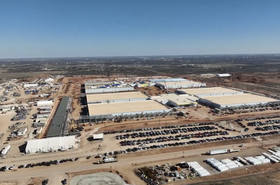
Oracle/OpenAI drop plans to expand flagship Abilene Stargate site, Meta in talks to pick up Crusoe capacity with Nvidia's help
Financing challenges and Stargate's changing scope end Texas data center expansion plans
Described as benefiting from a “halo effect,” CEO Mike Sicilia explained: “Our sovereign story is not new, and it is not a knee-jerk reaction to things that are happening in the world. Combined together with our Alloy story, we are really seeing increasing pipeline across the world. The fact that our form factor—we are so differentiated in our form factor—and we can deliver not just a smaller form factor, but complete OCI services on top of that form factor no matter how many racks are involved, whether it is three racks or 500 racks, we think that is a huge differentiator in the market. So you put apps together, you put OCI AI services together, you put sovereignty together, and yes, it is a pretty big halo effect.”
Oracle did not share its capex for the quarter, nor offer guidance for the next year, with Kehring stating that they would revisit the topic in the next quarterly earnings. Full year 2026 capex is expected to reach $50bn.
In the latest quarter, Oracle’s competitors, including Microsoft and Google, had a capex of $37.5bn and $27.9bn, respectively. AWS did not share its quarterly capex.
Other key performance metrics for Q3 FY2026 from Oracle include GAAP operating income of $5.5bn, while non-GAAP operating income was $7.4bn, up 19 percent YoY. Short-term deferred revenues were $9.9bn.
Oracle's shares are currently trading up 9.57 percent following the earnings results, posted yesterday.






Comments