
Open Compute Project (OCP) members are calling for more digital infrastructure firms to join their mission to make low-voltage direct current (LVDC) in data centers a reality for high-density AI racks.

Staff from companies including Google, ABB, and Siemens have formed a working group looking at ways to standardize the supply of LVDC to data centers.
In March, the group published a 170-page white paper setting out the reasons a switch to pure DC inside data halls would benefit operators, and the challenges and opportunities this presents.
Several of those involved took to the stage at OCP’s EMEA conference, held in Barcelona, Spain, this week, to explain why this change needs to happen, and to call for more input from across the industry when it comes to standardization.
AC/DC: Why now for direct current in the data center?
A traditional data center power setup takes alternating current (AC) from the grid, and runs this through a series of conversion processes, first to DC for the site’s battery or UPS, then back to AC to get it to the IT racks, then to DC to directly supply the server and its components.
Having so many conversions in the chain means this process is inefficient due to losses in each step, and some in the industry have argued for years that entirely DC-based facilities could provide a more efficient way to get large quantities of power directly into the data center. DCD has covered previous efforts in-depth, but none have seen wide adoption for a variety of reasons.
But AI and its rapidly growing power needs are about to change the game. Where traditional cabinets may require just a few kilowatts of power - and even today's high-density racks reaching ~120kW - GPU maker Nvidia has warned that its AI designs will soon need up to 1MW per rack.
As JP Buzzell, VP and chief data center architect at Eaton, told delegates at the OCP conference: "We need to make this a reality because the compute needs it - it’s the same aspect that drove the shift to liquid cooling.
“We have a rhinoceros coming through the door, so we have to make the door big enough for the rhinoceros, otherwise it’s going to hit us.”
Out of the sidecar
The first step towards LVDC in the data center emerged last year with the development of Mount Diablo, an OCP project led by Microsoft, Meta, and Google that came up with a rack design where compute and power were separated. Rather than having both elements in the same rack, the power is contained in a separate “sidecar” unit, with all the main rack space dedicated to compute.
Jason Adrian was one of the engineers who led the project during his time at Microsoft. He has since moved on to the role of AI systems architect in Google’s data center team, and told the OCP conference Mount Diablo brings LVDC into play, enabling AC inputs to be converted into DC of up to 400Vdc, a suitably high amount of power for upcoming AI hardware.
He said: “We’ve started pulling things out of the rack, but it’s a sidecar - it comes along for the ride and is extra work and an extra challenge. We’re talking about how we go from this interim solution to a long-term solution that’s going to scale with us.”
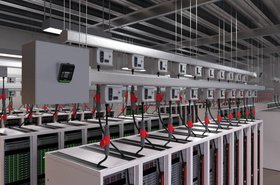
In its white paper, the working group proposes to move power conversion to a transformer outside the server room. This means all the white space can be dedicated to compute. How power is distributed to the racks will depend on individual use cases, Adrian said. It could be via a DC busbar - a metal conductor which links all the cabinets - or by cables, or a combination of the two.
DC distribution - the second coming
Dismissed in the 2010s, the idea of running direct current through your building could be set to make a comeback
This could enable up to 800Vdc of power to flow into servers, he added, while also opening the door for future power requirements to reach up to 1,500Vdc.
The working group could develop standards around two different types of transformer technology to enable the conversion from AC to DC for this purpose. One is the traditional transformer rectifier unit (TRW) used in the industry (“It’s very consistent, we know the technology, and its deployable,” Adrian says), while the other is the solid state transformer. This is an emerging technology that proponents believe will be capable of handling high amounts of power efficiently. One developer of SSTs, DG Matrix, raised $60 million earlier this year, indicating the strength of interest in the technology.
Adrian described SSTs as a “very exciting” technology with “substantially better efficiency”, but warned there is a lot of work to do to “take the technology into megawatt or gigawatt scale.”
He said the working group intends to release a new version of its whitepaper later this year, and encouraged more companies to get involved.
“This isn't going to happen overnight, and it's not going to happen by chance,” Adrian said. “We need to be very deterministic about this, and the way we do that is through driving specifications and interoperability.
“No one vendor can provide all the technology we're talking about; you've seen the demand, you've seen the hype. We need a way to solve it. The way to do that is creating open specifications.”




Comments