
Following the announcement of its forthcoming Language Processing Unit (LPU) chip at its annual GTC conference this week, Nvidia has updated its data center product roadmap through to 2028 to include three generations of hardware.
Continuing with its annual release cadence, which will see the company introduce a new GPU architecture each year, following its Christmas Eve license agreement with Groq, Nvidia is now on track to introduce a new LPU architecture each year too.
The Nvidia Groq 3 LPU is set for release in the second half of 2026 and will be available in liquid-cooled LPX racks, which feature 256 LPUs with 128GB of on-chip SRAM and 640 TBps of scale-up bandwidth. The rack is focused on low-latency AI inference workloads.
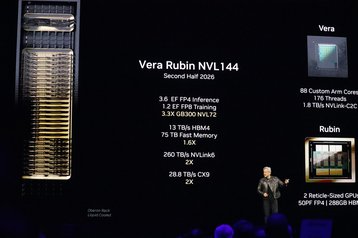
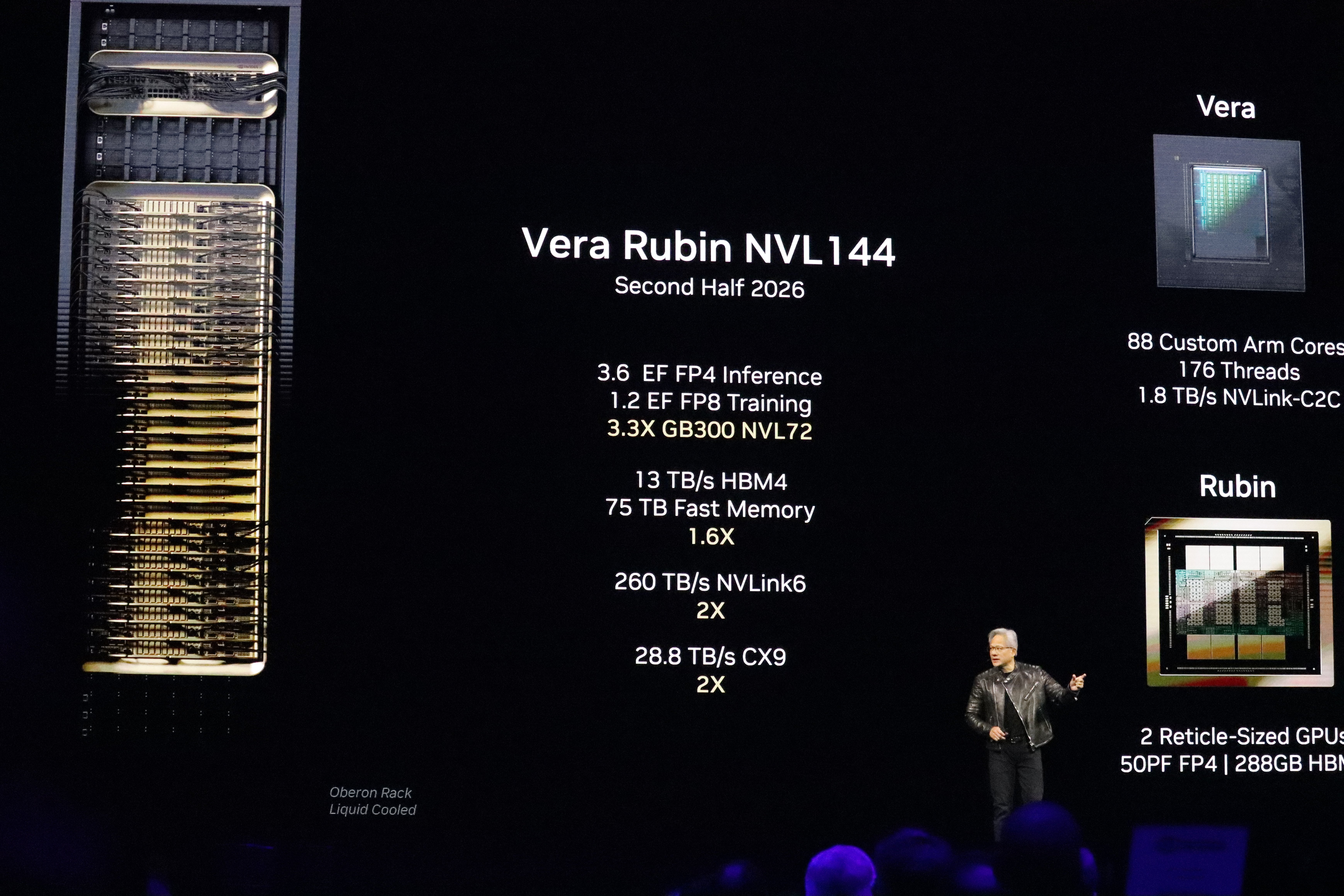
The chip designer will also release its Vera Rubin platform in the latter half of this year, comprising its Vera CPUs and Rubin GPUs, in addition to four other processors (five, including the Groq 3 inferencing accelerator) – the NVLink 6 Switch, ConnectX-9 SuperNIC, BlueField-4 DPU, and Spectrum-6 Ethernet Switch.
Earlier this month, Microsoft claimed to be the first hyperscaler to bring an Nvidia Vera Rubin NVL72 system online, while Google has also detailed plans for the deployment of the platform.
As announced by Nvidia at GTC 2025, the successor to its Rubin GPU will be the Rubin Ultra. Set to be released in the second half of 2027, the AI accelerator will feature four compute chiplets and 1TB of HBM4E (high-bandwidth) memory.
The company also plans to release its Kyber NVL144 rack-scale solution in 2027. Featuring 144 Rubin Ultra GPUs and connected via its NVLink 7 Switch, the system offers a 4x performance improvement over its Blackwell NVL72 system – also known as Oberon. Meanwhile, Nvidia’s second LPU, the Groq LP35 LPU, is also slated for release in the second half of 2027.
In 2025, following the Rubin Ultra announcement, Nvidia CEO Jensen Huang said that the transition to the platform would take “years of planning.”
“This isn’t like buying a laptop,” he said at the time. “We have to plan with the land and the power for data centers with engineering teams two to three years out, which is why I [am showing] the roadmap.”
Finally, 2028 will see the launch of new Nvidia CPUs, GPUs, and LPUs, dubbed Rosa, Feynman, and LP40, respectively.
According to the chip designer, the Feynman GPU will incorporate die stacking and custom high-bandwidth memory to help scale performance and increase memory bandwidth. Additionally, the Feynman platform will also be the first Nvidia release to adopt NVLink switches that include co-packaged optics.
Nvidia also plans to introduce its BlueField 5 DPU, Spectrum-7 Ethernet switch with co-packaged optics, and ConnectX 10 SuperNIC in 2028.
Speaking at the 2026 conference, Huang said that demand for Nvidia products through 2027 had hit the $1 trillion mark. Nvidia CFO Colette Kress later confirmed that the number only related to Blackwell and Rubin products, along with associated networking, and did not include new products, like Groq LPUs and standalone CPUs.
"A trillion dollars is an enormous amount of infrastructure,” Huang said. “You have to have complete confidence that the trillion dollars you're putting down will be utilized, will be performant, will be incredibly cost-effective, and have [a] useful life for as long as you can see that infrastructure investment. [Nvidia] is the only infrastructure in the world that you could go anywhere in the world and build with complete confidence."



Comments