
Networking has quietly become a driving factor behind Nvidia's meteoric rise, with the chip giant reporting a 98 percent revenue increase year-over-year (YoY), raking in $7.3 billion.
Nvidia's Q2 2026 earnings report revealed record-breaking success in its networking segment, achieving its highest-ever recorded revenue.
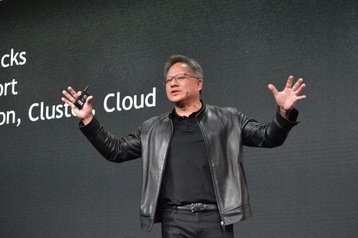
Overall, the chip giant reported revenues for Q2 2026 of $46.7bn, a 6 percent increase from the previous quarter and a 56 percent jump from the year before.
Networks to bridge AI 'super factories'
Driving the 46 percent revenue rise for Nvidia's networking segment in the past quarter were products like its Ethernet-based AI fabric, Spectrum-X, as well as more traditional InfiniBand and NVLink offerings.
“Spectrum-X delivered double-digit sequential and year-over-year growth with annualized revenue exceeding $10bn,” Colette Kress, Nvidia's CFO, told investors.
The CFO revealed that InfiniBand revenue nearly doubled in the past quarter, with demand being driven by the adoption of extended detection and response (XDR) technology.
Referring to the Blackwell NVLink 72 rack-scale computing system, CEO Jensen Huang said the vendor was “seeing orders of magnitude speed up and, therefore, energy efficiency and, therefore, cost effectiveness of token generation because of NVLink 72.”
The CEO also touched up the recent release of Spectrum-XGS Ethernet, a networking software platform that builds on Spectrum-X to connect multiple data centers.
“It’s a giga-scale for connecting multiple data centers, multiple AI factories into a super factory, a gigantic system. You’re gonna see that networking obviously is very important in AI factories,” said Huang.
First revealed in 2024, Spectrum-X fuses Nvidia’s networking hardware and software into an AI-tuned platform, pairing Spectrum SN5600 switches – built on the Spectrum-4 architecture – with BlueField-3 DPUs to boost generative-AI network performance to 1.6 times that of conventional Ethernet fabrics.
Spectrum-XGS marks the next evolution of Nvidia's Ethernet offering, with a networking algorithm that leverages the Spectrum-X infrastructure to enable the effective movement of data across longer distances between sites. The solution integrates Nvidia Spectrum-X switches with ConnectX-8 SuperNICs, the company's AI-centric 800 Gb/s networking adapters.
Nvidia claimed the new Spectrum-XGS offers adaptive distance congestion control, precision latency management, and end-to-end telemetry.
According to the firm, the platform nearly doubles the performance of the open-source Nvidia Collective Communications Library (NCCL), which facilitates high-speed communication between Nvidia GPUs, and delivers 1.6 times the bandwidth density of standard Ethernet in multi-tenant, large-scale AI environments.
Nvidia: The return on your purchase makes networking cost nothing
In a briefing with investors, Huang went further on the importance of networking to both clients and the firm.
Remarking on Spectrum-XGS as the networking backbone forming an AI 'super factory' out of disparate data centers, the CEO said: “Choosing the right networking, the performance, the throughput improvement going from, you know, 65 percent to 85 percent or 90 percent – that kind of step up because of your networking capability effectively makes networking free.
“Choosing the right networking … you know you’ll get a return on it like you can’t believe,” he continued. “Because the AI factory … could be $50bn. And so the ability to improve the efficiency of that factory by tens of percent in results is $1 or $2 trillion dollars’ worth of effective benefit.
“This is why networking is a very important part of it. It’s the reason why Nvidia dedicates so much to networking. It’s the reason why we purchased Mellanox five and a half years ago.”
Zero from H20
Elsewhere in Nvidia's financials, data center revenue grew to $41.1bn, up five percent from Q1 2026 and up 56 percent from the second quarter of 2025.
The chip giant updated its outlook for the third quarter of fiscal 2026, expecting revenue of $54bn, with a 2 percent margin of error. While Nvidia was allowed in July to resume sales of its H20 chip to Chinese customers, reportedly leading it to order 300,000 H20 chips from TSMC to meet demand, the outlook assumes no H20 shipments in the next quarter.
While no H20 sales to China-based customers were made in Q2, Nvidia reported it “benefited from a $180m release of previously reserved H20 inventory, from approximately $650m in unrestricted H20 sales to a customer outside of China.”
Alongside AMD, Nvidia agreed this month to pay the US government 15 percent of all revenue generated from the sale of chips to China as a condition for obtaining export licenses for the semiconductors.
More in Investment / M&A / Financing
-

-

-

Episode 2027 Trends and Outlooks: Europe



Comments