
NASA has put its plans to acquire lunar communication ground stations on hold in light of current uncertainty about its budget.
As reported by Space News, the space agency updated a "sources sought" notice previously shared on Sam.Gov on July 25 to inform "interested offers" that the project was currently paused, though not fully canceled.
NASA's Glenn Research Center (GRC) Office of Procurement will update the notice when "more information becomes available."
Described as being due to "current uncertainty in our [NASA's] budgetary situation," the department did not elaborate. However, it has been widely reported that President Donald Trump is keen to cut NASA's funding by as much as 47 percent, as well as terminate 55 operating and future missions.
In early July, the US Senate appropriations committee voted on a bill to provide NASA with $24.9 billion in funding, slightly more than the previous year, and rejected the Trump administration's budget proposal. While it was initially approved in a 15-14 vote, the bill has since been withdrawn, and NASA's budget remains up for debate.
The ground stations project would fall under NASA's Space Communications and Navigation program, which is requesting $394.9 million for FY 2026, a 25 percent cut from what it received in 2024.
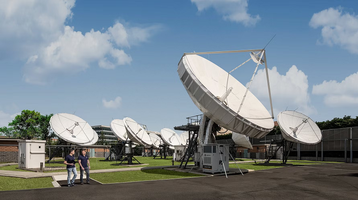
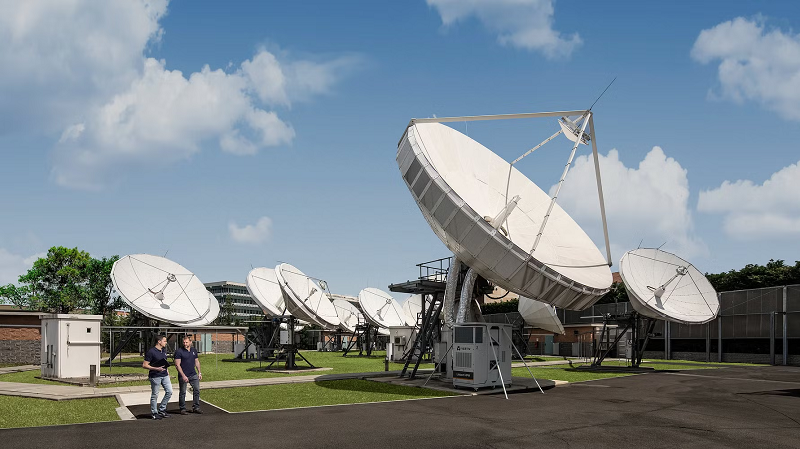
The space agency was previously looking to develop government-owned and contractor-operated "Lunar Exploration Ground Sites" (LEGS) with 18m antennas to provide communications services to "vehicles transiting from the Earth to cislunar space, the Gateway in near-rectilinear halo orbit (NRHO), the Lunar surface, and Earth-Sun L1 and L2 LaGrange Points."
The LEGS would be used for NASA's Near Space Network, and be required to provide "line of sight service coverage" to platforms in orbits between 36,000km (22,369 miles) and two million km (1.24 million miles), and would support communications at X- and Ka-band frequencies.
The aim of LEGS was to take some of the strain off of NASA's Deep Space Network (DSN), which has previously had to help support communications - including for the Artemis 1 mission in late 2022 - which took up more than 1,500 hours of DSN time.

How this feature got to the Moon
And what it means for the future of digital infrastructure, humanity, and what we will leave behind
According to the original sources sought notice, the LEGS would be located at NASA's White Sands Complex in New Mexico, Matjiesfontein, South Africa, and an unspecified site in Western Australia.
The notice adds: "NASA seeks commercial capabilities to deliver a turnkey ground station at each site, except for the antenna subsystem, which will be provided as Government Furnished Equipment (GFE). The government seeks a containerized solution, whereby non-antenna equipment is assembled into a mobile telecommunications station that can be assembled, tested, shipped, and installed on each site. The contractor will be provided a pad to locate the ground station on, as well as power and data interfaces."
The LEGS would use the cloud for data distribution, which the notice says is a deviation from a previous notice related to the project.
Proposals were previously due by this month (August 2025), with NASA planning to select contractors by November. The agency was aiming to get the White Sands LEGS deployed by December 2025, and the South Africa and Australia sites by June 2026.
Last month, Amazon Web Services signed a ground station-as-a-service (GSaaS) partnership with Kongsberg Satellite Services (KSAT), which will see KSAT integrate cloud services into its global network and offer access to both AWS Ground Station’s and KSAT’s antennas to its customers.






Comments