
Researchers at Microsoft claim to have made significant progress on Project Silica, an archival data storage system of laser-inscribed glass that can live up to 10,000 years.
According to the Microsoft Research Cambridge team behind the project, the expensive fused silica previously used as the storage platform can be replaced with ordinary borosilicate glass, a material described by the researchers as a “readily available and lower-cost medium… the same material found in kitchen cookware and oven doors.”
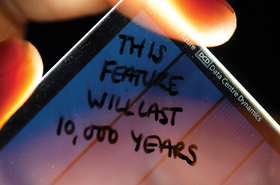
This feature will last 10,000 years
Lasers, robots, and the archive of tomorrow
This breakthrough helps to address key barriers to the commercialization of the technology, particularly regarding the costs and availability, the team went on to note. The findings have been published in the science journal Nature.
First demoed in November 2019, Project Silica uses a femtosecond laser to encode data in glass by creating layers of three-dimensional nanoscale gratings and deformations at various depths and angles. To date, the technique has only been proven to work with pure fused silica glass, a type of glass that is relatively difficult to manufacture and available from only a few sources.
However, the new findings published by Microsoft Research Cambridge detail how data can instead be stored in borosilicate glass, but with “important improvements.” As was the case previously, the technique allows hundreds of layers of data to be preserved on glass that is 2mm thin, but, with this new material, the reader for the glass only requires one camera, not three or four, reducing cost and size.
Furthermore, the writing devices require fewer parts, making them easier to manufacture and calibrate, and enabling them to encode data more quickly, the team said.
“Glass is a permanent data storage material that is resistant to water, heat, and dust,” wrote Richard Black, partner research manager at Microsoft Research Cambridge, in a blog post outlining the findings.
“We have unlocked the science for parallel high-speed writing and developed a technique to permit accelerated aging tests on the written glass, suggesting that the data should remain intact for at least 10,000 years.”
In 2024, DCD archived its entire site on an earlier prototype of SIlica, and profiled the history of long-term storage.





Comments