
US aerospace company Lockheed Martin has paired with Verizon, Nvidia, and others to test an AI-enabled system that is capable of detecting unmanned aircraft systems (UAS).
The partnership was announced last week by the US defense contractor, which is working with mobile carrier Verizon, chipset giant Nvidia, Keysight Technologies, ODC, and Astris AI to prepare a drone detection service.
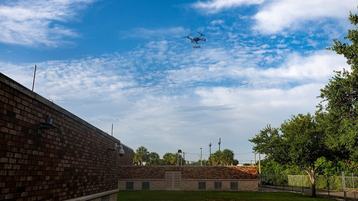
The companies have already carried out a demonstration, doing so last month in the Miami area, where Lockheed deployed its NetSense airspace awareness-as-a-service system.
According to Lockheed, the live demo last month took place in a "critical, high-traffic, urban area important for American protection."
The demo was able to showcase NetSense's components, capabilities, and UAS detection and alert systems in real-time, noted the company.
In order to carry out the demonstration, NetSense leveraged ODC's AI-native Radio Access Network (RAN) software, Nvidia's AI Aerial platform, and Keysight's advanced radio frequency (RF) simulation platform, while it tapped Verizon for its 5G network spectrum.
By using all of this tech, NetSense detected and alerted the team to the presence of drones and maintained track custody through the flight. A NetSense prototype system was unveiled in March ahead of the trial last month.
The system combines Lockheed Martin's warning and tracking systems, which work together using AI to read RF disturbances, predict and track a UAS's flight path and automatically send real-time alerts.
Lockheed: Quicker, cheaper to deploy
Lockheed noted that NetSense is able to use Nvidia's AI Aerial to analyze RF signal disturbances in real time and feed them to Lockheed Martin's NetSense algorithms.
Listing other benefits of NetSense, Lockheed states that it's quicker to deploy than traditional or custom-built systems leveraging COTS, while also easier to scale and more cost effective. The company also adds that the open architecture commercial systems allow for easier integration.
The company said the demo proved that NetSense can be used without having to change existing cellular radio deployments, ahead of the upcoming 6G era, which is set to focus heavily around Integrated Sensing and Communication (ISAC).
"As drones become more affordable and accessible, airspace awareness technology needs to evolve rapidly to outpace potential threats. That's why we developed the NetSense solution," said Sarah Hiza, senior vice president, technology and strategic innovation at Lockheed Martin. "By working within the established 5G network spectrum, we're able to collaborate with the commercial technology industry and deploy a solution that's ready at the time of need."
"By applying AI to the RF signal measurement data already traversing our 5G infrastructure, we can effectively turn our network into an intelligent sensing platform," added Anil Guntupali, senior vice president of technology and product development at Verizon. "By collaborating with Lockheed Martin to apply intelligence to our existing 5G spectrum, we're proving that the most complex security problems often have an answer embedded in the network."
Further pilot deployments are planned for the second half of this year and early next year, while commercial general availability is expected for next year. Lockheed stated that early deployments will be limited to select customers that urgently need the capability.




Comments