
The US' Lawrence Livermore National Laboratory (LLNL) has partnered with Amazon Web Services (AWS) for an AI-driven troubleshooting and reliability system at LLNL's National Ignition Facility (NIF).
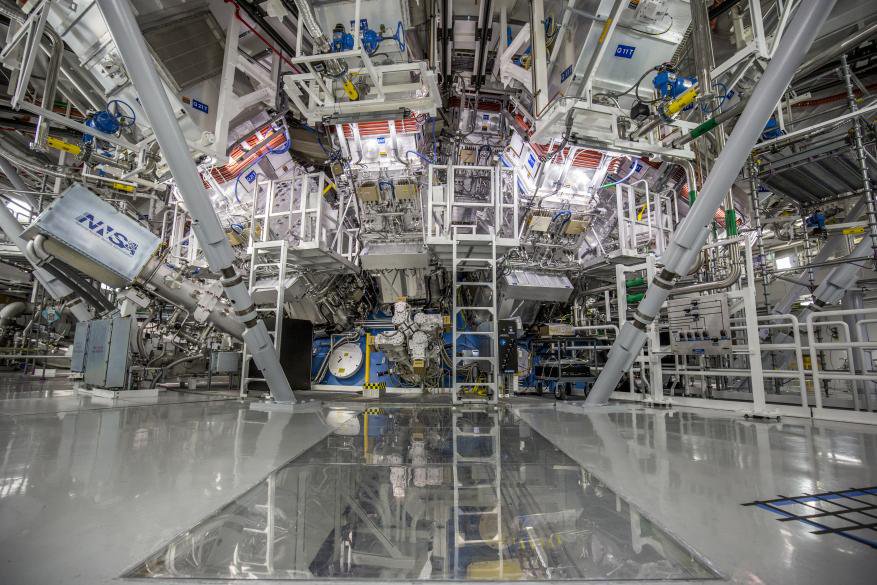
The NIF is a data factory used for high-energy-density physics experiments.
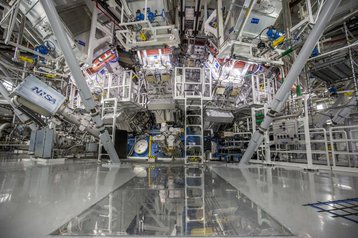
While AI is already used to manage the data generated by those experiences and to improve predictive modeling capabilities, AWS will provide an AI-driven troubleshooting and reliability system.
LLNL has completed the first phase of integration with AWS, which included deploying advanced semantic search capabilities across more than 98,000 archived problem logs spanning 22 years of operations. AWS is handling the project.
“I’m excited to unleash the superpower that is AI on NIF operations,” said LLNL director Kim Budil. “By leveraging our extensive historical data through advanced AI techniques, we’re solving today’s problems faster and paving the way for predictive maintenance and even more efficient operations in the future.”
The partnership is hoped to help enable real-time resolution of anomalies, enabling operations to continue reliably, and thus "enhance efficiency, improve responsiveness and support NIF operations into the 2040s and beyond."
“NIF is an incredibly complex facility that operates with extreme precision. We run 24/7, executing approximately 350 high-energy-density physics experiments each year,” said NIF operations manager Bruno Van Wonterghem. “This intelligent system analyzes 22 years of operational history across hundreds of NIF’s subsystems to help our staff resolve issues more quickly and keep experiments on track.”
The NIF will use AWS's generative AI services, including intelligent search, summarized large-language-model responses, and Retrieval-Augmented Generation chatbots via Amazon SageMaker.
The NIF, in 2022, successfully achieved fusion ignition, a milestone in the pursuit of nuclear fusion power. If successfully commercialized, nuclear fusion has the potential to provide an almost unlimited amount of energy. Unlike traditional nuclear plants, which rely on fission - a process that generates unstable nuclear waste - fusion does not produce any form of radioactive waste.
Since that first ignition, LLNL has repeated ignition seven more times, achieving higher fusion yields in the process. The lab deploys AI-driven cognitive simulation and attributes its HPC and machine learning capabilities as a key factor in its success thus far.
AWS and LLNL have previously worked together, signing a Memorandum of Understanding in 2022 to explore software and hardware solutions spanning cloud and on-premises HPC environments, with the goal of establishing a common stack of open-source software components that can run equally well at both large HPC centers and on cloud resources.
The LLNL falls under the US Department of Energy (DOE). The former CIO of the DOE, Ann Dunkin, previously told DCD: “I am convinced that to maintain leadership in capability computing - where we actually advance HPC - we need to do it on-premise. Not everyone agrees with me, but I really believe that's a capability we need to own, grow, and develop in the DOE.”
El Capitan, a supercomputer hosted at the LLNL, was crowned the most powerful supercomputer by the Top500 ranking in November 2024. The system retained its status in the June 2025 list, published this week.
El Capitan is an HPE Cray EX255a with AMD 4th Gen Epyc 24C 1.8GHz CPUs and Instinct MI300A GPUs, reported an HPL score of 1.742 exaflops.



Comments