
Brazil has deployed a new supercomputer for weather monitoring.
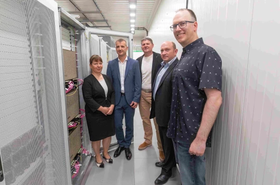
Brazil's National Institute for Space Research (INPE), linked to the Ministry of Science, Technology and Innovation (MCTI), now has a new supercomputer, installed at the institution's Scientific Data Center, located in Cachoeira Paulista (SP).
The equipment will help improve weather forecasting and climate modeling, meeting the growing demand for more accurate data due to the increased occurrence of extreme events.
With the new machine, the time needed to process ten-day forecasts has been reduced from approximately three hours to less than two. This improvement makes it possible to carry out several simulations with small variations, generating more detailed and useful probabilistic scenarios for agencies such as Civil Defense.
The project was funded by the Ministry of Science, Technology, and Innovation (MCTI), with support from the Financier of Studies and Projects (Finep).
Compared to the previous system, Tupã, the new supercomputer has five to six times more data processing performance and around 24 times more storage capacity, and is currently the most advanced equipment in the country for weather forecasting and climate modeling, according to Ivan Márcio Barbosa, INPE's data infrastructure and supercomputing coordinator.
The system also enables forecasts with greater spatial resolution, requiring more memory capacity. The forecast grid, previously 20km (12.4 miles), is now 10km (6.2 miles) for the entire globe, and can reach 3km (1.86 miles) in simulations aimed at South America. This makes it possible to identify local phenomena more precisely, such as heat waves in specific urban areas, intense storms in defined regions, and the effects of relief on climatic behavior.
The acquisition is part of INPEe's Renewal of Supercomputing Infrastructure (RISC) project, which plans to install three more supercomputers by 2028.
The initiative also includes updating the electrical infrastructure, modernizing the cooling system, and installing a photovoltaic plant, with the aim of making the Scientific Data Center more efficient and sustainable. The total estimated investment for the project is approximately 200 million reais ($37.3m).
Around 30 million reais ($5.6m) have been earmarked for the purchase, import, and transportation of the first piece of equipment. By the end of the project, the installed computing capacity could reach at least eight petaflops.
The new supercomputer, an HPE XD2000, was purchased from HPE-Cray in September 2024 and arrived in Brazil in May 2025.
The previous system - Tupã - is being decommissioned. It consisted of two modules: the XE6, acquired in 2010, and the XC50, acquired in 2017. Decommissioning began with the dismantling of the XE6 module, which was completed in March. The XC50 module remains in operational use, with shutdown scheduled for early 2026.
The new supercomputer is still waiting to be given a name that represents its mission and continues the legacy of the previous system, Tupã - a name inspired by Tupi-Guarani mythology, associated with the power of thunder and the weather, symbolizing the integration of science and Brazilian culture.
To name the new machine, INPE launched a two-stage campaign: in the first stage, more than 100 suggestions were received from employees, collaborators, and students; in the second stage, the final choice will be submitted to society via social networks. The initiative seeks to strengthen the link between science, culture, and public engagement in this new phase of national supercomputing.


Comments