
Hisdesat has announced that the military communications SpainSat NG II is unrecoverable after a collision incident.
The satellite, which reportedly suffered a “space particle” impact earlier this month, has endured non-recoverable damage, making the satellite an effective derelict on delivery.
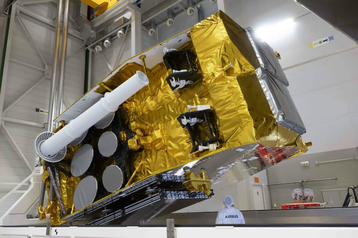
The company has initiated a request for quotation for a replacement of the satellite. The new machine, already designated SpainSat NG III, could take years to deliver.
“The satellite is stable, complete, and in a highly eccentric orbit, in such a way that it won’t interfere with any present or future space operations, and its loss will not cause any economic harm, as it’s insured against this kind of damage,” Hisdesat said in a statement.
SpainSat NG II, built by Airbus and launched by a SpaceX Falcon 9 in October 2025, was intended to enable secure communications for Spain’s Armed Forces, though on January 16, during orbital insertion, the satellite was likely hit by an untrackable element, estimated to have only been millimeters in size and a few grams in mass, though travelling at extreme velocity.
While Hisdesat has spoken with certainty about the execution of its insurance claim, such conclusions are not guaranteed, though its case appears to be more concrete than that of ViaSat-3’s in 2023, in which the satellite remained partially operable and suffered an antenna fault that some speculated to be the fault of the manufacturer.
Space underwriters have estimated the ensuing insurance claim will amount to $400 million, according to reporting by Space Intel Report. Though the cost of SpainSat NG II is not public, the program at large costs €2 billion ($2.35bn).
“SpainSat NG represents the next generation of secure satellite communications in Europe,” Laurent Jaffart, ESA’s director of connectivity and secure communications, said in a statement following the launch of SpainSat NG II. “This second launch marks a key milestone in providing more adaptable and secure communications services that will benefit governmental users across Europe and beyond.”
The claim estimation is just less than the $420 million in coverage that existed for Viasat’s ViaSat-3 satellite, which suffered an antenna fault in its May 2023 launch, crippling its ability to deliver service. In combination with Viasat-Inmarsat’s Inmarsat I6 satellite, the merged company made $768 million in claims that year, spooking several insurance providers away from the market.
This incident will likely affect the satellite insurance market similarly, and could scare some providers off for good, as the dangers of the orbital environment become clearer to them.







Comments