
Groups are suing to stall a data center project in Doña Ana County, New Mexico.
On October 17, the Empowerment Congress of Doña Ana County – a nonprofit organization – and two residents sued the Doña Ana County Commission, alleging that the body’s decision to approve funding mechanisms and tax rebates for a data center project was marred by procedural and regulatory irregularities.
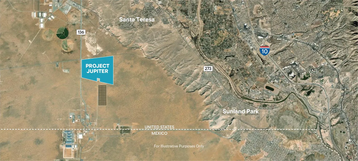
The proposed facility, called ‘Project Jupiter,’ would be built near Pete Domenici Highway and New Mexico Highway 136, outside Sunland Park, which is on the US border with Mexico. Site plans show that Project Jupiter would comprise four buildings, micro-grid facilities, natural gas power plants, a battery storage center, and a desalination plant across 1,400 acres.
The lawsuit’s claims center around two issues. The first states that the Doña Ana County Board of County Commissioners, in the process of approving $165 billion worth of Industrial Revenue Bonds (IRBs) for Project Jupiter on September 19, did not provide enough “information, supporting materials, or evidence” in line with the evaluative standard as set by the County’s own regulations and New Mexico state law.
At the September 19 meeting, some Commissioners noted that the Board had received hundreds of pages worth of documents missing from the developer’s initial IRB Application mere days before the meeting, giving them insufficient time to properly review the documents.
IRBs are bonds issued by governments that are then given to private enterprises. These are commonly used by data center developers and local authorities to raise funding for data center projects: the City of De Soto, Kansas, is one such example.
The second issue pertains to the County Commissioners’ decisions to provide tax rebates to Project Jupiter under the Local Economic Development Act (LEDA), with the lawsuit alleging that a data center project does not qualify as an eligible source of LEDA funding.
The suit calls for the 3rd Judicial District Court to review the Board’s actions. Alternatively, it calls on the Court to prevent the Board from implementing its decisions.
In a statement, the Empowerment Congress’ director, Daisy Maldonado, said that the Congress “did not take this decision lightly."
“We have carefully reviewed the record, the ordinances, and the application materials; our review found that critical information was missing, incomplete, or never provided to the public.
“Commissioners themselves admitted they were given less than two weeks to review hundreds of pages of materials, many of which were blank or had inadequate information.”
Other opposition to the project has also been fierce, with concerns about the facility’s potential impact on energy and water infrastructure. Developer BorderPlex Digital Assets has refuted these concerns, stating on its website that the facility will use a minimally water-intensive, closed-loop cooling system and that the data center will not impact power rates.
The project has also received financial backing from Stack Infrastructure, which announced its involvement with the project in August.
BorderPlex Digital Assets says it is planning “Growth Infrastructure Campuses” that combine power, water, land, industrial cooling, fiber, and compute in a single location. The company has not detailed plans for any other projects yet.
Doña Ana County is just north of the border town of El Paso. Neither the county nor the state of New Mexico have traditionally been data center hotspots, but the scale of the AI-fuelled data center buildout in the US has pushed operators into both.
In September, OpenAI announced that it would open a data center in Doña Ana County as part of its Stargate project. On a state level, most of New Mexico’s data centers are clustered around Albuquerque, its largest city. It is home to operators including H5, Windstream, UPN, and Centersquare, with Meta operating a campus in the area. Oppidan is developing a facility in Albuquerque.







Comments