
The global Bitcoin network hashrate has dropped for the first time since 2020, as Bitcoin miners face profitability issues and pivot towards hosting AI applications.
In Q1 2026, the Bitcoin network hashrate, which is a measure of the total computational power used to mine and process transactions on the blockchain, dropped by 4 percent.
According to digital asset management firm CoinShares, 2025 saw public Bitcoin miners announce more than $65 billion in AI and high-performance computing contracts with hyperscalers and neoclouds.
This drop is likely due to diminishing returns on mining, as former Bitcoin miners retrofit their facilities to handle AI workloads.
Diminishing returns
In its Bitcoin mining report Q1 2026, CoinShares said that a sharp 31 percent BTC price correction, from all-time highs of around $124,500 in early October to around $86,000 by late December, with compressed hash prices at five-year lows. Hash prices are the mining industry metric quantifying the daily revenue a miner earns per unit of hashing power.
CoinShares said that the weighted average cash cost to produce one Bitcoin among publicly listed miners rose to around $79,995 in Q4 2025, which, when combined with continuing drops in BTC price – around $68,000 at time of writing – is squeezing profitability, and in many cases resulting in losses.
These issues are being exacerbated by the Iran-US conflict in the Middle East, which has caused the closure of the Strait of Hormuz, an oil passageway between the Persian Gulf and the Gulf of Oman, leading to skyrocketing oil prices.
While renewable energy has seen widespread adoption in Bitcoin mining – with nearly 53 percent of miners using sustainable energy sources, according to the University of Cambridge Digital Mining Industry Report – rising energy prices are still affecting miners.
In its report, CoinShares noted there had been more than $70 billion in cumulative AI/HPC contracts announced in the public mining sector, with many becoming “data center operators that happen to mine Bitcoin.”
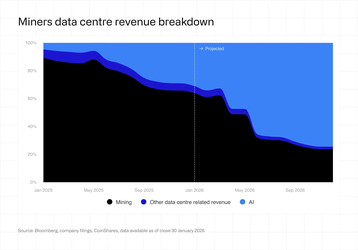
AI infrastructure can generate three times the revenue per megawatt when compared to Bitcoin mining, according to CoinShares.
Some miners have taken on debt loads to fund their AI retrofits. IREN, for example, has rapidly pivoted from Bitcoin to AI, carrying $3.7 billion in convertible notes to fund its AI expansion efforts, and is now marketing AI cloud and colocation services.
“Listed miners could derive as much as 70 percent of their revenues from AI by the end of this year, up from 30 percent today,” CoinShares said.
The crypto pivot to AI
Even as Bitcoin reaches record highs, miners are chasing a different digital gold
While redeployments to AI infrastructure are an attractive proposition for many miners, this is not a universal transition. Some remain dedicated to Bitcoin mining, but are pursuing low-cost, intermittent energy sources, such as stranded renewables or flare gas.
However, CoinShares said questions remain over the durability of a shift to AI infrastructure, and while macroeconomic conditions are currently working in favor of AI, mining profitability may recover, meaning this transition may be less permanent and more a function of “relative returns.”
This means that the likely winners of these conditions are companies that operate hybrid infrastructure able to operate both mining and AI workloads simultaneously, or interchangeably.
Retrofitting AI
One example of this is data center developer, Hive Digital Technologies, which has seemingly pivoted from developing “Bitcoin factories,” retrofitting them into AI data centers.
In a blog post, Frank Holmes, CEO and CIO of US Global Investors, and executive chairman of data center developer Hive Digital Technologies, said that Hive has been building “more than just ‘Bitcoin factories,’” instead engineering “adaptable digital power ‘shells,’ complete with industrial-grade infrastructure, redundant power system, and access to low-cost renewable energy.”
These “Tier I shells” are then upgraded to “Tier III, AI-ready data centers,” bypassing the lengthy land acquisition, zoning, and permitting that are facing most traditional development timelines today.
Holmes said this originally started as a “side hustle” for many miners, but is now transforming into a “full-fledged business model” with compelling economics, with many miners already controlling significant power in low-cost, rural areas with access to a variety of renewable energy sources.
Key issues curbing AI data center growth today mostly focus on logistics, supply chains, and access to power. With the advantage of an existing facility, former miners, such as Hive, can bypass much of the struggle facing data center development today.






Comments