
Frontier, a carbon-buying consortium backed by Meta and Google, has signed a carbon-removal agreement with Canadian biowaste carbon-capture and storage firm Nulife GreenTech.
As per the terms of the agreement, Frontier will pay the firm $44.2 million to remove 122,000 tons of CO2 between 2026 and 2030. The deal marks Frontier's third deal with a Canadian carbon removal company, bringing its investment in the country to $100m.
"Nulife turns an everyday waste problem into measurable, long‑term carbon removal. This is a good example of how smart waste disposal can double-up as a carbon removal solution that could deliver at gigaton scale," Hannah Bebbington Valori, head of deployment at Frontier, said.
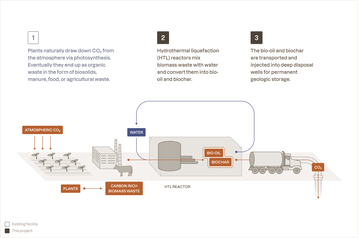
Nulife removes carbon through hydrothermal liquefaction (HTL), a process that converts biowaste into a transportable, storable product. The HTL reactor acts like a large industrial pressure cooker, breaking down biowaste into new substances.
The majority of the carbon becomes a thick liquid called bio‑oil, which is then transported by truck to permanent storage more than 1,000 meters (3,280 feet) underground in licensed salt caverns. The process also produces biochar, which is also injected together with the bio-oil.
According to the companies, the process has the potential to work across a range of biomass waste types, including dry biomass, such as woody biomass and crop residues, as well as wet waste like manure and sewage sludge. As a result, Frontier estimates the process could remove 1.5 gigatons of CO2 per year by 2040.
"Frontier's decision to proceed with this offtake is a strong validation of the engineering rigor, transparency, and real-world waste-management value behind our BiCRS platform. Our modular HTL units enable rapid, repeatable deployment, supporting scalable growth across Canada and internationally," said Jerry Kristian, co‑founder of Nulife.
The carbon buying consortium has made several large-scale purchases this year. Last month, it inked a deal with biogas carbon capture firm Reverion to remove 96,000 tons of CO2 between 2027 and 2030. As part of the deal, Frontier buyers will pay Reverion $41m.
In July, the consortium inked a deal with bioenergy with carbon capture and storage (BECCS) firm Arbor for 116,000 tons of carbon removal credits.
As part of the deal, Frontier will pay Arbor $41m, with the credits set to be delivered between 2028 and 2030.
Before this, in March, the consortium signed a $33m deal with enhanced rock weathering firm Eion for the removal of 78,707 tons of CO2 between 2027 and 2030.






Comments